Showing posts with label audio book. Show all posts

Tuesday, June 28, 2011

A good day for reading

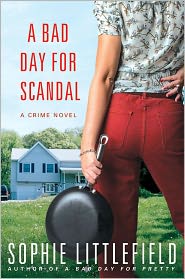
A Bad Day for Scandal
by Sophie Littlefield

A Bad Day for Scandal is Sophie Littlefield’s third mystery featuring Prosper, Missouri’s answer to… I want to say Clint Eastwood, but that’s not right. Stella Hardesty is one tough lady. Don’t let the sewing machine shop fool you; it’s a cover. Her real calling is meting out justice and vengeance, often in equal parts. Ever since she emancipated herself—permanently—from her abusive husband, she’s been helping out other ladies in the same boat.

Therefore, it really isn’t that unusual when Stella’s phone rings in the middle of a social gathering. Like so many professionals, she’s on call 24/7. Priss Porter’s timing couldn’t be much worse, though. Stella was entertaining, among others, the one man she should be keeping her distance from, Sheriff “Goat” Jones, and for once, things seem to be moving forward between the two of them. But Priss is over at her brother’s, in town from Kansas City, insisting that she needs to see Stella immediately.

It has been said that friends will help you move, and that really good friends will help you move bodies. Well, rest assured, Stella and Priss aren’t THAT close. Stella wants nothing to do with the little problem decomposing in Priss’s trunk. When Stella proves to be unbuyable, Priss moves on to blackmail to elicit her help. That doesn’t work either. Unfortunately, before Stella can get a feel for how to handle Priss, both she and her brother turn up missing. The Sheriff is looking at Stella askance. And Stella and her associates again find themselves following a convoluted path in search of answers.

What I described above are the opening scenes of an enjoyable enough mystery, but unusually for the genre, it’s not the plots that make this series. The mysteries are well-plotted, fast-paced, and complex enough that I’ve never come near to figuring out who done it on my own. Perhaps more impressively, Ms. Littlefield hasn’t fallen back on the same structure or type of story, though the series’ premise suggests she would or could. Nonetheless, each outing finds Stella in a different kettle of fish. Still, for me, these stories are all about character.

I’ve always been able to hear Stella’s distinctive voice in my head, but it was delightful to finally hear it in audiobook form, read by the talented Barbara Rosenblat. Ms. Littlefield strikes a perfect balance between the light elements and the dark ones in her novels, and Ms. Rosenblat gets this balance just right, too. There’s no denying that these books are exceedingly funny, but there’s nothing cute about them. Ms. Rosenblat mines all the humor while still bringing every character realistically to life. It’s worth noting that she does an unusually good job with the male characters. And while Stella is at the center of this universe, over the course of three novels, her world has been fully peopled with individuals that jump off the page. There’s her sidekick, Chrissy; Todd, the teenager across the street; and the Green Hat Ladies—to name but a few.

I guess you could jump into this series with any of the books, but when reading such delicious characters, personally, I think you’d get more pleasure starting at the beginning and watching the relationship and character arcs develop. Both Littlefield and Hardesty seem to be improving with each tale. So far, I’m three for three with Sophie and Stella. I’ve read them on paper, on my Kindle, and now on audio. As far as I can tell, there’s no wrong way to enjoy these novels.

Added bonus:  Totally inane 16 second interaction...


Tuesday, May 17, 2011

An amazing talent… for annoyance

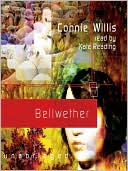
Bellwether
by Connie Willis

Connie Willis’s novels have been recommended to me many times over the years by a variety of sources—though never this particular novel. As an introduction, it was a limited success. I only found Bellwether to be so-so, but it certainly wouldn’t discourage me from reading more of her work in the future.

Bellwether is a short satirical novel, set in the world of science for profit. It’s the story of how a social scientist researching fads and trends meets a colleague studying chaos theory and information diffusion, and how they team up to survive their corporate management and the “help” of a surly office assistant. Along the way, Willis takes pot shots at parenting, cuisine, fashion, lifestyle, and other trends, and those who adhere to them.

Honestly, on paper, this looks it should be a home run for me. I’m a big fan of satirical novels, but I’ve seen similar takes on office culture done better. (Max Barry’s Company is highly recommended!) Another issue is the fact that I listened to Bellwether as an unabridged audiobook. Reader Kate Reading (yeah, that’s her name) did a fine job with most of the narration, but for the annoying office assistant, Flip, she did a really annoying Valley Girlish voice. It got old fast. Not only that, she used the same voice for all of the many other annoying characters the protagonist encounters. It was a legitimate choice, implying a sameness to the hostile, ignorant, lazy characters in the book, but again, it was tedious. I find stories about really annoying people tend to get on my nerves. Maybe it’s me?

I did think the information on the science and history of fads was quite interesting, but there was simply too much of it. And there were some laughs along the way to the novel’s clever ending, but they didn’t fully compensate for the negative aspects of the book—for me. I will read Willis again, because she is clearly a talented writer. But next time I’ll stick to a recommended title. I think I could become a fan; this just wasn’t the right starting place.

Friday, April 22, 2011

Tina tells her tale

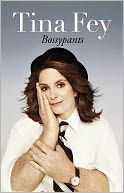
Bossypants
by Tina Fey

Last weekend I had the great pleasure of listening to Tina Fey’s book Bossypants read by the author herself. Not only is the lady fantastically funny, she’s also got something to say. Plus, on the audiobook, she does the Sarah Palin parts in her Sarah Palin voice. And, if you’re anything like me, you’d be very interested in Fey’s own take on the Palin phenomena and her role in it. Fey isn’t writing a straight memoir here. The breakdown is something like this:
46% Celebrity memoir
28% Essay collection
12% Feminist manifesto
9% Stand-up routine
5% Self-help manual
She does cover the major highlights of her life (roots, family, education, career, marriage, motherhood, and miscellany) in a semi-chronological fashion. The book is made up of two dozen or so short chapters, each an essay. Some of the essays are very personal, such as a portrait of her father, or the tale of her disastrous honeymoon. Others were about female empowerment, such as chapters on body image and the fact that women can be just as funny as men.

Speaking of funny… I don’t think it will come as a surprise to anyone that Tina Fey is hilarious. I laughed out loud through this entire book. I’m sure it was all the more amusing coming straight from her mouth. (By the way, I was surprised to learn that she’s not a half-bad mimic. She does a passable take on Lorne Michaels, Alec Baldwin, Amy Poehler, and other recognizable friends she quotes within the text.) While some chapters were incidentally funny, a handful of them were loosely disguised comedy bits.

It was amusing the way she kept divorcing herself from celebrity. She spoke about glamorous movie stars as though she hasn’t made the lists of Hollywood’s most beautiful and powerful. Somehow she’s retained an everywoman quality that leaves her relatable and approachable. By the end of this slight book, I felt I knew a lot more about Fey. I liked and respected her even more than I had going in. And I was thoroughly entertained. I can’t ask more than that.

Monday, April 4, 2011

Just peachy…

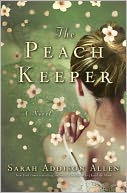
The Peach Keeper
by Sarah Addison Allen

I enjoyed Sarah Addison Allen’s debut novel, Garden Spells. For no particular reason, I haven’t managed to read any of her subsequent novels until this latest. And while I enjoyed this light romantic read, I must admit to having some complaints—which apparently puts me very much in the minority, if my fellow reviewers are any indication.

Set in fictional Walls of Water, North Carolina’s answer to Niagara Falls, The Peach Keeper is primarily the story of two women. The “have” of the story is Paxton Osgood, the perfectionist daughter of one of the town’s wealthiest families. The “have not” is Willa Jackson. Once upon a time, it was the Jackson family that was at the very crest of Walls of Water’s society, but that was generations ago. Their family lost their money, position, and ancestral home the year her grandmother was 17. Now, Willa leads a modest and fairly isolated life while running her sporting goods store. She’s an only child, her parents have passed away, and her grandmother has been lost to dementia for years.

Suddenly, though, there are a lot of events shaking up Willa’s staid life. The Osgood family has purchased the Blue Ridge Madam, the long-abandoned mansion of the Jackson family. They are turning it into a high-end inn, but first it will serve as the site of the Ladies Society’s 75th anniversary gala. The Society that was formed all those years ago by Pax and Willa’s grandmothers, best friends at the time. This upcoming event seems to be a catalyst for many events in the present, and also for unraveling long buried mysteries (and at least one skeleton) from the past.

In addition to the relationship between these two very different women, it is about their relationships with the men in their lives. As I mentioned above, it was light, romantic reading, and I enjoyed the novel in a superficial sort of way. The characters were likable and the prose readable. But the further I got into the novel, the more problems I had with plot contrivances. An example: of the two couples, I enjoyed the story of Paxton and Sebastian more, but the whole conflict of the potential relationship between these best friends comes down to an “is he or isn’t he” question. And all it would have taken to get past this conflict is just a tiny little bit of communication. Addison Allen presents opportunity after opportunity for these characters to clear the air. And they come right up against the moment of truth again and again—and they turn back. Some might call this narrative tension, but realistically, I have to call it a fairly naked plot contrivance. Any normal human beings would have hashed things out one way or another. When I really stop and think about it, my biggest problem is that in many instances, I didn't buy the motivations for the actions of the characters. This was equally true of Willa and Colin.

Neither the mystery from the past nor the fantastic elements scattered throughout the novel really went anywhere either. So in the end, this was a novel of relationships for me. And it was entertaining for a few hours. But I just can’t muster the enthusiasm to rave about this one.

Friday, April 1, 2011

Miss Pettigrew made my day!

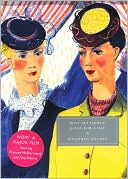
Miss Pettigrew Lives for a Day
by Winifred Watson

Guinevere Pettigrew has never sworn—not even in her own head. She’s never told a black lie, and precious few white ones. And she’s never been kissed. Miss Pettigrew is a lady. Alas, she’s a down on her luck lady, currently between positions as a governess, and times are hard. It is with no small amount of desperation that she knocks at the address the employment agency supplied for an interview. After about five minutes of steady rapping, the door is flung open by a somewhat frenzied young woman in a negligée. Without so much as stopping to ask who she is, the woman breathlessly drags Miss Pettigrew into her drama-filled life. Her immediate goal is to ease her lover out the door gracefully before her other lover arrives. So begins a whirlwind romance—a romance between the older, wiser, but frightfully insecure Miss Pettigrew and the kind-hearted but flighty Delysia LaFloss, actress and nightclub singer.

Readers who saw the 2008 film of Winifred Watson’s obscure comedy, first published in 1938, may remember the opening I described. But after the first couple of scenes, the details of the novel diverge. What remains the same is the spirit of the tale, the absolutely heart-warming characters, and the delightful humor. I was amazed at how well the comedy held up. This book could have been written today—with one big caveat…

Simply put, 1938 was a different time, and it was more than a little jarring when these wonderful, winning characters would suddenly come out with something astonishingly racist or anti-Semitic. It happens several times, and at one point the charming male lead suggests the adorable female lead might be in need of some “physical correction” occasionally. You can’t ignore it, but you must overlook it. It was a different time.

And despite that one big caveat, this is a novel I have fallen head over heals in love with. You will be praying just as fervently as Miss Petigrew for the doorbell to ring just one more time, and to see what adventure lies around the next corner. For Miss Petigrew, until now, has had a sad, lonely life. She starts the day somewhat rigid and judgmental, and watching her grow and blossom as the chapters count down the hours of one extraordinary day “24” style is a joy that no reader should be denied.

I actually listened to Miss Pettigrew Lives for a Day as an unabridged audio book. It was read to perfection by Frances McDormand, the actress who brought Miss Pettigrew to life in the film. Her affection for the material must equal my own; I could hear the smile in her voice. In some ways, the novel reminds me of a racier, feminist counterpart to P.G. Wodehouse’s beloved Wooster and Jeeves tales. All I know is that this is the book I’m going to pull from the shelf the next time I’m in need of a pick-me-up. And I’m going to spend the next several decades haunting used book stores searching for an illustrated copy from the thirties. Miss Pettigrew has joined the ranks of my all-time favorites.

Tuesday, March 29, 2011

I'm just wild about Harry

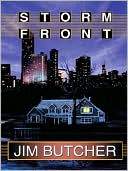
Storm Front (The Dresden Files, Book 1)
by Jim Butcher

After the recent disappointment of A Discovery of Witches, it was, perhaps, an odd choice to dive into another book that featured wizards, witches, vampires, and demons. The thing is, I couldn’t help it. I got sucked in. I’d had the audio book sitting on my Kindle for a while, and when the opportunity to get a bargain on the next book in the series arose, I decided to listen to a few minutes of this one to see if I liked it. Eight hours later, it turned out that I did.

At this point, surely everyone knows that this is the first book in the wildly popular Dresden Files series. The series is named after the books’ protagonist, Harry Blackstone Copperfield Dresden—named after three magicians, and at this time Chicago’s only professionally practicing wizard with an ad in the yellow pages. He’s a finder of lost items, and an instigator of paranormal investigations—no love potions. What he really is, is a classic hard-boiled PI with supernatural trappings.

In this first case, a cash-strapped Harry has two jobs going at once. One is a missing persons case of sorts, taken on behalf of a damsel in distress. Harry can’t resist ‘em. The other is a consulting job for the Chicago PD. Lieutenant Karen Murphy uses him for cases dubbed “unusual.” A double homicide in which the victims’ hearts literally exploded from their chests’ by means unknown certainly meets the requirement.

This wasn’t the greatest mystery I’ve ever read. I could see some of the plot twists coming a mile away, but it was a strong and entertaining debut novel. Things moved at a fast pace and Harry’s a winning, if world-weary, character. Buffy alum James Marsters does a really nice job of bringing Harry, Bob, and the others to life in the audio book version I listened to. I don’t feel the need to run out and read the subsequent umpteen books right now, but I would certainly consider working my way through them as a break from my usual fare. This was an enjoyable start, and based on the series’ success, they only get better from here.

Monday, January 10, 2011

The life and times of the last American housewife

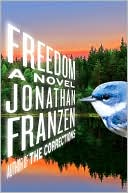
Freedom: A Novel
by Jonathan Franzen

Like Patty Berglund, the character at the center of Jonathan Franzen's Freedom, I'm not always as good a person as I wish I could be. For instance, I find it hard to root for Mr. Franzen's success. He's hardly an under-appreciated artist. Therefore, it is with all sincerity and conviction (and perhaps just a bit of disappointment) that I must tell you: This book is as good as everyone says it is. Possibly better. It's freakin' brilliant.

Freedom is nothing more than a satirical look at suburban America. Franzen accomplishes this with an intimate portrait of one American family, that of Walter and Patty Berglund. We get exhaustive information on the characters' formative years and on their lives together from a variety of overlapping perspectives. We are privy to the most intimate details of their marriage. We follow the lives of their children (primarily son Joey) and their closest friends. Franzen has created a series of deeply flawed characters in this clan, with incredibly rich, complex relationships. It is truly astonishing how thoroughly he inhabits each and every character, including many of the minor ones. Their voices are so comprehensive that every action and interaction, no matter how bizarre or inexplicable, rings absolutely true.

I mentioned above that the novel is a satire, and Franzen proves that he does, indeed, have a rich sense of humor. Getting the full nuance out of this novel was aided immeasurably by the tour de force performance by reader David LeDoux on the audiobook. LeDoux created distinctive voices for all significant characters and milked every last drop of humor and pathos from the text. His bravura performance allowed a great novel to shine all the more brightly.

Keep your secret and give me back my reading time

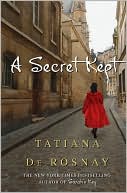
A Secret Kept
by Tatiana de Rosnay

When a novel is entitled A Secret Kept, you can safely assume it revolves around a secret. And that secret better be a good one. Unfortunately, I found Tatiana de Rosnay's sophomore effort to be a disappointment.

I was one of many readers who'd enjoyed Sarah's Key, and that was the principle reason I chose to read this novel. With her previous novel, it was the subject matter and the story being told that captured my attention, far more than the quality of her writing. Even then, I had to acknowledge that there was a cheesiness factor.

Unfortunately, that cheesiness is front and center in A Secret Kept. I started to write that it is the story of siblings Antoine and Mélanie Rey, but Antoine is our first-person narrator and this is really his story. As the novel opens, he has surprised his sister on the occasion of her 40th birthday. They are visiting the island resort they frequented for years as children. Neither has been back in 30-some years, since the sudden death of their mother. The return has been a mixed success, and it has reawakened old memories disturbing enough to cause Mélanie to literally lose control of the car they are in.

Antoine is unharmed, but Mélanie has a long recovery ahead of her. At first they begin to explore the implications of Mélanie's recovered memory together, but she pulls out, leaving him to dig alone. Along the path to discovery, de Rosnay throws every roadblock imaginable--including literal roadblocks!--in his way.

In addition to researching the past, there are events afoot in the present: family dramas, relationships beginning and ending, career highs and lows. I could summarize it all, but who really cares? None of it is especially compelling. And when the secrets are finally revealed and all the cards are on the table, none of it is very shocking or even that interesting. Plus, we had to read several love letters along the way that can only be described as cringe-worthy.

I partially read this book on paper, and partially listened to the audiobook. Narrator Simon Vance does a reasonable job with the material he has, but why have a novel peopled with French characters read by an actor with a British accent? Every French name and phrase is pronounced impeccably, so why not have the characters speak in their own accent? It seemed an odd choice.

This is certainly not the worst book I've ever read. It's solidly mediocre. And that's just not enough for me to go out of my way to recommend it to anyone. In the future, I'll think twice before reading a story because of de Rosnay's name alone.

Friday, August 13, 2010

Food for thought

The Windup Girl
by Paolo Bacigalupi

Cal*o*rie (kal-uh-ree)
n.
A unit of energy equal to the amount of heat needed to raise the temperature of one gram of water by one degree Celsius. One calorie is equivalent to 4.1868 joules.


The biggest problem with Paolo Bacigalupi's novel The Windup Girl is me, the reader. I'm not a big fan of science fiction due to my own failure of imagination. The further away from reality as I know it, the harder it is for me to get involved in and follow a story.

Bacigalupi's much-lauded and honored debut is set in our world--in Thailand, a few hundred years in the future. But it's a much-changed world. Specifically, it's a post-petroleum world. I started this review with a definition of the word "calorie." In this weight-obsessed time, people have forgotten that a calorie is actually a measure of energy. That point isn't commented upon in the text, but it seems relevant as much of the novel revolves around the Kingdom of Thailand's need to feed its people and power its nation and economy.

It seems a variety of plagues have beset the agricultural world. Some may have been natural, some engineered, and surely climate change has taken its toll. Unfortunately, commerce may have played an even larger role, with sterile, disease-resistant seed stocks being owned by huge multi-national "calorie companies." The powers that be in Thailand seek independence from these monopolies, even as central character Anderson Lake, a "calorie man," investigates the available food sources cropping up outside of Agrigen's control.

This description barely scratches the surface of this complex novel. It is an intriguing exploration of a post-petroleum society with regard to the science, industry, and politics of the time. Internal Thai politics are a big part of the story, as are crime and punishment, social mores, and the often clashing cultures which have been thrust together in a volatile environment. Finally, it is a novel of relationships, human and not-quite-human...

Narrator Jonathan Davies does a good job with the unabridged audiobook. I won't swear that his Asian accents are authentic or even culturally sensitive, but my American ears could understand the dialogue clearly. In fact, I had an easier time discerning the huge cast of characters from the distinct voices he created than I did from the unfamiliar foreign names.

The Windup Girl wasn't exactly my cup of tea, but I'm glad to have read it. It's left me with more than a little food for thought.

Sunday, January 3, 2010

Rarely is so much talent so poorly used

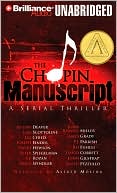
The Chopin Manuscript
by Jeffrey Deaver et al

The Chopin Manuscript and other novels of its kind are novelties. The idea is that one author will start and finish the novel, and that each chapter in between will be written by a different author working off of what's come before. This particular collaborative venture was the brainchild of the International Thriller Writers (ITW), and you'd be hard-pressed to find a more prestigious group of storytellers anywhere. In addition to Jeffrey Deaver, there are quite a few best-selling authors participating in The Chopin Manuscript, among them Lee Child, Joseph Finder, Lisa Scottoline, and David Hewson. Even among the less well-known authors there is tremendous talent exhibited. These are all writers capable of keeping their audience rapt, but the cards are stacked against them here.

Deaver opens the story with American Harry Middleton being stopped at the Warsaw Airport and being brought to the police for questioning. Middleton insists the hand-written Chopin music manuscript he's carrying is a fake--one he was called in to authenticate, but it turns out that's not what the police want to discuss. Rather, it is Middleton's lunch companion who, along with two others, has just turned up murdered. It's a respectable start to what soon becomes a globe-hopping tale of international intrigue.

Chapter by chapter, each author builds on what's come before, but tries to add his or her own twists, turns, surprises, and reversals--to the point that things ultimately become a bit ridiculous. This is a challenging task they've set themselves, and no one drops the ball, but it's just no way to tell a cohesive story. It's impossible. The plot is all over the place, the characters are undeveloped, even settings are descriptive passages are superficial. Some of the plot twists and story elements are patently absurd.

Oh, and I have no idea why this was produced exclusively as an audio book. The production values are excellent. And it's a tour de force for the preternaturally talented Alfred Molina, who does dozens of different character voices in just about every foreign accent imaginable. Even so, it was a devil to follow. There were so many characters to keep track of, and you couldn't just flip back in the book to remind yourself who they were. Far worse was this--the bulk of the characters had Polish or Slavic names. I couldn't tell you what they were. I couldn't spell them, pronounce them, or keep them straight as I tried to follow this complex narrative. Hopefully, you have better ears for that sort of thing.

The Chopin Manuscript is a novelty. I was curious to hear it and now I have. I'm definitely impressed with the talent of all involved, but I'm not rushing out to hear the sequel.