Showing posts with label 3-star review. Show all posts

Monday, May 27, 2013

Abandon all hope, ye who enter here...

Inferno
by Dan Brown

Dan Brown opens his fourth Robert Langdon thriller running—or rather lying down. The Harvard professor awakens in a hospital. In rapid sequence he discovers that he’s lost two days from his memory; that—astonishingly—he’s in Florence, Italy; and most shocking of all, that he’s in the hospital because persons unknown have tried to murder him. Most of these facts are given to him by a (naturally) pretty young doctor. Mere pages into the novel, an assassin is shooting up the hospital and Langdon and this doctor are on the run. (“She knew it was probably just the adrenaline, but she found herself strangely attracted to the American professor. In addition to his being handsome, he seemed to possess a sincerely good heart. In some distant, alternate life, Robert Langdon might even be someone she could be with.”)

Soon enough, there are more revelations—about this impressive woman, about mysterious objects secreted on Langdon’s person, and about a larger conspiracy. Of course, the conspiracy involves a bio-terror plot, and it can only be foiled by… a professor of symbology! Brown sums the opening up well in the following quote—and forgive me if the punctuation is not letter perfect, I’m transcribing from the audiobook without a printed copy for reference:
“Dante’s Inferno, Langdon thought. Inspiring foreboding pieces of art since 1330. Langdon’s course on Dante always included an entire section on the illustrious artwork inspired by The Inferno. In addition to Botticelli’s celebrated map of Hell, there was Rodin’s timeless sculpture of the three shades from The Gates of Hell, Stradanus’s illustration of pledges paddling through submerged bodies on the river Styx, William Blake’s lustful sinners swirling through an eternal tempest, Bouguereau’s strangely erotic vision of Dante and Virgil watching two nude men locked in battle, Bayros’s tortured souls huddling beneath a hail-like torrent of scalding pellets and droplets of fire, Salvador Dali’s eccentric series of watercolors and woodcuts, and Doré’s huge collection of black and white paintings depicting everything from the tunneled entrance to Hades to winged Satan himself.

Now it seemed that Dante’s poetic vision of Hell had not only influenced the most revered artists throughout history, it had also, apparently, inspired another individual, a twisted soul who had digitally altered Botticelli’s famous painting, adding ten letters, a plague doctor, and then signing it with an ominous phrase about seeing the truth through the eyes of death. This artist had then stored the image on a high-tech projector sheathed in a freakishly carved bone. Langdon couldn’t imagine who would have created such an artifact. And yet, at the moment, this issue seemed secondary to a far more unnerving question: Why the Hell am I carrying it?”
As for the twisted soul above, well, it’s not a priest. Inferno’s plot doesn’t revolve around the Church this time. The catalyst of the novel’s events is a mad scientist. Oh, he’s got a plan, and it’s positively Bond-villain-esque! The fact that his actions make absolutely no sense in the world as we know it must simply be overlooked. This sort of convoluted plotting comes with the madness, you see.

On to the substance of the book… If Brown’s writing has irritated you in the past, you can most
definitely expect more of the same. I think you can see how easily the language flows in the lengthy quote above. The action commences from the outset, as if the characters were sprinting from a starter’s gun, and the pace keeps up, but a lot of it begins to feel like action for action’s sake. Momentum without meaning. Plot is Brown’s bread and butter, and while there is definitely some fun stuff in this book, a big part of me feels like it’s nothing we haven’t seen from this and other authors before. And I, personally, didn’t feel like there was significant emotional payoff to compensate for other flaws.

So, am I trashing this book? No. Not really. Listen, I’ve read every book the man has written. At this point, it’s almost entirely because I need to read what everyone else on the planet is reading. (And apparently I’m immature enough to stay up all night and read it first.) But I love thrillers. Dan Brown does have the basic skills down. The story moves relentlessly forward on short, hooky chapters. It’s the type of quick read that makes long airplane rides fly by, and I’m entirely in favor of that. Furthermore, you might learn a few factoids and a thing or two about art that inspires you to visit a museum sometime. And apparently, Robert Langdon has a great many fans. They’ll be happy to see their old friend (much like his creator) up to his old tricks.

Monday, April 29, 2013

"This house may not give you what you want, but it will give you what you need."

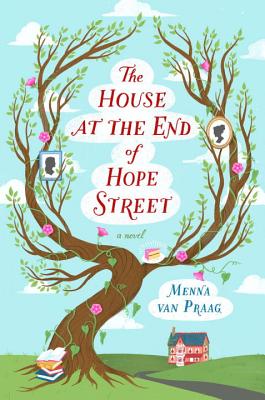
The House at the End of Hope Street
by Menna van Praagh

“The house has stood at the end of Hope Street for nearly two hundred years.” So begins Menna van Praag’s debut novel. In those opening pages, nineteen-year-old Cambridge doctoral student Alba Ashby, reeling from an unnamed “worst event in [her] life,” is inexplicably drawn to the house. Alba is more than an academic over-achiever. She sees things that others can’t: ghosts and auras, but also vibrant and colorful scents and sounds. She immediately senses that this house is different.

Welcomed in by Peggy, the house’s elderly caretaker, she’s told, “You can stay here for ninety-nine nights, until the seventh of August, just before midnight. And then you must go… No rent, no bills. Your room will be your own, to do with as you like. But take care of the house and it’ll take care of you.” This last is an understatement. The house at the end of Hope Street is a veritable Hogwartsian Room of Requirement. When you’re sad and lean against the wall, it softens to comfort you. When you want to draw, a notebook materializes. You get the idea.

The tale opens with Alba, but eventually it proves to be an ensemble fantasy, as readers meet the other inhabitants of the house. There’s Peggy, of course, as well as an aspiring singer, Carmen, and actress, Greer. Each woman gets her ninety-nine days for healing, for reinvention, for whatever it is she needs. And this has been going on for two centuries. All over the house are framed photos of illustrious and accomplished ladies: Florence Nightingale, Daphne du Maurier, Vita Sackville West, Beatrix Potter, and dozens of others. (Don’t worry that you won’t recognize all the names—such as Elizabeth Garrett Anderson, the first female doctor in England—there’s a handy guide to all the ladies at the novel’s end.) These women are more than the house’s history; they’re a part of its present. Their photographs speak and frequently advise the house’s current tenants. It’s just that kind of place. Okay, so that’s the set up. I’ll leave the actual plot for you to uncover.

The reason I actually decided to take a chance on this book is that Ms. Van Praag was compared to so many authors whose work I loved: Jasper Fforde, Sarah Addison Allen, Alice Hoffman. I’d say that Addison Allen is the most apt comparison, and that fans of her light, magical realism-filled novels are likely to enjoy this. I don’t believe that van Praag’s prose is up to par with Ms. Hoffman’s lush writing. And Jasper Fforde was, for me, the strangest and most disappointing comparison. While it’s true that many classic literary figures make an appearance in the novel’s pages, this book contains none of the wit and great humor that is such a feature of his work. Overall, I’d describe this as gentle women’s fiction with a fantastic edge.

As the paragraph above indicates, I had a mixed response to the novel. I’m not going to lie… I had issues with Alba. “Every day she went to the library at the same time. Every day she bought her lunch at the same café and ordered the same thing.” This character is not just boring and repressed; she’s painfully shy and incredibly passive. When confronting a person who has wronged her terribly, she’s “barely audible.” Again and again I found myself wanting to slap this little mouse. And this is something I see in fiction all the time. An author who wants to show growth creates a character that is so damaged and diminished that it’s hard to care about her. (Kinder, gentler readers may well disagree with me on this.)

In general, I found the characters of the novel to be fairly one-dimensional. Alba has siblings, for instance, that are so cold and uncaring that they in no way resemble real human beings. And another thing—if you use historic figures like Dorothy Parker and Sylvia Plath as characters, write them dialogue that sounds like it might come out of their mouths. Give Parker a witty line, for God’s sake! Give Plath some poetry!

On the other hand, one of the great pleasures of the novel is the bibliophily on display throughout.
Alba is a serious book lover, her one redeeming quality. I thoroughly enjoyed her ruminations on literature. And even if they weren’t well-characterized, the extensive literary cast and references were great fun. I’ve always said that you can’t go wrong preaching to the choir. The story, in general, is entertaining and it all moves quickly. Also, Ms. van Praag did manage to surprise me with a few fun plot twists I didn’t see coming. And I actually quite enjoyed the theme of female empowerment, as exemplified by the house’s past tenants. The other thing that van Praag handled well was the novel’s resolution. While I felt frustration with certain elements of the tale, I have no complaints about the ending. It was the feel-good fix I was looking for.

So, all in all, a mixed bag. I’m happy enough to have read the book. It was quick and not overly challenging. In other words, not a bad way to pass a day. And the great thing about debut novels? The authors are still learning and growing. Who knows what Menna van Praag may dream up next?

Wednesday, March 21, 2012

My long-awaited introduction to Matthew Pearl is a mixed bag

The Technologists
by Matthew Pearl

I’ve had a galley of Matthew Pearl’s The Dante Club sitting on my bookshelf since before it was published. How long ago was that? That’s how long I’ve been meaning to get around to reading the man. Story of my life. Hurrah! I have finally met this goal!

Set in 1868, this period thriller opens with an act of terrorism. Early one Boston morning, several ships’ compasses and other instruments fail. In the fog, they crash into each other and the wharves. There is pandemonium, destruction, and loss of life. The cause and perpetrator of this mayhem is unknown. This is the first of several incidents that virtually bring the city to its knees. All the attacks seem to involve science, and this is at a time when there’s a great distrust of science in general.

1868 also happens to be the year of the first graduating class of MIT. Pearl’s protagonists, determined to secretly solve the mystery and save the city, are several members of the small student body, most of whom are underdogs in one way or another. At the very heart of the tale is working-class charity student Marcus Mansfield. Mr. Pearl has created a mostly appealing ensemble, but I don’t honestly think that character development is his greatest strength. It is clear that historical accuracy and research is. I’m not enough of a history buff to tell you if every single aspect of this novel is accurate, but I was doing a lot of Googling as I read, and there was a tremendous amount of real history worked very effectively into the plot. And the time and place was fascinating—especially to me, having lived in Boston for a number of years. Thank you, Mr. Pearl, for the time machine. Additionally, the science used in the plot was clever and inventive.

About the novel’s plot… Well, it’s complex and convoluted—perhaps a bit excessively so. I found my credulity becoming increasingly strained as the novel proceeded. There were some coincidences late in the game that I found annoying as well. Elements of the story were overly melodramatic. And the dénouement, when it came, was satisfyingly full of surprises and reversals, but I wonder if Mr. Pearl took things just a step too far. There were so many surprises and reversals that it felt like it took forever to finally get the truth!

Did I enjoy reading this novel? Yes I did, unquestionably. But I do feel it had flaws, and overall, after looking forward to reading this author for so long, I was just the slightest bit disappointed. Since this is my only experience of his work, it’s possible this wasn’t the best book with which to start, and I look forward to reading more of him in the future.

NOTE: I had tremendous fun reading this novel on the free Subtext iPad app.  It allowed me to fully annotate the novel with marginalia--links to websites, articles, photographs, and more--and to interact and discuss the novel with other readers.  If you have an iPad, check this app out!

Friday, January 13, 2012

Not my cup of tea, but it might be yours

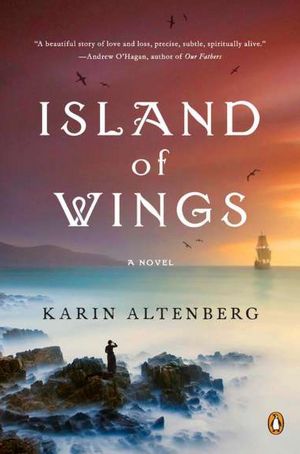
Island of Wings
by Karin Altenberg

My best friend and I jokingly rate books and films on their “Susan-friendliness,” and that’s nothing more than the completely subjective scale of my idiosyncratic likes and dislikes.  I should have known that Karin Altenberg’s debut novel, Island of Wings, wouldn’t be my cup of tea.  But that said, I don’t necessarily think that there’s a thing wrong with this novel.  It’s not my kind of story, but I think that it was skillfully and effectively told.

Perhaps most interestingly, the story here is heavily based on historical fact.  It is a fictionalized account of the life of Reverend Neil MacKenzie and his wife Lizzie.  MacKenzie, dealing with demons of his own, asks the Church of Scotland to “preach the Gospels in the most godforsaken place they could offer—he had suggested Newfoundland, where he was sure he could do a world of good.  In the end, the Society in Scotland for the Propagation of Christian Knowledge had asked him to go to St. Kilda—the furthest inhabited islands in Britannia.”

The novel, which is told somewhat episodically in eight parts between the years 1830 and 1843, has clearly been meticulously researched, and I found the author’s note at the end quite interesting.  The setting of the novel is a fascinating place with which I was completely unfamiliar.  When the couple arrives in 1830, the islanders are enjoying a happy subsistence, living exactly as their ancestors did centuries earlier.  It’s a very different, rather primitive way of life.  Altenberg does a great job of conveying the harsh beauty of this remote place, with special attention to the natural world.

What I personally had trouble with was the relationship at the heart of this novel, and the character of the Reverend.  Women didn’t have an easy time of it back then, and while I can’t say that this novel is completely joyless, it’s a harsh existence and utterly humorless.  Also, as a secular Jew, the whole idea of Christianity being forcefully foisted onto a disinterested people is distasteful to me in the extreme.  Reverend MacKenzie is not a sympathetic character and was simply not someone I wanted to spend 300 pages with.  Still, he was characterized well enough (and not as some kind of black and white monster, but as a very flawed human) to arouse strong feelings in me.

While Island of Wings ultimately wasn’t for me, I fully expect it to find its audience, and I am certainly open to reading Ms. Altenberg’s future work.

Thursday, December 8, 2011

"I hate therefore I am"

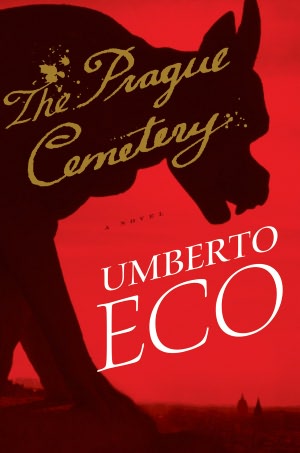
The Prague Cemetery
by Umberto Eco

The quote above tells you almost everything you need to know about the protagonist of Umberto Eco's latest novel. Set in 19th century Europe, Captain Simonini is an equal opportunity misanthrope, and early in the novel there's a lengthy diatribe against not only the Jews (always very much at the center of Simonini's hatred), but also the Germans, French, Italians, priests, Jesuits, Masons, women, and several other groups in asides. Simonini expounds, "They say that a soul is simply what a person does. But if I hate someone, and I cultivate this grudge, then, by God, that means there is something inside! What does the philosopher say? Odi ergo sum. I hate therefore I am."

I think it took me about three attempts to make it past these over-the-top opening salvos of hatred, and a smarter reader would have quit, but Eco has defeated me in the past, and I was determined to read this entire book. Why? Why? The Prague Cemetery is a dense, complex, convoluted tour through 19th century European history. (I strongly recommend that you acquire a Ph.D. in the subject before you sit down to read.) Simonini, it seems, is--Forrest Gump-like--at the center of almost all major events, and pretty much behind every conspiracy of the era.

As you may have gathered above, he is not a good guy. At one point he justifies: "Yes, I admit it. In my conduct toward my would-be Carbonari comrades, and to Rebaudengo, I did not act in accordance with the morals you are supposed to preach. But let us be frank: Rebaudengo was a rogue, and when I think of all I have done since then, I seem to have practiced all of my roguery on rogues." Yeah, right.

The novel is an autobiography of sorts, as there is some confusion as to Simonini's identity. He seems to be possibly inhabiting the same apartment? body? mind? as a clergyman named Abbé Dalla Piccola. Simonini's memory is full of holes, which Dalla Piccola seems to be able to fill, as he inserts his own recollections into Simonini's written document. Does this sound confusing? You have no idea. "Abbé Dalla Piccola seems to reawaken only when Simonini needs a voice of conscious to accuse him of becoming distracted and to bring him back to reality, otherwise he appears somewhat forgetful. To be frank, if it were not for the fact that these pages refer to events that actually took place, such alternations between amnesiac euphoria and dysphoric recall might seem like a device of the Narrator."

On the subject of "events that actually took place," pretty much all of the history (if not the stories behind the events) took place, and in fact, according to Eco, Simonini is the only fictional character in the entire novel. So, those European history Ph.D.s are really going to have a field day. For the rest of us, not so much fun, I have to say.

If it's not yet clear, I hated this book. I violently HATED this book! Reading it gave me PTSD. I know, you're wondering why the three stars? Well, as much as I hated it, I can't actually tell you it's bad. Eco is a brilliant, talented writer. I simply can't imagine why he chose to use his talent to tell this particular story. Here are some of the issues I had with the novel:
  • The required knowledge of history was oppressive. Without that knowledge, the novel was almost impossible to follow and/or appreciate.
  • The cast of thousands, all with multi-syllabic foreign names, was impossible to keep track of, especially as characters would reappear decades after their last appearance in the book.
  • Despite the sheer amount of stuff that happens within these pages, the story moves at what, for me, was an excruciatingly slow pace. I'm not actually sure how Eco managed that.
  • Not only is the central character a truly awful human being, there really is no one to like or care about much in the book.
  • While at first I was able to shrug off the anti-Semitic content of the novel, after 464 pages of the most vile garbage imaginable, it really, really got to me. As a Jew of European descent, no matter how ridiculous and over-the-top the hatred was (from all characters, not just Simonini), I know that everything Eco wrote was very reflective of the attitudes of the era. It made me ill. Make no mistake; I don't believe Mr. Eco is an anti-Semite. I just didn't need to read this hatred. It hurt me.
Umberto Eco is a great writer, but any way you chose to look at The Prague Cemetery, I don't believe to be among his strongest works, and it is certainly not one of his more accessible titles. Despite Mr. Eco's talent, I can't recommend this book to anyone. And it'll be a long time before I decide to read him again.

Wednesday, December 7, 2011

It's not a masterpiece, but it's fine airplane reading

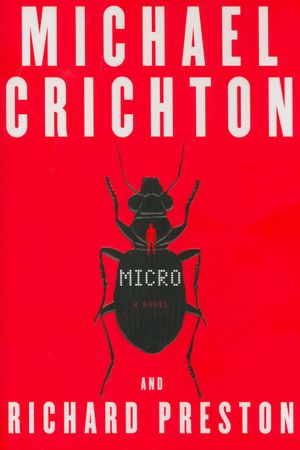
Micro
by Michael Crichton & Richard Preston

I was, and am, a huge fan of Michael Crichton's work. I never had very high expectations for this final novel, but that's no reflection on the choice of Richard Preston to complete the work. In any case, for better or worse, Micro lived up to my tempered expectations.

Like several of Crichton's earlier novels, Micro has a high concept hook. Most nanotech companies fabricate on a nano scale, but Nanigen MicroTechnologies has developed revolutionary shrinking technology. Not only can they reduce machines and robots, they can reduce living beings and then return them to full size. I won't get into all the details of the novel's set-up, but seven graduate students learn about this technology the hard way once they become a threat to Nanigen's president. Seven against one is much easier to manage when the seven (and one unlucky Nanigen employee) are half an inch tall. Before they can be dispatched quickly, however, the students escape into Hawaii's verdant "micro world."

Crichton's strengths and weaknesses as a storyteller remain consistent. His primary characters are more archetypes than individuals. Rather than Rick, Erika, Amar, and Karen, these students quickly show themselves to be the Leader, the Warrior, the Know It All, the Weasel, and so forth. Each has an assigned role to fulfill. Some barely live long enough to become typecast, because the micro world is treacherous. When you're half an inch tall, a beetle is not unlike a rhinoceros. Luckily, these students are unusually well prepared to survive their hostile surroundings--or unusually well informed about the danger they're in--depending on how you look at it. Among them there are experts in insects and arachnids, poisons and venoms, and the chemical defenses of plants and animals.

Crichton is great about translating the wonder of science. His amazing shrinking technology won't send me running to the textbooks this time around, but there's still plenty of gee whiz science to be enjoyed in Micro's pages. More than that, he effectively shows the beauty as well as the horror of the situation his characters are in. As for the horror, I have to admit that I found it especially disturbing this time out. I have no special fear of dinosaurs, but I am absolutely phobic about spiders and insects. There are scenes that I definitely could have done without reading, and if this is an issue for you as well, be forewarned.

Much like Jurassic Park, Micro has a picaresque quality, with its protagonists leaping from one threat to another. I hate to say it, but the plotting was pretty by the book. There was a police procedural subplot that never really went anywhere, and true surprises were few and far between. Despite this, I read the novel easily in a day (instead of saving it for my Thanksgiving flight like I was supposed to). Once I started, I didn't want to stop reading, and the pages flew past swiftly.

Preston appears to have done a good job finishing what Crichton left behind. There is no feeling that this is the work of another author. Still, I do find myself wondering how the novel would have differed had Crichton written it all. Alas, we'll never know. If you're a hard-core Crichton fan like me, by all means read this novel. Just don't expect this final work to be the man's masterpiece. And even if you're not a hard-core fan, if the premise sounds fun to you, you could do a lot worse for airplane reading.

Tuesday, November 8, 2011

Starts with a whimper, but ends with a bang

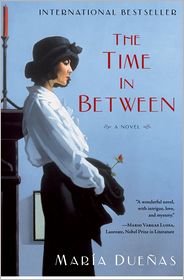
The Time In Between
by Maria Dueñas

I have to admit that Simon and Schuster piqued my curiosity about this title simply because they promoted it so heavily prior to its publication.  In my mind, that’s a huge vote of confidence from the publishing house.  And, apparently it has been a bestseller in Europe, where it was originally published.  Alas, my own response to The Time in Between was mixed.  It got off to a rocky start, but ended much stronger—which is a better situation than had it been the other way ‘round.

With regard to the “rocky start,” the first-person narrator of this 600-page epic is Sira Quiroga, a young seamstress from Madrid with a modest background.  Unfortunately, she makes a terrible initial impression.  Virtually the first thing we learn about her is that she is an inconstant woman.  She behaves deplorably towards a man she’s supposed to love, and then runs off to Morocco with a man slicker than Teflon.  On many, many levels, her behavior is unforgivably stupid.  Truthfully, I wanted to slap her.  (Note to Authors:  Having your protagonist repent and/or wise-up eventually does not justify making us hate her in the beginning.)  And this whole opening drama takes up about the first hundred pages of the novel.

Which leads us to issue number two…  God, I felt like it took forever for this story to really get going!  No way did this novel need to be over 600 hundred pages long.  I would have written a far more positive review had it been condensed by a good 200 pages.  The overly drawn out introduction (that made me sort of hate the heroine) could have been condensed so that we could get to the meat of this story so much sooner.  As it is, the plot described in the jacket copy of this novel doesn’t even come into play until well past the half-way point of the novel. 

And that plot involves Sira working on behalf of the British Resistance in the early days of WWII.  But, given that that doesn’t even get broached until page 355 of my galley, there’s a whole lot that goes on before the excitement kicks in.  And I don’t mean to imply that it’s all bad or boring.  I think that Ms. Dueñas is going for a picaresque quality to Sira’s story, with a series of episodic adventures.  Some parts were more successful than others for me, but stuff does happen.  I wouldn’t call it fast-paced.  What I liked much, much more than the drawn out plot were the many supporting characters that bring life and interest to the story.  They’re an excellent and entertaining supporting cast.

And as the novel goes on, the pace does pick up, the main plot kicks in, and from there on out it’s a different book.  There is romance, excitement, suspense—all the things I would have enjoyed seeing more of in the first half of the novel.  So, The Time In Between ends on a high note.  Heck, the door is even open for a sequel.  By the end, Sira is a far more appealing protagonist.  The prose throughout the novel is acceptable, but not what I’d consider a selling point.  The North African setting of much of the tale, however, is unusual and adds its own level of interest.

I would recommend this debut to readers who are fans of long novels, and who are willing to have a little patience.  I would also recommend it to fans of these types of stories—of the time, the place, the war.  If the flaws I described sound like deal-breakers, you’re probably better off skipping The Time In Between.

Monday, September 12, 2011

Being paranoid doesn’t mean they aren’t out to get you…

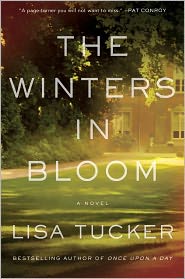
The Winters in Bloom
by Lisa Tucker

David and Kyra Winter have transcended their difficult pasts and made a happy life together. When they married, they never planned to have a child, but five-year-old Michael is the joy of their lives. So much so that the anxiety they feel about his well-being has transformed into smothering over-protection. They are constantly waiting for the other shoe to drop, and on a bright, sunny afternoon it does.

Home-schooled Michael has been allowed out into the yard to play on his own for half an hour. His mother turns away from the window for a moment and he’s gone. Just gone. They know he would not leave on his own, and their fears are confirmed when the police find a note. It states that “Michael is fine and he’ll be back in a day or two.” This does nothing to allay the worries of the Winters, or their frustration with the police investigation. Both David and Kyra have people in their pasts that are unstable or desperate enough to have taken their child.

The story is told in a third person omniscient voice that moves from character to character in the telling of the tale, and backwards and forwards in time as both the reader and the spouses learn the truth of their pasts. This is a relatively brief novel, and the story unfolds in a quick, engaging, and just pleasantly readable fashion. Despite the subject matter, there’s nothing too challenging or serious on the page. Twists and revelations keep the story moving along, and the ultimate revelation of the identity of the kidnapper is satisfying. While both David and Kyra are portrayed as flawed characters, they are almost too good, too likable to be believed. Clearly, the reader is meant to root for this small family to have a happy ending. It doesn’t give the drama an overly realistic feel, but it works just fine for light entertainment. This was my overdue introduction to Ms. Tucker’s work, and I’m very glad to have finally had a chance to read her.

Tuesday, May 17, 2011

An amazing talent… for annoyance

Bellwether
by Connie Willis

Connie Willis’s novels have been recommended to me many times over the years by a variety of sources—though never this particular novel. As an introduction, it was a limited success. I only found Bellwether to be so-so, but it certainly wouldn’t discourage me from reading more of her work in the future.

Bellwether is a short satirical novel, set in the world of science for profit. It’s the story of how a social scientist researching fads and trends meets a colleague studying chaos theory and information diffusion, and how they team up to survive their corporate management and the “help” of a surly office assistant. Along the way, Willis takes pot shots at parenting, cuisine, fashion, lifestyle, and other trends, and those who adhere to them.

Honestly, on paper, this looks it should be a home run for me. I’m a big fan of satirical novels, but I’ve seen similar takes on office culture done better. (Max Barry’s Company is highly recommended!) Another issue is the fact that I listened to Bellwether as an unabridged audiobook. Reader Kate Reading (yeah, that’s her name) did a fine job with most of the narration, but for the annoying office assistant, Flip, she did a really annoying Valley Girlish voice. It got old fast. Not only that, she used the same voice for all of the many other annoying characters the protagonist encounters. It was a legitimate choice, implying a sameness to the hostile, ignorant, lazy characters in the book, but again, it was tedious. I find stories about really annoying people tend to get on my nerves. Maybe it’s me?

I did think the information on the science and history of fads was quite interesting, but there was simply too much of it. And there were some laughs along the way to the novel’s clever ending, but they didn’t fully compensate for the negative aspects of the book—for me. I will read Willis again, because she is clearly a talented writer. But next time I’ll stick to a recommended title. I think I could become a fan; this just wasn’t the right starting place.

Tuesday, April 12, 2011

David Baldacci enters “Chuck” territory

The Sixth Man
by David Baldacci

Okay, not to be overly simplistic, but David Baldacci’s latest thriller featuring former Secret Service agents Sean King and Michelle Maxwell does have a plot highly reminiscent of the television show “Chuck,” though certainly not a similar tone. No, there’s no “Intersect” computer imbedded in anyone’s brain, but there is a defense contractor running what’s called the E-Program. As the novel opens, the contractor, Peter Bunting, is seeking an individual who can be the next “Analyst.”

The Analyst is the person tasked with watching the “Wall,” a six by eight foot screen on which flowed “information on suspicious activities being carried out by either Americans or foreigners operating domestically.” It’s a “compilation of top secret communications, all of colossal importance. And on it poured, from all corners of the globe, delivered en masse in high definition. If it were an Xbox or a PS3 game it would be the most exciting difficult one ever created. But there was nothing made up about it. Here real people lived and real people died, every second of every day.”

The idea is that our intelligence network is too spread out and diversified, and that in order to truly get the Big Picture, one individual needs to be able to process every scrap of data we collect. It’s a staggering job that literally brings brilliant men to their knees. Obviously it’s not a job for the average Joe, but a few extraordinary individuals can utilize 90-some percent of their brain, rather than the paltry ten percent most of us access. And all of this is exposited in a brief prologue.

Next, we’re with series protagonists King and Maxwell as they touch down in Maine. They’ve been called up for an investigative job. Ted Bergin, an old friend and law professor of Sean’s is defending the serial killer Edgar Roy, and he seems to believe there’s more to this open-and-shut case than meets the eye. He’s brought in reinforcements. Alas, they arrive too late. En route to their first meeting with Bergin, they come across a stalled vehicle. Inside they find Bergin’s body with a bullet to the brain. The question is: what do these two plotlines have to do with each other?

So begins a novel more packed with action than with plot. There is plot, but it’s not terribly complex or sophisticated. Some stuff happens, more stuff happens, and there’s a lot of traveling up and down the eastern seaboard. Baldacci gets some stuff right. He’s good at gracefully expositing what’s come before, and he can write a tight, tense scene. However, after four previous novels with these protagonists, I was really shocked at how one-dimensional the characters felt. King and Maxwell are at a pivotal point in their personal and professional lives. I was astounded by just how uninvested I was.

It’s not that this is a terrible novel, but there isn’t a whole lot of substance to it. If you’ve been following the series you’re going to want to read this one. Otherwise, I simply wouldn’t bother.

Monday, April 4, 2011

Just peachy…

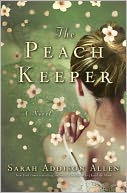
The Peach Keeper
by Sarah Addison Allen

I enjoyed Sarah Addison Allen’s debut novel, Garden Spells. For no particular reason, I haven’t managed to read any of her subsequent novels until this latest. And while I enjoyed this light romantic read, I must admit to having some complaints—which apparently puts me very much in the minority, if my fellow reviewers are any indication.

Set in fictional Walls of Water, North Carolina’s answer to Niagara Falls, The Peach Keeper is primarily the story of two women. The “have” of the story is Paxton Osgood, the perfectionist daughter of one of the town’s wealthiest families. The “have not” is Willa Jackson. Once upon a time, it was the Jackson family that was at the very crest of Walls of Water’s society, but that was generations ago. Their family lost their money, position, and ancestral home the year her grandmother was 17. Now, Willa leads a modest and fairly isolated life while running her sporting goods store. She’s an only child, her parents have passed away, and her grandmother has been lost to dementia for years.

Suddenly, though, there are a lot of events shaking up Willa’s staid life. The Osgood family has purchased the Blue Ridge Madam, the long-abandoned mansion of the Jackson family. They are turning it into a high-end inn, but first it will serve as the site of the Ladies Society’s 75th anniversary gala. The Society that was formed all those years ago by Pax and Willa’s grandmothers, best friends at the time. This upcoming event seems to be a catalyst for many events in the present, and also for unraveling long buried mysteries (and at least one skeleton) from the past.

In addition to the relationship between these two very different women, it is about their relationships with the men in their lives. As I mentioned above, it was light, romantic reading, and I enjoyed the novel in a superficial sort of way. The characters were likable and the prose readable. But the further I got into the novel, the more problems I had with plot contrivances. An example: of the two couples, I enjoyed the story of Paxton and Sebastian more, but the whole conflict of the potential relationship between these best friends comes down to an “is he or isn’t he” question. And all it would have taken to get past this conflict is just a tiny little bit of communication. Addison Allen presents opportunity after opportunity for these characters to clear the air. And they come right up against the moment of truth again and again—and they turn back. Some might call this narrative tension, but realistically, I have to call it a fairly naked plot contrivance. Any normal human beings would have hashed things out one way or another. When I really stop and think about it, my biggest problem is that in many instances, I didn't buy the motivations for the actions of the characters. This was equally true of Willa and Colin.

Neither the mystery from the past nor the fantastic elements scattered throughout the novel really went anywhere either. So in the end, this was a novel of relationships for me. And it was entertaining for a few hours. But I just can’t muster the enthusiasm to rave about this one.

Monday, January 10, 2011

Keep your secret and give me back my reading time

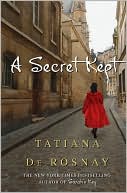
A Secret Kept
by Tatiana de Rosnay

When a novel is entitled A Secret Kept, you can safely assume it revolves around a secret. And that secret better be a good one. Unfortunately, I found Tatiana de Rosnay's sophomore effort to be a disappointment.

I was one of many readers who'd enjoyed Sarah's Key, and that was the principle reason I chose to read this novel. With her previous novel, it was the subject matter and the story being told that captured my attention, far more than the quality of her writing. Even then, I had to acknowledge that there was a cheesiness factor.

Unfortunately, that cheesiness is front and center in A Secret Kept. I started to write that it is the story of siblings Antoine and Mélanie Rey, but Antoine is our first-person narrator and this is really his story. As the novel opens, he has surprised his sister on the occasion of her 40th birthday. They are visiting the island resort they frequented for years as children. Neither has been back in 30-some years, since the sudden death of their mother. The return has been a mixed success, and it has reawakened old memories disturbing enough to cause Mélanie to literally lose control of the car they are in.

Antoine is unharmed, but Mélanie has a long recovery ahead of her. At first they begin to explore the implications of Mélanie's recovered memory together, but she pulls out, leaving him to dig alone. Along the path to discovery, de Rosnay throws every roadblock imaginable--including literal roadblocks!--in his way.

In addition to researching the past, there are events afoot in the present: family dramas, relationships beginning and ending, career highs and lows. I could summarize it all, but who really cares? None of it is especially compelling. And when the secrets are finally revealed and all the cards are on the table, none of it is very shocking or even that interesting. Plus, we had to read several love letters along the way that can only be described as cringe-worthy.

I partially read this book on paper, and partially listened to the audiobook. Narrator Simon Vance does a reasonable job with the material he has, but why have a novel peopled with French characters read by an actor with a British accent? Every French name and phrase is pronounced impeccably, so why not have the characters speak in their own accent? It seemed an odd choice.

This is certainly not the worst book I've ever read. It's solidly mediocre. And that's just not enough for me to go out of my way to recommend it to anyone. In the future, I'll think twice before reading a story because of de Rosnay's name alone.

Saturday, October 23, 2010

Yu's fanciful debut would have benefited from warp drive

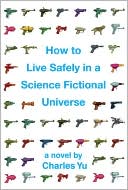
How to Live Safely in a Science Fictional Universe: A Novel
by Charles Yu

There's a great deal to like in Charles Yu's debut novel, and not much to hate. It's the story of a reclusive time machine repairman also named Charles Yu. Yu has sort of been drifting through life, a not very active participant. He lives in a closet-sized time machine with a fictional dog:

"It's not comfortable in here. But it's not not comfortable either. It's neutral, it's the null point on the comfort-discomfort axis, the exact fulcrum, the precise coordinate located between the half infinity of positive comfort values to the right and the half infinity of negative values on the left. To live in here is to live at the origin, at zero, neither present nor absent, a denial of self- and creature-hood to an arbitrarily small epsilon-delta limit. Can you live your whole life at zero? Can you live your entire life in the exact point between comfort and discomfort? You can in this device. My father designed it that way."

He has a crush on his computer's operating system:

"Is TAMMY's curvilinear pixel configuration kind of sexy? Yes it is. Does she have chestnut-colored hair and dark brown eyes behind pixilated librarian glasses and a voice like a cartoon princess? Yes and yes and yes. Have I ever, in all my time in this unit, ever done you know what to a screenshot of you know who? I'm not going to answer that."

For me, the principal joy of this novel was Yu's delightful use of language, often amusing and Jasper Fforde-clever, but also philosophical and even poignant at times. Where Fforde mostly sticks to peppering his novels with literary references, no aspect of pop culture is off-limits to Yu:

"Client call. Screen says

SKYWALKER, L

And my first thought is oh, man, wow, but when I get there, it's not you know who, with the man-blouse and soft boots and the proficiency at wielding light-based weapons. It's his son. Linus."

So, this is all charming, right? Where the book falls down is narrative drive. The novel opens with Yu offering some exposition about his life, the world, and the ins and outs of time travel. So far, so good. However, it bogs down in the middle. After the set-up, there's a meandering plot about Yu's search for his lost father, the inventor of time travel. The meta-fictional Yu reflects at length on his dysfunctional family and rambles in circles about the physics of time travel. As short as this small novel is, it's a bad sign that it tended to drag due to a lack of real plot. At one point, deep in the middle, Yu mused, "But what if I were to skip forward? Just cut out all of this filler in the middle?" I found myself wondering the same thing.

Tuesday, July 27, 2010

Light and slight (with just a bit of trashy underwater fiction)

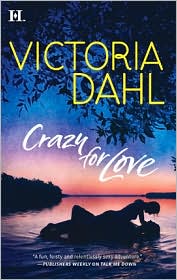
Crazy for Love (Hqn)
by Victoria Dahl

Do you ever just feel like reading something completely fluffy? Maybe you read a few pages and you just get sucked in? And reading the novel in a day is easier than stopping? Such was the case on Saturday. Despite the Harlequin imprint, I'd classify this one as more of a chick lit novel than genre romance.

It's the story of Chloe Turner, a nice girl in crazy circumstances. Specifically, her former fiancée has embroiled her in a tabloid news scandal by faking his own death to get out of the wedding! Now hounded by paparazzi, her best friend Jenn has taken her to a remote island off the Virginia coast to hide out and begin to heal. Wouldn't you just know that there are two gorgeous brothers (with issues of their own) in the cabin next-door.

As noted above, this was a quick, fluffy read. There wasn't a thing believable about it, but there were a few laughs and I didn't have to think too hard. It was hardly the worst way I've spent a Saturday afternoon.

Friday, June 25, 2010

There's a sucker born every minute...

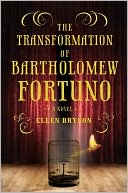
The Transformation of Bartholomew Fortuno: A Novel
by Ellen Bryson

Oh, those marketing guys over at Henry Holt & Co. are good! They did a great job of capturing my interest in Ellen Bryson's debut novel The Transformation of Bartholomew Fortuno (TToBF) by comparing it to two beloved books, Geek Love and Water for Elephants. And I can't even complain that the comparisons aren't apt.

Like Geek Love, TToBF is the story of... well, some "human curiosities." Bartholomew Fortuno is an employee (performer? exhibit?) in P.T. Barnum's American Museum in New York as the Civil War is winding down. He is billed as "the world's thinnest man," and he just may be. His best friend is, of course, Matina, the fat lady. Like the characters in Geek Love, Fortuno views their differences as "gifts." While TToBF does share a bit of Geek Love's darkness, that's where any similarity ends. What're missing are the black humor, the wonderful satire, the knock-out prose, and the pure weirdness of Dunn's brilliant novel.

Like Water for Elephants, TToBF is a period novel--albeit one set 70 years earlier--with a male first-person narrator. And while these performers don't work for a circus (Barnum wasn't in the biz yet) some of the trappings and much of the hokum are the same. Unfortunately, Ellen Bryson can't (yet) hold a candle to Sara Gruen as a story-teller. Any comparison only serves to highlight TToBF's inadequacies in terms of character, of pacing, and of narrative substance.

The catalyst of this tale occurs in the opening pages. Unable to sleep, Fortuno happens to be looking out the window late one night just in time to observe Barnum's unexpected return with a mysterious veiled woman. Eventually she is revealed to be a new curiosity, Iell Adams, a bearded lady. From that first glance, Fortuno's obsession with this woman grows exponentially and inexplicably, putting what had been an odd but orderly life into turmoil. There are all sorts of allegiances, agendas, and intrigues within the insular museum community that get set into motion.

Reading over what I just wrote, this still sounds like a pretty interesting book--and it wasn't terrible--but neither was it good. Let's start with Fortuno. We spend the entire novel inside his head, and the two words that come to mind to describe him are: prissy and neurotic. These are not attractive qualities, but he fits in well with his colleagues; there wasn't a single character in this book that I found to be likeable. Given that, it's awfully hard to care what happens to them. Take Fortuno's pursuit of Iell, for example. Eventually he proclaims himself to be in love. If that's love, well, yuck. Just... yuck.

There are small intrigues that propel the story, but they were thin material to keep a novel going. Given the fascinating setting, it was all surprisingly boring. The pace felt glacial, and when the "big reveals" finally came, I could not have been less surprised. "It's not terrible" is faint praise indeed. My advice is go read Water for Elephants or Geek Love. You'll be better off.
Comment Permalink