Wednesday, March 27, 2013

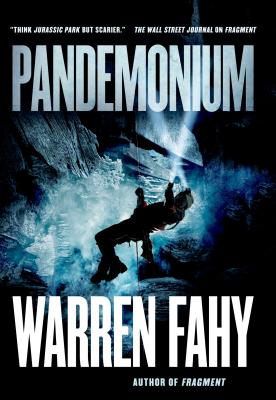
"Ladies and gentlemen, may I present Pandemonium."

by Warren Fahy

UPDATE 3/27/13:  The following review was written on an earlier version of Pandemonium. Having now read the two versions concurrently, I can tell you that there isn't a single page unaltered--but none of the changes are substantive. My review stands. In the time since this was originally published, Fahy has polished the prose to a high gloss. In addition to tightening the language, he's added tiny character moments, comic relief, the occasional great line of dialogue, etc. I'd read the first draft; this is the final. It held up remarkably well to a second reading, and I liked Pandemonium for all the same reasons all over again.

Additionally, I want to mention just how beautiful the design of the hardback novel is. In addition to the shiny foil cover, please know that there are eleven pages of gorgeous illustrations and maps at the back of the book--some of which are pasted below. They're an excellent resource as you read the book. I loved reading this on my Kindle, but I'm thrilled to finally have a copy to place on my bookshelf!

Nearly three two four years ago, I read a debut thriller by an unknown author leading me to ask the immortal question, "Where have you been all my life, Warren Fahy?" And more to the point, where did you go? Happily, Mr. Fahy is at last back with a self-published sequel to Fragment. It would be an understatement to say that my expectations for this book were high. Arguably, too high. Let me cut to the chase and simply tell you: this book is totally AWESOME!

Pandemonium opens just a few months after the events of Fragment. Fahy had left the door wide open for a sequel, and he steps right through it as the desiccated body of Thatcher Redmond washes up on a remote Japanese island, carrying it's deadly cargo of Hender's fauna. (Don't assume you know where this is leading. Fahy is always three steps ahead.)

Across the world, Nell and Geoffrey Binswanger are enjoying their first days of wedded bliss. Since their escape from Henders Island, they—along with colleague Andy Beasley—have been working with the five surviving hendros from the island. These gentle creatures have captured the world's imagination and are well on their way to winning their hearts. But the powers that be aren't sure how much freedom these alien intelligences should be granted. They are currently being held in comfortable isolation, but they are petitioning for full freedom—or at least internet access.

Nell and Geoffrey are shaking up the hendros' comfortable routine by going off on their honeymoon. However, just as they're about to depart for Hawaii, the two are given the proverbial offer they can't refuse. It’s a lucrative working vacation studying an extraordinary unknown ecosystem. Their benefactor is a slightly suspect Russian billionaire by the name of Maxim Dragolovich. And before anyone knows where they’re going, he’s whisked Nell and Geoffrey off to a subterranean world like nothing you’ve imagined in your wildest dreams, a world he calls “Pandemonium.” There, Nell and Geoffrey renew old acquaintances and make new ones, and at first it’s all so magical… I don’t want to tell much more. It’s far too much fun to make each delicious discovery on your own!

There’s a reason why sequels rarely live up to reader expectations. When an author has done his job really well, he’s created a whole new world in a book. No matter how great the second novel is, it simply can’t offer the freshness and originality of the first. Let me tell you why I think Fahy succeeds so well here.

First, he offers more of what he got right in Fragment. This novel moves at an absolutely breathless pace. I read it in a single day, and there was simply no way you could have gotten me to put this book down before I reached the conclusion. Fahy’s bread and butter is creating fantastic creatures, both magnificent and horrifying. He revisits some territory in Pandemonium, but he expands quite satisfactorily on what he’d created previously. His imagination is off the hook! But what I love the most is that everything he creates, from the environment, to the creatures, to the technology (which I’ll get to in a moment), is so thoroughly grounded in real, right-up-to-the-moment, science. It’s smart, it’s fun, and it’s truly a joy to read.

I criticized the character development in Fragment and I’m not going to claim that this is a nuanced character study. In fact, the main villain of this novel is again a bit on the cartoonish side, but this time he’s cartoonish in a good way! He’s definitely a more interesting, more well-rounded character. I don’t know that I learned a great deal more about Nell, Geoffrey, and Andy, but they’re likable characters and fulfill their roles admirably. This novel introduces a child character—always a dicey proposition—but I have to admit I kind of loved her. (Except, Warren, isn’t Sasha a man’s name in Russia?)

He definitely walks the same cuteness tightrope in his depiction of the hendros, or sels, or whatever you want to call them. It would have been so easy for them to become twee, but here again, I think Fahy gets the balance just right. I simply loved them. These characters are a golden opportunity for comic relief, like when they gather around to watch a movie and it’s Jurassic Park, LOL. But these creatures are more than cute comic devices. They’re supposedly possessed of great wisdom, and Fahy manages to illustrate that, such as with Hender’s oft repeated admonition for tolerance, “There is no ‘they.’ Remember? There is only one. And one. And one. No ‘they!’” He’s managed to create alien characters that are, if anything, more intriguing and complex than the human ones. Plus, they have a better grasp of social media than I do.

The latter part of this novel involves a military operation. This is where Fahy brings in the big guns. Literally. The military hardware and technology was just so cool! Here Fahy tapped into my inner child, and apparently my inner child is a 13-year-old boy. Who knew? But I was completely enthralled with the exoskeleton robot (think Avatar) worn by one character, the ROVs named after Dr. Who’s Daleks, and the sheer firepower assembled. As one soldier says, “These species may be more evolved for battle than we are, but we have the technology, folks. I guarantee they’ve never come up against what we’re bringing to the fight.”

So, yeah, there’s a fight. And no one is safe. Fahy may kill off your favorite character in the blink of an eye. He creates tension, jeopardy, adrenaline, and he brings it all home for a most satisfying conclusion. He hasn’t left the obvious open door to a sequel this time around, but there was one question he left unanswered… I can’t stop wondering if it was intentional. I sure hope it was.

The bottom line is this: If you liked the first book, I think you’re going to love this one.

NOTE:  We haven't checked in with Warren Fahy in a while.  Look for a new interview with him in the near future.

Tuesday, March 26, 2013

Extreme weather and extremophiles

Frozen Solid
by James M.Tabor

I thought James M. Tabor’s fiction debut, The Deep Zone, was flawed, but promising. I’m happy to report that his sophomore novel, Frozen Solid, has lived up to that promise. While Mr. Tabor still has room to grow, this second novel was just as much fun as the first, and far better executed.

Frozen Solid again features his protagonist, Hallie Leland. The government microbiologist has been routed up to Antarctica of all places, just days before the winter-over begins. She’s there to fill in for a deceased scientist—an old friend of Hallie’s, as it happens. Once more, Hallie’s unusual skill set (climbing, diving, laboratory research) is a match for a project’s needs. Unfortunately, her brief visit gets off to a terrible start, as more scientists succumb to an unknown ailment. Tensions are running high in a powder keg environment. Meanwhile, Hallie has suspicions about her predecessor’s death and is having problems with the research project. Is someone sabotaging her work? The entire base? And will she be able to fly out in four days, or will she be stuck in Antarctica for months?

Mr. Tabor gets all of his plot elements into position beautifully. I had a few qualms early on in the novel. There was a brief snatch of clichĂ©d and clunky writing. (“I will find you, she vowed. If it takes the rest of my life, I will find you. Wil Bowman will help me. And you will pay.”) And there were some minor plot contrivances. (Some of those clues were awfully easy to find—even when she wasn’t looking for them.) But once the story got going, those early issue fell by the wayside as the novel’s momentum took over. The pacing of the novel was excellent. It moved quickly and was full of excitement. Sometimes the action in thrillers feels like it’s just inserted to keep things moving, but here it all felt organic to the story being told. Let’s face it, Antarctica is an extreme environment, and when you’re diving beneath the ice or staging a colleague’s rescue, it’s exciting stuff.

Plus, there’s Hallie’s area of scientific inquiry. She studies extremophiles—organisms that survive in
extreme environments—like miles below the ice. Or, an organism that “survives in sodium concentrations that would kill anything else.” This isn’t a Crichton novel. It isn’t as chock full of science, but I wish that it was, because what was there was fascinating. Hallie’s a girl after my own heart… “In the end, she found herself asking this question: Who do you trust when you can’t trust anybody? The answer came quickly: Not who. What. And the what was science. You could always trust the science.” I trusted Mr. Tabor’s science here. Sure, it’s speculative as hell, but it has the ring of truth and some research behind it. Plus, it was super cool! That’s good enough for me.

I like Hallie as a character. I really enjoy seeing a strong, confident, competent, and believable woman at the center of an action/adventure series. (“She knew this was how disasters began: with a single failure that led to two others, each of which led to more, a cascade of events feeding upon itself.”) This is a lady that doesn’t wait to be rescued. She rescues herself—and frequently others. There are a couple of other characters from the first novel in supporting roles, but as Hallie is out of her normal environment, most of the cast is new, and they’re a fairly intriguing bunch. I’m quite willing to believe that it’s a quirky crew attracted to work in Antarctica. Obviously, the setting is an important part of the tale, and Tabor’s Antarctica is a bit more oppressive and depressive than most depictions. It is atmospheric, that’s for sure. His settings are evocative and well-drawn—none better than the underwater scenes. (Yes, that was totally my favorite part.)

When all is said and done, I’ve seen variations on the novel’s central plot before, but it was well-handled and getting there was more than half the fun. I feel that my early faith in Mr. Tabor’s growth as a novelist has been well –rewarded, and I shall be looking forward to his next offering with even more anticipation and enthusiasm.

Thursday, March 21, 2013

Not all the leopards are metaphorical...

The Unchangeable Spots of Leopards
by Kristopher Jansma

Look, I won’t claim there aren’t disappointments, but after decades of selecting books for myself, I’ve gotten pretty good at guessing what I’m going to like. And from the first time I heard even the briefest description of The Unchangeable Spots of Leopards, it was high on my must-read list. I mean, seriously, the title alone--somehow it just spoke to me. And I wasn’t disappointed.

But the odd thing is, when I read the jacket copy, the part that I really honed in on was about the rivalry between the two writers. And while certainly that is an element of the novel’s plot (such as it is), that’s not the part that I should have been paying attention to. No, it was phrases like “search for identity,” “web of lies,” and “exploration of the nature of truth and storytelling” that are really at the crux of Kristopher Jansma’s exciting debut novel.

Let’s back up… There have been some fantastic novels that blurred the lines between fact and fiction through a variety of narrative devices. In Life of Pi, Yann Martel opened the novel in direct address to readers, eventually becoming the character of The Writer. And when The Bridges of Madison County was published a few decades ago, so many readers wrote to the National Geographic believing the tale was true that they made a museum exhibit of the correspondence. I digress, but the opening of The Unchangeable Spots of Leopards brought these examples to mind, because the first page after the table of contents says this: “If you believe that you are the author of this book, please contact Haslett & Grouse Publishers (New York, New York) at your first convenience."

Interesting. We move on, but that opening note is never quite forgotten.

And this tale begins, again, in direct address to readers in the form of an author’s note. It launches, “I’ve lost every book I’ve ever written.” And the narrator tells the tale of that first loss. You will learn of others along the way. The last line, incidentally, of that author’s note is this: “These stories all are true, but only somewhere else.” And this coming after not one, not two, but three separate epigraphs on the nature of truth. Interesting.

The novel’s first-person narrator seems earnest enough, but be prepared for sleight of hand—or whatever the literary equivalent might be. The storytelling here is unconventional, it’s meta-fictional, it’s challenging, it’s non-linear, it’s literary, and, oh yes, it is always interesting. Jansma’s characters are… Well, to be honest, they’re not all that likable when you get right down to it, but they’re well-drawn enough for familiarity to breed contempt. (And in the scheme of unlikable characters, these ones are not so unpleasant as to put you off from following their journey.) You’ll note that I did not describe them as “believable,” because there’s a heightened quality about the trio at the center of the tale, and the circumstances they find themselves in, as they chase and/or flee each other around the globe. Jansma isn’t trying to replicate reality. There is artifice throughout, and it’s very intentional.

His writing is fantastic! It’s read-aloud, eminently quotable, just a pleasure to absorb. Everything about this novel is stylish, stylized, and sophisticated. It’s also very funny. It’s gonzo, romantic, clever, and the sort of book to remind readers and writers both why they do what they do. In short, this is an exhilarating debut novel. My instincts were right on this time. Score one for me.

Tuesday, March 19, 2013

I can picture it on the big screen...

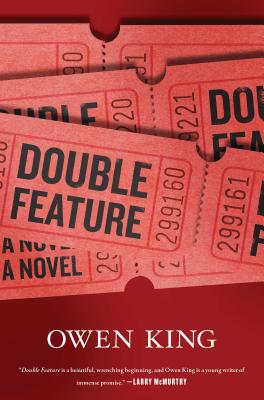
Double Feature
by Owen King

I’m nothing so pretentious as a cinephile; I’m a movie-lover. So, I think, is debut novelist Owen King. But the young protagonist of Double Feature, Sam Dolan, is very much a cinephile and a freshly-minted graduate of film school. As the non-linear narrative opens, Sam is about to start filming the script that was his college thesis. The first third of the novel involves the shooting of this low-budget, indie feature film and the aftermath of that film’s creation. It affects Sam’s life in long-lasting and unexpected ways. Beyond this, Double Feature is about Sam’s complicated relationship with his father, Booth, a deeply flawed and aging B-movie actor. One passage:
“The story was undoubtedly an exaggeration if not an outright fabrication. Booth had been in the business of cheap entertainment for so long that he had gone native. In his telling, everything was a sensation, a shock, a crisis, a betrayal, amazing bad luck, or an unforeseeable confluence. When Sam was younger, his father had let him down. Now that Sam was older, his earlier self’s stupidity mortified him: how could he have expected anything else from a man who relished any opportunity to tell strangers that his infant son looked like a leper? Booth’s fallaciousness was right there all the time, as inherent as the nose on his face.”
It’s bold—Bold I say!—when you’re Stephen King’s son, to publish a debut about a young artist with major daddy issues. Readers tend to read into these things. But I can’t honestly say that I believe Mr. King is working through any issues of his own. Still, he may have some insights into being the child of a celebrity that most of us don’t.

I mentioned above that the novel is non-linear. It moves in time from the opening when Sam is in his early-twenties, back to his parents’ courtship decades earlier, forward to the altered life of Sam’s early thirties, and many points in between. I’m a big fan of this type of story-telling when it’s done right. It’s an interesting way to make revelations, often with answers coming before questions are even asked. Mr. King did manage this device well, for instance, eventually supplying the additional information on Sam’s mother that as a reader I actively craved.

As you can see from the quote above, his use of language is sophisticated. This is not the type of macabre commercial fiction that his father and brother trade in. This is a satirical dramedy, and yes, it’s definitely funny, though not generally in a laugh-out-loud way. Both the characters and the events of the novel have a heightened quality about them, not exactly mirroring real-life, but intentionally so. King has created a fantastic and entertaining assortment of supporting characters. This is one case, however, where I don’t feel that the novel’s jacket copy does them justice or really describes the story accurately. What can you say? No one wants to be guilty of spoilers.

Double Feature is an accomplished debut, but I do have a few criticisms. I felt that both the novel’s beginning and ending were especially strong, but things slumped a bit in the tale’s middle. Further, there are plot developments that occur that are so unbelievably obvious to the reader that it’s hard to credit that Sam can’t see the big picture as easily as we can. It’s true that when you’re living in the moment, these things generally aren’t as obvious, but it still stretched my credulity.

That said, the novel’s plotting was especially impressive. King juggles quite a few literary threads and manages to bring his story full circle in a notably satisfying manner. It’s truly difficult not to develop affection for this loony cast of characters. And one more treat… Do you stay to the very end of films’ credits like I do? Sometimes there’s an “Easter egg” at the very end. This may be the first time I’ve seen a literary Easter egg after a novel’s acknowledgements, but it’s awesome. It’s the perfect way to end this tribute to the magic of movies.

Thursday, March 14, 2013

“For the moment, then, let’s allow our imaginations free reign.”

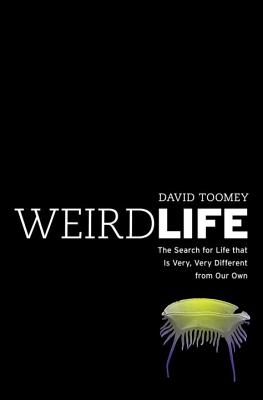
Weird Life: The Search for Life That Is Very, Very Different From Our Own
by David Toomey

Look, I’m as geeky as the next girl. How can you hear the subject matter of this book and not be fascinated? David Toomey opens Weird Life exactly where I would expect—with extremophiles. Extremophiles are some of the most unusual and extraordinary creatures in all of biology. Which makes sense, because life = biology. Right?

That’s what I thought, but clearly that’s due to a massive failure of imagination on my part. One the most impressive things about Toomey’s book are the sheer breadth, depth, and scope of what is covered. Toomey starts with biology—microbiology, exobiology, marine biology, synthetic biology, molecular biology, astrobiology, evolutionary biology. That, friends, is the mere tip of the iceberg. Toomey touches on disciplines and theories including: organic chemistry, inorganic chemistry, interstellar chemistry, molecular chemistry, biochemistry, nuclear chemistry, geology, genetics, robotics, computer science, mathematics, theoretical physics, particle physics, quantum physics, astrophysics, string theory, nanotechnology, multiverses, astrology, botany, taxonomy, engineering, ecology, epistemology, psychology, and philosophy. If that’s not enough, there’s even a chapter on weird life in science fiction! This book is thorough, that’s all I’m saying. There’s a reason for this:
“The attentive reader may have noticed that ideas for the weirdest sorts of weird life did not originate with biologists or even, for that matter, with astrobiologists. They came from scholars and practitioners in other fields. The hypotheses of life in other universes were formulated by theoretical physicists (Harnik, Kribs, and Perez; and Jaffe, Jenkins, and Kimchi). Ideas of life in the vicinity of black holes and the atmospheres of white dwarf stars were conceived by astrophysicists (Adams and Laughlin). Hypotheses of life surviving through eternity were developed by a mathematician and theoretical physicist (Dyson), who also supplied us with what may be the broadest definition of life so far. Of the many ideas of weird organisms from science fiction, two that are notably well grounded in science are from a physicist turned aerospace engineer (Forward) and from a professional astronomer (Hoyle). Even the relatively conservative hypothesis of hydrogen-breathing dirigibles was proposed by a physicist (Saltpeter) and a planetary scientist turned astrobiologist (Sagan).”
So… there’s some smart stuff in this book. Do not be intimidated! I’m incredibly uneducated, and I had no difficulty reading Weird Life from cover to cover. My mind was occasionally blown—but always in a good way. And if you need a little reminder on the difference between a mesophile and a methanogen, please be aware that there’s a glossary at the back of the book between the text and the endnotes, but before the very thorough bibliography.

This book covers science that is being done right up to the minute. At least three times a variation on the phrase “as we go to press” was used. This science is emergent and so very, very fascinating. Here’s a good example, arising from our lack of understanding of what comets are made of:
“Being mostly solid bodies, comets resist interferometry. In 2003, it occurred to Allamandola and his colleague Doug Hudgins that there was another way. If they could make a comet from scratch, they could study it. They took a sample chamber called a “cosmic ice simulation chamber,” removed most of its atmosphere, and froze what was left to a temperature near absolute zero, thus making the inside of the chamber a fair representation of deep space. They introduced into the chamber a few simple molecules that might be found in a star’s outflow, and turned on a lamp (representing nearby stars) that bathed the molecules in ultraviolet radiation. Then they waited. They were not expecting much, and they were certainly not expecting what happened. The molecules combined, split, and recombined, and before long the chamber contained some very complex molecules, many of which were prebiotic.”
Is your mind blown? Maybe it’s just me. But I couldn’t put this book down. My only minor disappointment is that there weren’t more photos and illustrations, but I guess it’s hard to fault an author for not including images of hypothetical things that may or may not exist. Toomey did pretty well, all things considered.

Life, in all its colors and flavors, is amazing. Mr. Toomey has reminded me of that fact. This was the most enjoyable science book I have read in quite a few years. My mind and ideas have been expanded, quite painlessly. So let’s, as Mr. Toomey suggests, allow our imaginations free reign.

Monday, March 11, 2013

The rocky road to redemption

A Thousand Pardons
by Jonathan Dee

As Jonathan Dee’s latest novel opens, readers get to witness suburban New Yorkers Ben and Helen Armstead give up the ghost on couples counseling. Their marriage is at an impasse when successful lawyer Ben goes off the rails. Staggeringly bad judgment causes both his marriage and his career to implode. His very freedom is jeopardized. And now forty-something housewife Helen must care for their adolescent daughter and find a new path for their lives.

In a somewhat unrealistic turn of events, Helen finds her professional calling. The thing is, realism isn’t everything. I was willing to give Dee a pass on some of the finer plot points, because I was entertained and invested in the tale being told. Husband Ben, stays on the periphery of the narrative, but there’s a third character, a childhood friend of Helen’s who has achieved great fame. This reader was just waiting for him to make an appearance, and of course, eventually he did—though not, perhaps, exactly as I expected him to.

This was my first experience reading Mr. Dee, but I certainly heard the buzz on his last novel, The Privileges, and am aware of his literary reputation. Therefore, I think I was a bit surprised by the simplicity of this novel. The prose is highly readable, but neither remarkable nor overly ornate. Characters were well-drawn and sympathetic (surprisingly so in many cases), but it’s a fairly brief redemption tale being told. It’s just not that deep. I point this out not as a fault; it simply is what it is. And A Thousand Pardons succeeds quite well on that level. This was a quick, entertaining read that I enjoyed more for the story being told than anything else. It moved more quickly and I read the book in no time flat.

I would offer one caveat: Readers who need to have all narrative threads tied up neatly in a bow may feel some frustration with the novel’s ending. I, myself, have no objection to a few loose ends. They leave me with food for thought. Still, this novel’s ending did give me pause. It sort of snuck up on me. I read it, thought, “I don’t know about that,” and read it again. And upon second reading I decided that it was all good. This was an enjoyable and overdue introduction to an author on the ascent.

Monday, March 4, 2013

Reassessing the Short Form

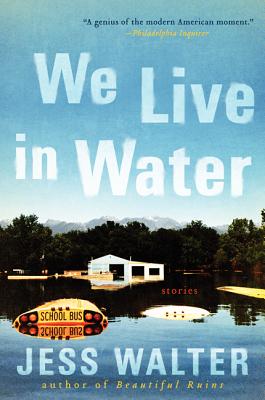
We Live in Water
by Jess Walter

It wasn’t that long ago that any publisher would have told you that “story collections don’t sell.” These days, however, they’re all the rage. If asked, I would proclaim, “I’m not into short-form.” And yet, I’ve read three excellent collections within the past month. I am being forced to reassess my attitudes because there is a lot of exciting short fiction being produced these days!

Jess Walter’s debut collection, We Live in Water, is literally overflowing with story. The first several tales in the collection deal with parent/child relationships. Do I detect a motif? But then there were tales of male/female relationships, and then tales of crime and punishment. Eventually some themes did emerge, and if there is one commonality to be found throughout these stories, I believe it to be the question of honor. Walter explores this concept from a variety of angles and approaches.

Most of the tales within this collection are fairly realistic. The one exception is “Don’t Eat Cat.” I’m trying to think of how to describe it. It’s speculative and satirical, moving and poignant, all at once. It was one of my favorite stories in the collection, but as I made my way through the baker’s dozen tales, I proclaimed several to be my favorite for a time. The first was the title story, “We Live in Water.” The reader comprehends the significance of the title at the same time as the central character does. It’s a beautiful revelation.

A few of these stories seem to reside in the same Walterverse. The characters and settings of “Can of Corn” overlap with those of “The Brakes.” Less obviously, is the Mr. McAdam referenced in “Thief” (another favorite) he same Mr. McAdam who shows up later in “The Wolf and the Wild”? I guess it’s not surprising there would be some overlap. Most of these tales stick pretty close to Walter’s home territory of Spokane, Washington. His characters have challenges and fallibilities. They are flawed and funny at once. They are at all times believable.

I believe different story writers have different strengths. Some you read for their beautiful language. Others offer extraordinary insight into character. Mr. Walter is fine on both counts, but that’s not where he really shines. The greatest satisfaction of this collection is the completeness of the stories that he is telling. They have a beginning, a middle, and an end. They were unusually well-structured and well-plotted, regardless of length. They did not leaving me hungering for the rest of the tale. Simply put, Mr. Walter knows how to tell one hell of a good yarn.

Monday, February 25, 2013

Patient readers will be rewarded

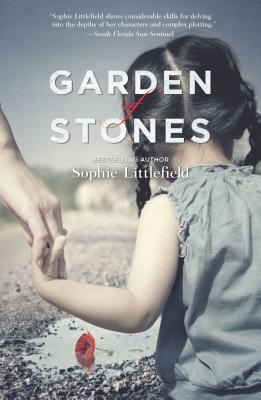
Garden of Stones
by Sophie Littlefield

Sophie Littlefield’s latest novel, Garden of Stones, opens in San Francisco in 1978. The first chapter anticipates the murder of an old man. The second chapter introduces Patty Takeda and her mother Lucy. Patty, visiting her mother in the days leading up to her (Patty’s) wedding, wakes to find Lucy having an early morning chat with a police inspector. Lucy is being questioned because she knew the victim decades prior, and neighborhood residents placed her at the scene. With her horrible facial scaring, she’s hard to miss. The third chapter is where the novel’s structure becomes apparent. It flashes us back to the Los Angeles of 1941.

Having just met the caustic older Lucy, we are now introduced to the stunningly beautiful adolescent version. This privileged young girl is about to suffer a series of blows leading up to the United States’ entry into the war. Her Japanese heritage is suddenly a huge liability. From there, the novel moves back and forth in time between the events of 1978 and those in the 1940’s—with the bulk of the tale occurring in the past. Lucy is sent to the Manzanar internment camp, along with her family, friends, and neighbors. It is events that occurred at Manzanar that directly cultivated the woman Lucy was to become—and perhaps to the murder that has occurred.

Now, I have been a fan of Ms. Littlefield’s for years, and I love the sheer breadth and depth of what she writes from comic mysteries to zombie apocalypses. The set-up above seems like another mystery, but truthfully, it’s more of a historic drama. The subject of Japanese internment strikes close to home to me—literally—having spent the past decade living a block from San Francisco’s Japantown. My neighborhood was greatly impacted by this shameful period of California’s history. I think fiction can be a powerful medium for evoking history. Through fiction, stories live on and are humanized.

I also think that a lot of research went into this novel, and yet I felt somewhat frustrated by viewing this history through the eyes of an unsophisticated teenage girl. Those flashback sections of the novel had something of a YA feel about them. Now, I have nothing against young adult fiction—I read a ton of it—but here I was hungering for a little more…detail …maturity … substance. That would be my complaint.

That said, I found myself very caught up in the story of these characters. Littlefield writes, “It was as if her mother had once been an entirely different person, and Patty faulted herself for never having seen far enough into her depths, for not being curious enough to coax out the story until now.” Lucy Takeda lived an extraordinary life in a period of great historic significance. As events led up to what felt like a climax, I realized that I was only at the center of the tale. As Lucy matured, I became more and more invested in her story. The frustration I’d felt earlier in the novel disappeared. Character development has always been Ms. Littlefield’s strength, and that is again the case here. Still, by the time I’d reached the novel’s end, she managed to truly surprise me with a couple of unexpected plot twists. One, in particular, was really cleverly done.

Ultimately, the murder that opens this novel is little more than a framing device, but as such it works well. Garden of Stones is a great choice for readers interested in mother-daughter relationships, or who are simply looking for a great story set against a historic backdrop. While it took me a little while to become fully invested in the tale, the deeper I read, the more I enjoyed this novel.

Thursday, February 21, 2013

“I know it sounds crazy.”

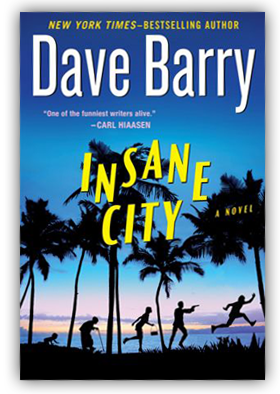
Insane City
by Dave Barry

I’ve been a fan of Mr. Barry’s for decades. He has elicited from me embarrassing snorts of laughter on too many occasions to count. Therefore, and new novel is always an occasion to be looked forward to.

The insane city of the novel’s title is Miami, Florida, soon to be the site of the Weinstein-Clark wedding. At the heart of the tale is groom Seth Weinstein, and the novel’s first few chapters could be the opening of The Hangover III. It’s bachelor party night, and while amusing, I did think to myself, “If this is 300 pages of Boys Behaving Badly, I’m not sure I can take it.” Happily, that is not the case. Well, there is a lot of bad behavior from boys, girls, and, uh, various other creatures, but the bachelor hijinks soon pave the way for a far more absurd and entertaining tale. It’s goofy as all get out, but has both substance and heart at its very core. I could try to summarize the novel’s plot, but I think it would be a lot more fun to share a few brief quotes:
“This isn’t what it looks like.”

“So, you’re not bleeding from the head and hanging out with a BeyoncĂ© look-alike and a Jerry Springer bouncer carrying a large snake?”

“He had to stop being an idiot.”

“Wait, he shot a Jet Ski? Even in Miami, that has to be against the law.”

“I know it sounds crazy.”

“Eventually these people decided that this was just another one of those strange things that seem to happen in Miami.”

“Nothing I hate more than an orangutan shooter.”

“If you’re just joining us this morning, we’re following one of those weird stories that makes you shake your head and say, ‘Only in Miami.’”

“It’s complicated.”

“Even by Miami standards, this was a weird group making its way through the Bayside crowd.”

“Any man fleeing from the police with three women, two children, and an orangutan is a friend of mine.”
Oh, yes, it’s novels like this that make me wonder why I’m considering relocating to Miami. Dave Barry can still make me laugh out loud after all these years. And while no one will ever mistake his work for literary fiction, he did once win a Pulitzer Prize for Commentary. He knows how to write a proper sentence. Furthermore, he did a nice job of creating characters who, over the course of the novel, manage to reveal their true natures.

Don’t come to this one looking for sophistication or subtlety, but if you’ve had a bad day and are seeking a little screwball comedy, look no further. Insane City is guaranteed to lift your spirits.

Tuesday, February 19, 2013

“Extinction is the rule. Survival is the exception.”—Carl Sagan

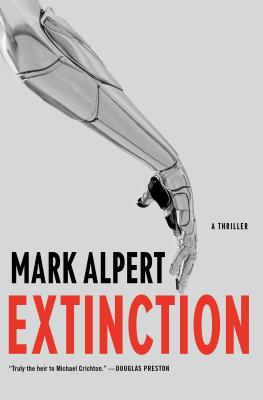
Extinction
by Mark Alpert

Every time a writer is compared to the late, great Michael Crichton, my heart skips a happy beat. I don’t think his large shoes will be filled any time soon, but I am delighted to see other writers trodding the same territory. Mark Alpert is a natural for these comparisons. With a degree in astrophysics and more than a decade on the editorial staff of Scientific American magazine, the man knows his science. Extinction is his third foray into the word of fiction.

After a brief prologue, readers are introduced to former soldier Jim Pierce. Himself an amputee, Jim has turned his engineering know-how to the world of high-tech prosthetics. In the novel’s opening scene, he’s having a consultation with a young soldier, explaining to the wounded man just how advanced these devices have become. The prosthetics Jim builds (and wears) are like something out of a James Bond film, and controlled wirelessly by the user’s brain—just like a natural body part.

Shortly after he leaves Jim’s workroom, an unexpected visitor arrives asking questions about Jim’s estranged, 22-year-old daughter, Layla. The visitor claims to be from the military, but that story quickly breaks down into threats and violence. Jim is more than an ex-soldier, he’s a former intelligence officer, and he knows a Chinese spook when he sees one. What the hell has his daughter gotten herself into?

Alpert’s tale is not a simple high-concept plot that can be summarized in a few sentences or even paragraphs. I suspect I should quit this synopsis while I’m ahead. Extinction deals with a variety of technologies involving machine-brain interfaces. Some are as innocuous as bionic limbs and eye glasses that function as eyes for the blind. Other technologies lead to the threat at the heart of this novel—a dangerous new artificial intelligence, a sort of human-machine hybrid that wants to rid the world of the vast majority of those pesky human components. It is this borg-like entity that may well pull the trigger on our extinction. And Jim Pierce and his daughter somehow get sucked into this high-stakes drama. I’ll leave it to you to uncover the details.

It is unsurprising that Mr. Alpert is at his best when delving into the science that is integral to the novel’s plot. Says one character:
“Just think of it! We won’t be tied to these fragile bodies anymore! If we can store a person’s memories in a sufficiently powerful processor, we can program it to generate new thoughts based on those memories. For all intents and purposes, the intelligence inside the processor would be identical to the one inside the person’s brain. And this will become possible very soon, within the next few decades. There are people alive today who will never die!”
An author’s note at the novel’s end gives readers a better idea of what is fact and what is fiction. It’s surprisingly difficult to figure out in this day-after-tomorrow-set tale. The science in this book is smart, fascinating, and has a really high gee-whiz quotient. Alpert delves enthusiastically into several different disciplines. It’s exactly what I want to see in this type of thriller. Further, Mr. Alpert has fashioned a fun, fast plot in which to imbed all that science. Yes, it is somewhat formulaic, but aren’t they all?

Mark Alpert brings a heap of knowledge to his fiction, and he’s great at explaining complex ideas and building a plot around them. However, it’s the actual mechanics of writing fiction where he’s weakest. This is most apparent near the novel’s opening. Some of the early exposition was truly graceless. Nor will he win any awards for the elegance of his prose. It’s serviceable, but nothing more. And, yes, there were a few plot contrivances. Alpert does better with his action sequences. They really propel the narrative in the second half of the novel. Character development is a mixed bag. A description of how Layla experiences music, for example, was a great insight into how she experiences the world. It was a lovely detail.

Most readers of techno-thrillers aren’t concerned about a little clumsy exposition. Most are looking for some smart, speculative science buried in a propulsive plot. They’re looking for a glimpse of that old Crichton magic. And they just might find it in Extinction.