Tuesday, June 26, 2012

Sigma's going to the dogs

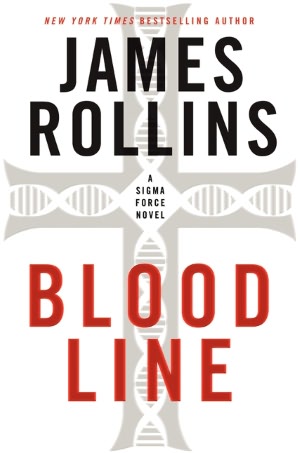
Bloodline
by James Rollins

After a brief prologue, James Rollins’ latest Sigma Force thriller picks up shortly after where last year’s superlative The Devil Colony left off.  Commander Gray Pierce is dealing with the fallout of his mother’s murder, and the team is ready to exact vengeance against the Guild. (Now, those first two sentences should tell readers something.  While I certainly think that there is enjoyment to be had reading Bloodline as a stand-alone, this installment of the series is very much built upon what’s come before, both in terms of plot and character arcs.  In a perfect world, I’d recommend reading this after reading the other books in the series, or at the very least The Devil Colony.)  Early in the book, the enigmatic double-agent Seichan shows up unexpectedly:


“‘There’s been a kidnapping off the Seychelles by Somali pirates.  A high-value American target.  Painter wanted to know if you were up for a mission.’  Gray frowned.  Why was Sigma involved with a simple kidnapping?  There were plenty of policing and maritime agencies that could attend to such a crime.  Sigma Force—made up of Special Forces soldiers who had been retrained in various scientific disciplines—was a covert wing for DARPA, the Defense Advanced Research Projects Agency.  Sigma teams were sent out into the world to protect against global threats, not to address the kidnapping of a single American.”

Well, there’s high-value, and then there’s HIGH-VALUE.  And this kidnapping victim is the latter.  And wouldn’t you know, this crime eventually leads back to the Guild.  This is the book Mr. Rollins has been promising readers.  It is the ultimate showdown between these two organizations.  And, yes, Sigma is called upon to fulfill the mission stated above.  The Guild’s plot goes well beyond kidnapping, but I shall decline to elucidate further.  What I will do, instead, is highlight some of the strengths and weaknesses of the book.

STRENGTHS:

 
·         Seichan tells Gray, “We’ve been ordered to pick up another two teammates, local assets already in the region, with unique skills to help us on this mission.”  Those who read Rollins’ recently published e-short, Tracker, have already guessed that I’m referring to retired Army war dog, Kane, and his handler, Tucker.  These two are the freshest thing to hit Sigma in quite some time!  First, they’re just great characters.  Former-veterinarian Rollins does a bang-up job writing from a dogs-eye view.  These war dogs are unbelievably skilled.  What they can do, and how they work with their human, is flat-out fascinating.  Are you a fan of Dean Koontz’s Watchers?  You are going to LOVE Kane!

·         I think Rollins’ greatest strength is the integration of really smart, completely fascinating, and scarily plausible science into his plots.  I have never failed to learn something within his pages.  This novel deals with genetics, robotics, and the quest for immortality.  At one point, the mad scientist is giving an epic lecture on how men can live indefinitely, and I’m thinking of a huge scientific impediment to that idea.  I’m about to proclaim it all BOGUS.  Well, almost as if he had read my mind, Rollins addressed my objection.  Is it plausible?  I don’t know.  But it sure sounds legit.  I proclaim it NOT BOGUS.

·         Rollins lets some recently underutilized characters shine in this novel, none more so than Kat Bryant, Sigma’s second in command.  She’s out in the field for the first time in a long time, and this lady knows how to kick some ass.  I’ll never look at her the same way again.  Bloodline is very much an ensemble piece, with everyone getting some face time, and it is stronger for it.

·         Which reminds me… Way to write those strong female protagonists, Mr. Rollins!  This has always been a strength, and it continues to impress.

·         Kowalski.  Kowalski is so awesome in his Kowalskiness.  Who else, after watching Kane’s amazing, life-saving performance under fire, would sum everything up with, “I got to get me one of those dogs”?  He’s always good for comic relief, but Mr. Rollins shows great restraint in not making this character too over the top, or of over-utilizing him.

·         As always, Rollins leaves readers with a fascinating author’s note about fact versus fiction.  This time around he even includes links to video.

Now, die-hard fan that I am, it makes sense that I see more strengths than weaknesses, but as always, I do have some quibbles.

WEAKNESSES:

·         For the last few books, Rollins has been trying (successfully) to humanize Seichan, and to reveal more of her background.  That is very much the case here, but for me, personally, things were getting a little too… sentimental.  You may judge for yourself.

·         Also, I don’t need to hear any more about the “inexplicable bond between dog and handler, tying them together by something deeper than just hand signals and spoken commands.”  I LOVED seeing the two in action, and Rollins didn’t belabor the point, but any time their “bond” was referenced, I just wanted to roll my eyes. Clearly, I am a horrible person.

·         Maybe it’s because I’m a Washingtonian, or because I was obsessed with The West Wing, but I found certain elements of the Presidential/White House subplot of the novel strained even my generous suspension of disbelief.

Okay, sorry to prattle on, but there’s always so much to talk about with these books!  Despite my penchant for criticism, when you get right down to it, James Rollins is at the top of my favorite authors list.  As always, he leaves me anxiously awaiting his next installment.

Note: The video below tells far more about the novel's plot than my review does, though obviously the author and publisher aren't giving out significant spoilers.  Also, secret inside scoop, the retriever walking with Jim is his loyal companion, Penny.  I was at his house the day Penny arrived, a sickly, skinny little puppy, many years ago now.  The shepard-looking dog is the same breed as Kane in the novel, and was recently adopted by one of Jim's sisters.  Now you know more than anyone else watching the video, LOL.


Wednesday, May 30, 2012

Madeline Miller at the Gaithersburg Book Festival


Part 4 in my continuing adventures at the Gaithersburg Book Fest:

Okay, I'm going out of order because, in fact, Madeline Miller was the second to last author I saw at the book fest--but she deserves to jump to the head of the pack.  Ms. Miller has just won the Orange Prize for her debut novel, The Song of Achilles!  For those who don't know, the Orange Prize "celebrates excellence,  originality and accessibility in women's writing from throughout the world."  Congratulations, Madeline! 
I've actually had a galley of The Song of Achilles staring at me since last October.  I've been wanting to read it, and intimidated at the same time.  (I really need to read the book.)  Consequently, I was very interested in hearing the lady speak.  In her opening remarks, posted above, I learned that she's a school teacher, so perhaps that explains her comfort in front of an audience.

Now, I have to apologize for the video being a bit dark.  I was shooting in the ambient light under a tent, and by that point in the late afternoon it was cool and shady, with the sun backlighting the speaker.  Nonetheless, it's not too bad.  Below is a brief (3 minute) reading from the novel, and you'll see that Ms. Miller is an exceptionally talented reader.  She has background in the theater and it shows.


Alas, my little FlipCam holds only 2 hours of footage.  I was erasing earlier authors just to film what I was able to get.  Below is the very beginning of her Q & A session.  Gosh, I wish I could have recorded it all, because it was very interesting.  I filmed until I ran out of "tape."  Enjoy! And congratulations again to Ms. Miller on this huge honor, the first of what will surely be an impressive career.


Sunday, May 27, 2012

Diana Abu-Jaber at the Gaithersburg Book Festival


Part 3 of my adventures at the Gaithersburg Book Festival:

If there was one author I was most excited to see at the Book Fest, it was probably Diana Abu-Jaber.  I've been a fan of this literary novelist/memoirist/thriller writer ever since I read her novel Crescent many years ago.  It's a real favorite, in part due to its depiction of the full richness of Arab (and Arab-American) culture, as well as romance, drama, suspense, comedy, tragedy--but I digress.  And I've never had the opportunity to hear her speak before.

Therefore, it was shameful that I missed her opening remarks, but there was socializing to be done.  After Ali (AKA novelist Allison Leotta) and I had chatted with Keith Donohue briefly, she introduced me to novelists Rebecca Coleman, who appeared to be out enjoying the day as we were, and Alma Katsu, who I'd met briefly at Thrillerfest and who was one of the speakers at the festival.  We were both, in turn, introduced to Eleanor Brown, who is apparently connected to the area via her parents who are local.  Anyway, all three ladies were lovely and we were still chatting away as Diana began to speak. 

Eventually, I excused myself, and joined the talk in progress in time to record Diana reading an excerpt from her most recent novel, Birds of Paradise.  What a surprise, I loved this novel!  My review may be read here.  In any case, it is that reading that is the video at the very top of this post. 

Below, are two videos of the Q & A session she did after the reading.


A note on the video.  Yeah, I know my shooting sucks.  It was very hand-held.  And most of the time I'm reasonably steady, but if there's big movement, it's a good bet that superstar puppy Maggie may have had a hand in it.  Between getting tangled in leashes and having her start eating my hair at one point, well, it can be a distraction.  But a very, very cute and forgivable one.  I'm so sorry I didn't snap a pic of her for you.


After Diana Abu-Jaber, Ali and I were supposed to head over to another tent where Eleanor was going to be having a conversation with writers Jen Lancaster and Sarah Pekkanen, but first I asked Ali if we could stop by Diana's signing line so that I could meet her.  Ali was so sweet about following along wherever I wanted to go, so we waited in line for several minutes, but it was worth it.  Diana was as nice as could be!  I think it was obvious that I'm a real fan and long-time reader.  I asked her about the Miami literary scene, because I'm considering relocating there, and she was like, "It's great!  Come on down!"  A very genuine and really lovely lady.  I'm so pleased to have finally met her; I'm just sorry that all my first-edition hardbacks are packed away.  Hopefully, there will be an opportunity to get them signed at a future event. 

Afterwards, Ali and I did go over to where Eleanor was interviewing Jen and Sarah, but the tent was packed.  After standing in the hot sun for a while, Ali was like, "Let's go back to our cool tent."  It was sort of good news/bad news in the land of literary fiction.  It was never hard to get a seat, but there wasn't the audience there was for some of the other festival offerings.  In any case, it was about time for Alma to begin speaking, and that will be the next post...

Saturday, May 26, 2012

Keith Donohue at the Gaithersburg Book Festival


Part 2 of my adventures at the Gaithersburg Book Festival:

After getting her kids and hubbie settled in the children's village, Ali (AKA, novelist Allison Leotta) and I walked across the City Hall grounds in time to hear novelist Keith Donohue speak. Despite his novels being prominently displayed on my bookshelves, I have not read him yet. I've always wanted to, but you know how it is. So many books, so little time. Soon, Keith! But it was terrific to have a chance to hear him speak and read.

At the top of this post, you'll see video of Keith's opening remarks to the audience, before he began reading from his most recent novel, Centuries of June.  (Incidentally, he starts by referencing Eleanor Brown, who had introduced him.  Ms. Brown is the author of the delightful The Weird Sisters, which I reviewed here.)

The first video clip ends right as Keith was about to read the opening pages of his novel.  I have to confess that I did film him reading for about 12 minutes, but the little FlipCam I use is a very limited tool.  The biggest problem is that it has no ability to focus.  Second biggest is that it only  holds two hours of video.  Ultimately, I deleted the first reading in order to film more authors later in the day.  Consequently, we skip the first reading and head directly into the Q & A:


As you can see, the first Q & A segement leads into another brief reading, which can be seen below:


And here is the final Q & A segment:


Ali and I chatted briefly with Keith after his presentation, and he was very friendly. I kept running into him all day after that and we kibitzed briefly each time. It was nice to see authors sticking around beyond their narrow time-slot and attending their colleague's presentations.  I saw this over and over all day.  And there were other writers in the audience--ones who weren't speaking or signing at the festival--like Ali who was there hanging out with me.  Case in point, sitting in the row in front of us was novelist Rebecca Coleman, but more on her in the next post...

Friday, May 25, 2012

Who'd a thunk it? Gaithersburg has a rockin' Book Festival!


Last Saturday, I had the great pleasure of attending the Gaithersburg Book Festival.  I'm not kidding about it being a great pleasure!  A little background...  I spent my teen years in Gaithersburg, Maryland.  I call DC my hometown, and it is, but Gaithersburg is the place I most associate with growing up.  It's the place I remember best; it was where I spent my high school years.  And, relatively speaking, it's a fairly sleepy little burg. 

So imagine my surprise upon, after returning home for an extended visit, discovering that little ol' Gaithersburg has grown a world class literary festival--and after only three years!  I'd never even heard about it in the prior two years, but now like the National Book Festival in DC, it's on my radar, and is enough of an event to merit a visit home in years to come. 

Gaithersburg Council Member Jud Ashman
I actually got the whole back story late in the day when I ran into Gaithersburg Council Member Jud Ashman, who founded the festival.  I didn't so much "run into him" as go up to him and introduce myself.  I knew who he was, and wanted to congratulate him on a hugely successful event.  I expected him to be too busy or too important or too whatever, but it turned out that he was a super friendly guy (politician, go figure) and we had a really lovely chat.  He explained to me that in 2008, as the Bushes were leaving office, the future of the National Book Festival was in doubt.  Per the Librarian of Congress, there was no guarantee that the Obama administration would fund it.  (Because that Obama isn't nearly the book-lover that George Bush was.  *rolls eyes*)  Anyway, when Ashman heard about this, he feared that the region would have no book festival at all, and it was then he thought of bringing a festival to G'burg. 

It's a modest enough idea for a modest town, but I'm fairly overwhelmed with the execution.  I don't know what the first two years were like, but this year boasted over 110 authors, some local, some flying in from all over.  Among them were celebrities, #1 bestselling authors, and writers of every stripe.  In addition to the many talks, interviews, and panel discussions taking place all day, there were many interesting exhibitors, writing workshops, and a truly magical "children's village."  I know this because I spent part of my day with children, and man did they have a good time!

I spent the day in the company of my friend, novelist Allison Leotta, and her lovely family--including six-month-old beagle mix, Maggie.  Let me tell you, if there was one star of the day, it was that puppy!  Ali's husband took the kids for the better part of the day, and we took the puppy.  Everywhere we went we were stopped by friendly dog-lovers.  Everyone at the festival was so friendly, attendees and authors--several of whom with which I had really lovely interactions.  It was a great day for community.

There's much more to tell, but happily, I brought my little FlipCam with me, so all weekend I'll be posting about the authors I saw, augmented by some admittedly shaky hand-held video.  It is, as they say, better than nothing.  For now, rest assured the next year's festival on May 18, 2013 is already on my calendar.  And Mr. Ashman envisions a future when the city supports a multi-day festival.  I'm so there!

Wednesday, May 23, 2012

A powerhouse opening to a dazzling work of fiction

Canada
by Richard Ford

Every review of Canada is going to begin the same way, with the stunning opening sentences of the novel.  “First I’ll tell you about the robbery our parents committed.  Then about the murders, which happened later.  The robbery is the more important part, since it served to set my and my sister’s lives on the courses they eventually followed." That’s a bit more sensational than the average start of a serious literary work, but it telegraphs so much of what is to come.  In fact, I’ll give you a run-down of what those opening sentences illustrate:

·         This novel is told from the point of view of a first-person narrator who speaks with a simple, clear voice. 
·         Despite the author’s Pulitzer Prize-winning pedigree, this is a plot-driven novel bordering on a literary thriller.
·         This is a coming-of-age tale.
·         This novel is being told in reflection from some point in the future.

That’s a fair amount of info to glean from three sentences!

The novel’s narrator is 15-year-old Dell Parsons, one half of a set of fraternal twins.  The other half is his sister, Berner, older by six minutes and always the more worldly of the two.  The novel opens in the summer of 1960, and the family of four (with father, Bev and mother, Neeva) is living in Great Falls, Montana.  The kids have had a fairly rootless upbringing, due to Bev’s Air Force career and a lack of extended family connections. 

Dell relates the family history, beginning with his parents’ courtship and ill-advised marriage.  “…they were no doubt simply wrong for each other and should never have married or done any of it, should’ve gone their separate ways after their first passionate encounter, no matter its outcome.  The longer they stayed on, and the better they knew each other, the better she at least could see their mistake, and the more misguided their lives became as time went on—like a long proof in mathematics in which the first calculation is wrong, following which all other calculations move you further away from how things were when they made sense.” 

It’s the older Dell, nearing retirement, that can look back on his past and family history and see things so clearly.  His story is told in a combination of his older and younger voices.  Nonetheless, given the above, it’s no surprise he describes his family as “doomed.”  Bev doesn’t adjust well to life outside the military, and a series of poor decisions leads the family, and particularly the teens, into dire and life-altering circumstances.

Like all novels being told in reflection, this one features quite a bit of foreshadowing—again, you can see it in those opening sentences.  This continues throughout the novel, and there’s a reason that foreshadowing is one of the most commonly used literary devices.  Because it’s so darn effective!  Rather than diffusing the novel’s tension, it ratchets it up, and it definitely keeps readers turning pages.  It’s amazing how powerful a simple “I never saw her again” or “considering how her life turned out” can be, and when the foreshadowing is of a crime, even more so.

Despite the novel’s page-turning plot, characters are given equal attention.  This is obvious early on as Dell describes his father:
“He was a non-stop talker, was open-minded for a southerner, had graceful obliging manners that should’ve taken him far in the Air Force, but didn’t.  His quick hazel eyes would search around any room he was in, finding someone to pay attention to him—my sister and me, ordinarily.  He told corny jokes in a southern theatrical style, could do card tricks and magic tricks, could detach his thumb and replace it, make a handkerchief disappear and come back.  He could play boogie-woogie piano, and sometimes would ‘talk Dixie’ to us and sometimes like Amos ‘n’ Andy.  He had lost some of his hearing by flying the Mitchells, and was sensitive about it.  But he looked sharp in his ‘honest’ GI haircut and blue captain’s tunic and generally conveyed a warmth that was genuine and made my twin sister and me love him.” 
That’s only a small part of Dell’s recollection of Bev.  Could I describe my own father so well?  I doubt it.  Even relatively minor characters have a feel of completeness about them, leaving me with linger questions about them long after they’d come and gone.  How much did Mildred really know about her brother’s life?  Did Florence see Dell again? 

The novel’s prose is not ornate, but it’s beautifully crafted.  Ford expertly paints the time and places in which the novel is set.  Clearly, I could go on quoting from and discussing this novel indefinitely, but better you should make these discoveries on your own.  Near the novel’s end, Dell states, “There’s little else to say.  I have that as my satisfaction.”  And by the time you reach this astonishing work’s end, you’ll have yours as well.


NOTE:  I had the pleasure of hearing Mr. Ford read from and speak about Canada at Politics & Prose bookstore in Washington, DC this evening.  Below is video of his Q & A session after he read from the novel.  These three videos are 8-10 minutes long, each.  Sorry that the video is slightly out of focus.  The FlipCam I use has no focus control.  This was my first time hearing Mr. Ford speak.  Very interesting! 


Thursday, April 26, 2012

Forget Waldo, where's Susan?


Well, I don't like to dwell on my personal life here, but I just participated in an exciting Twitter discussion where I claimed to be a book blogger.  So I, uh, thought I should blog something, starting with a brief explanation of some stuff I've been up to:
  • Most notably, I am in the process of a major cross-country move.  That involves packing up a lot of books and a lot of everything else.  Briefly, my San Francisco apartment is going into storage, and I'm entering a (hopefully brief) nomadic period.  I'll be spending time in DC and NY in the next few weeks, and then back to SF later this summer through August.  After that, I'm not sure, but you may assume it will be a very literate city.  ;-)  Blogging will resume a more regular schedule in the near future.
  • I mentioned above that I'm Tweeting these days.  Remember when I used to do Mailbox Monday?  Well, it's a whole lot easier to just Tweet when new books arrive.  Or when I post a review somewhere.  Or just a quick update on what I'm reading.  Please feel free to follow me at SusanTunis on Twitter.
  • Did a stranger hand you a free book on Monday night?  That's because it was World Book Night!  The US participated
    for the first time ever, and I was so proud to be a book giver on this inaugural year.  Not only that, but I got to hand out copies of A Prayer for Owen Meany by John Irving, which happens to be my very favorite book of all time.  What a thrill!  I had a great time accosting commuters as I myself was crossing San Francisco.  I felt a little like a freak as I shouted about free books to disinterested people, but it was really fantastic to give out books to the people who were really into it.  Here's a photo of one happy customer.  (I love that her clothes match my blog, LOL.)  My favorite was a young man from Argentina, who couldn't believe there were no strings attached to the gift.  After I gave him the book, he asked, "Okay, what do I have to do now?"  I explained that all he had to do was read it and enjoy it.  He was delighted, and will be practicing reading in English.
  • Speaking of Mr. Irving (my very favorite author), I am so excited to have acquired tickets last night to hear him speak in Washington, DC in two weeks.  This is the perfect way to jumpstart a life on a different coast.  I've heard him speak many times before, but he's awesome and I worship him.  I can't believe I haven't read the forthcoming book, In One Person yet!  Yay for John Irving!  Boo hiss for Simon & Schuster publicity!
  • On the other hand, I've had the pleasure of catching "Author Guy" Christopher Moore on tour for Sacre Bleu twice, and videotaping him each time.  I promised him that I'd wait for the book tour to end before posting, but that video and several others will be posted in the near future, I promise.
  • What else?  Well, since I'll be on the East Coast, I'll likely be attending BookExpo America again this year (but maybe not the Book Blogger Con), and of course Thrillerfest in July.  I haven't missed one yet.  Oh, and I attended my first ever Left Coast Crime about a month ago in Sacramento.  It was great to see so many author friends and to make several new ones!
So, I think that catches you up on the basics.  Sorry to be slacking off, but it simply can't be helped at the moment.  I look forward to catching up in a big way in May.  I've read some amazing books that I look forward to sharing with you!  For now, I'd love to hear what you've been up to, and about anything extraordinary you've been doing reading.

Monday, April 9, 2012

When Brad met Hilary...


Full disclosure: I've never read Brad Parks or Hilary Davidson.  I mean, jeez, I can't read everybody

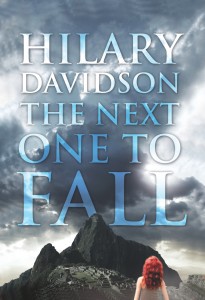
Hilary has just published her second mystery featuring travel writer Lily Moore, The Next One to Fall.  She originally landed on my radar for a variety of reasons.  I'm not sure if she came to my attention first as a member of the ITW Debut Author Class of 2010/2011 (of which Brad is also a member), or based on the rave reviews of her debut novel, The Damage Done.  Regardless, she made an impression, and I've been meaning to get around to reading her ever since.  And with a backlist of only two novels, there's a chance I actually will.

Brad, on the other hand, I know exactly when he came on my radar.  It was at the debut author breakfast at Thrillerfest a couple of years ago.  That breakfast is one of my favorite parts of the conference.  It's a great opportunity to get introduced, in their own words, to future favorite authors.  Also, it's just good fun, as each author attempts to outshine those who came before.  That year, it was definitely Brad Parks that everyone was talking about.  The man spent his two minutes launching into a full-on serenade of novelist Brad Meltzer with re-worked lyrics to the tune of "Maria" from West Side Story.  And he hasn't stopped singing since.
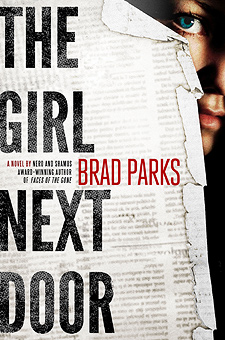
Nor, has he stopped publishing.  Brad has now released three comic mysteries featuring New Jersey investigative journalist Carter Ross.  The first was Faces of the Gone, followed by Eyes of the Innocent.  Now he's back with The Girl Next Door, and as you'll hear in the video below, there are at least two more novels in this series already in the pipeline.

Now, I don't know either of these writers well, but we travel in the same circles in the conference circuit and our paths cross once or twice a year.  It's clear that the two of them have become good friends on that same circuit, so it's fun to enjoy the mutual admiration society of their joint event.  They can sing each other's praises far better than I can.  (In Brad's case, literally.  And for those who are curious, he did sing at Book Passage, but just to kill time before the talk officially started.  Alas, I shot no video.  The link above will have to suffice.)

I'm just going to post the video in sequence below.  After introducing each other and making opening remarks, Hilary reads first, and then Brad.  After that, they pose a few questions to each other, and then open things up to the audience.  The last thing I'll mention is that I really need to apologize to Brad and all of you.  But mostly to Brad.  I positioned myself to film someone speaking at microphone at the podium.  As you'll see, they eschew it.  I finally repositioned myself when it was time for Brad to read, but before that, there's a lot of awkward trying to shoot around that pesky mike.  That's amateurs for you!  Hopefully those of you who were not fortunate enough to catch these two on book tour will still enjoy.


Saturday, April 7, 2012

A sad tale in any language...

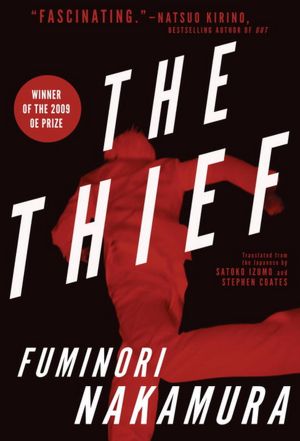
The Thief
by Fuminori Nakamura

As much as I read, I read plenty of novels in translation. I neither seek them out nor avoid them. But as a not especially well-traveled American, I do always have a gnawing feeling that I’m lacking the cultural context to fully appreciate the tale I’m reading. And while that’s certainly no fault of the author’s, that was again the feeling I had while reading Fuminori Nakamura’s novella, The Thief.

It is about—you won’t be surprised to learn—a thief, specifically a pickpocket. Now, Japanese popular culture has disavowed me of any notion that theirs is a gentler, more upstanding society than my own. Much of what I’ve seen out of Japan is even harsher than what we Americans produce. Still, I have an idea that with the prominent role of honor in their society, that to be a thief in Japan is somehow… different than it is here. More of a break with the mainstream, but perhaps I’m overanalyzing.

What I can tell you is that the thief at the heart of this novel is a rather tragic character. Through the course of this brief tale, we get some inkling about how he came to his life of crime. Part of it was circumstance, but much of it was in his nature. For this man, to steal is almost a reflexive action, at times completely unconscious. A psychologist might have a few things to say, but I do know that psychology is not widely practiced in Japan. Regardless, he lives a very isolated life.

During the course of this story, two notable things occur: a woman and her child come into his life, and he comes to the attention of a bigger fish. Regarding the woman and the child—do not in any way assume you can guess the nature of those relationships based on that sentence. Regarding the bigger fish, he’s a scary man. He coerces this pickpocket into participating in some illegal activities. When asked why he was hired, the man responds, “Because you guys have no family. Because you’re all alone in the world and even if you died there wouldn’t have been a single person who cared.”

This is more of a character study than a true crime novel, and as such it succeeds very well. Nakamura does a great job of getting inside the thief’s head. The relationships this man does have are explored. And even career criminals have ethical codes, and this man is no exception. It’s an intriguing look at a man living on the edge of society. And while I note that it’s more about character, there are criminal plots that propel the story forward. Ultimately, the tale is short enough to be read in no time flat, which is probably for the best. This is not a world I wanted to linger in overly long. But it was an interesting place to visit, with no passport required.

Tuesday, April 3, 2012

"Art isn't easy"

Sacre Bleu
by Christopher Moore

The quote above isn’t from Christopher Moore’s Sacré Bleu, but is rather from Stephen Sondheim’s “Sunday in the Park with George,” a musical about the painter Georges Seurat. These lyrics were like a soundtrack in my head as I read Moore’s latest:

Piece by piece-
Only way to make a work of art.
Every moment makes a contribution,
Every little detail plays a part.
Having just a vision’s no solution,
Everything depends on execution;
                                                      Putting it together-
                                                      That’s what counts!

Under the dust jacket
Sondheim could as easily have been speaking about writing—and let’s face it, he was. Christopher Moore’s latest is indeed a work of art, in more ways than one. The first thing the reader will notice is the extraordinary look and design of this gorgeous novel. It’s something so rarely seen these days, but in the not too distant past, bookbinding was its own art form. Kudos to HarperCollins for making this book so special! It’s covered in a metallic blue half dust jacket that allows the exotic, erotic painting printed right on the book’s cover to peek through. The endpapers feature a vintage map of Paris. The book has a lovely layout, and the text is—yes—printed in a rich indigo blue. And within, there are full color reproductions of dozens of paintings by the Impressionist masters who are the characters of this novel. It’s odd to spend this much time discussing the outside of a book, but that’s how fabulous this one is. And I have heard that only the first edition hardback will be printed in full color, so I would suggest grabbing a copy fast.

As for the story, that’s a little more difficult to summarize this time around. For past Moore novels, I could say: It was about vampires, a demon, a jinn, a sea monster that feeds on emotion, a man who walks on water. Like those previous books, this one features an element of the fantastic, but I absolutely cannot explain that element in a word, a phrase, or quite possibly a paragraph. It’s different, it took me quite a while to figure out what was going on, and I’m not going to spoil that ride for you.

A page from the book
What I can talk about is the world against which Moore’s over-the-top tale is set, and that is the world of the great French Impressionist painters. It opens with the death of Vincent Van Gogh in Auvers, France in 1890. Long assumed to have been suicide, Moore posits a murder. From that opening, the story moves to Paris, and takes up with Vincent’s shocked peers. The news is told to baker Lucien Lessard, the struggling artist at the heart of this tale, and one of the very few fictional characters in the book. Lucien rushes out to give the sad news to his pal Henri. You may be familiar with him as Count Henri-Marie-Raymond de Toulouse-Lautrec-Monfa, or just Toulouse-Lautrec, as he is generally known today.

Henri is the ideal sidekick for a Moore novel. As outrageously as Moore’s characters tend to behave, one gets the impression that Henri is depicted quite true to character. And he is wildly entertaining! The truth is, I didn’t need the somewhat odd plot about the color blue and the menacing “Colorman.” I could have spent this entire novel eavesdropping on Lucien, Henri, Monet, Manet, Pissarro, Gauguin, Renoir—yes, Seurat—and so many more, as they went about creating and discussing art. It was riveting. As with Moore’s Shakespeare novel, Fool, this tale clearly springs from the author’s love and appreciation of their work. And he’s done his homework; reading Sacré Bleu is like the most awesome art history lesson ever.

If that’s not enough for you, Moore has included a terrific Afterward entitled “So, Now You’ve Ruined Art” which answers “…what, among this big, blue lie, is true? What really happened?” And it wasn’t enough for me, actually. I was so entranced by Moore’s artists that I immediately dove into a non-fiction work after reading Sacré Bleu. It was all I could do to restrain myself from hopping on the first flight to Paris. That’s how this book affected me.

I realize I haven’t actually said much about what happens in the novel. My advice is just read and go where the story takes you. It’s funny and profane and over-the-top. It’s Christopher Moore. Art isn’t easy, and I don’t know another writer who can do what Moore does. As Mr. Sondheim said, everything depends on execution. Sacré Bleu is an homage to art from a true artist in his own right.

NOTE: There is an excellent website dedicated entirely to this novel here, which includes a reader's guide, an informative blog by the author, book tour info and more.  Also, with any luck, I'll be posting video from Chris's San Francisco book launch tomorrow.  Check back!

UPDATE 4/4: So, I did film Chris last night, and he was his usual uproarious self.  He asked me not to post the video until his tour concludes, so of course I'll honor his request.  But rest assured, I'll post it.  In the meanwhile, I have a backlog of video that I need to post, so I'll put up something soon.  :-)