Wednesday, October 3, 2012

Variations on the theme of family


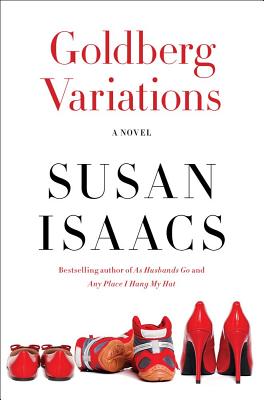
Goldberg Variations
by Susan Isaacs

I cannot honestly say that my failure to date to have read Susan Isaacs was really nagging at me, but when the publisher offered me a chance to review the galley of her latest, I jumped on it. I knew I was well and truly overdue. And what a pleasure this introduction proved to be. Not because it’s some major literary work; simply because it entertained me. Goldberg Variations captured my interest early with its cleverness and humor and kept me hooked through a rapid read.

I should mention that I am listening to Bach’s Goldberg Variations as I type this review—a clever title for a novel about the dysfunctional Goldberg family. Other than the play on the name, is there a deeper connection to the Bach? I don’t know. Wikipedia tells me that “In music, a variation is a formal technique where material is repeated in an altered form. The changes may involve harmony, melody, counterpoint, rhythm, timbre, orchestration, or any combination of those.” Something about that feels resonant to family interactions and the repeated mistakes we tend to make in our interactions with those we love… But perhaps I’m stretching.

No, it’s another classic that may be the seed of this family dramedy. As alluded in the novel’s description, Isaac owes a debt to Shakespeare’s King Lear. She doesn’t stretch the connection much beyond the barest premise. Her monarch is Gloria Garrison, whose kingdom is Glory, Inc., a lucrative and thriving makeover business. Approaching eighty, Gloria finds herself estranged from everyone she was ever close to. She has no obvious heir. With some distaste, she flies the three adult grandchildren she hasn’t seen in over a decade from New York to Sante Fe and tells them:
“I will choose one of you—only one—to come to Sante Fe, learn everything I have to teach about Glory, and inherit the business. I don’t believe in partnerships or co-anything. So no cousin duos, no brother-sister act. One of you will get Glory. The other two will get…nothing.”

Does Gloria sound harsh? You don’t know the least of it! More on her in a moment. Back to the proposition above. When Lear threw down this proposition, it led to murder and madness. Happily, things aren’t that grim here. There is a great deal of humor at the heart of this novel, and much of that comes through the internal voices of the central characters. The novel is told through the alternating points of view of Gloria and the three grandkids, siblings Daisy and Matt, and their cousin Raquel. I found these alternating POVs a really effective way to tell the tale, to get into each of their heads as their weekend-long reunion evolves.

As you may have gathered by now, this is a character-driven rather than plot-driven novel. And at the very heart of it is Gloria—and make no mistake, she’s a monster, but a frequently amusing monster:
“Not that I’m prejudiced, but I never liked short women. All too often they wrapped every work and act of theirs with cuteness. They’d say Oooh when Oh would do. They’d pin back their hair with tiny plastic barrettes as if God had not created taste. They’d stand too close to you and stare at you with their heads back, like you were a human Mt. Rushmore. True, there was a minority of shorties who shunned cute. Those were the dangerous one you have to keep your eye on all the time. They were like those tiny sharks a diver asks himself about—These little things aren’t the ones that bite, are they?—in the instant before his arm gets ripped off his body.”

Make no mistake, Gloria is an unlikable character, and if that’s an issue for you as a reader, consider yourself forewarned. For me, she was over-the-top like a soap opera villain. Her coldness didn’t feel very realistic to me, but that didn’t keep me from enjoying the tale. Her grandchildren, to varying degrees, are significantly more sympathetic, thus saving the novel from being overwhelmed by Gloria’s nastiness.

In addition to family drama, Isaacs is commenting on a number of other character issues: social standing, religious identity, female empowerment, prejudice, and more. These issues are woven throughout the tale in a reasonably natural way. And at the story’s very core is the issue of reconciliation and forgiveness.

Is the novel’s ending realistic? Probably not. And yet, I had absolutely no problem with the novel’s conclusion. As noted above, Gloria’s not a very realistic character—or at least I hope she isn’t. But Isaac entertained me and didn’t make me work too hard. Goldberg Variations was a great introduction to her work, and I shall look forward to exploring further.

Saturday, September 29, 2012

My brief wondrous visit with Junot Diaz


Washingtonian that I am, I was so sad to miss last weekend's National Book Festival. The sting was at least somewhat relieved when my friends Rina & Jacob invited me to go see one of the Festival's headliners when he came through the Bay Area recently. Junot Diaz was at the top of my must-see list. If I'd known what an interesting, unusual, and entertaining speaker he is, he would have been even higher on my list.

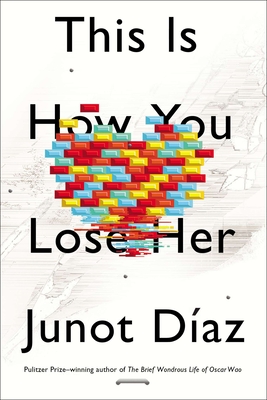
Confession: I never read Junot Diaz's Pulitzer Prize-winning novel, The Brief Wondrous Life of Oscar Wao. It just... never happened. It's been nagging at me ever since. So, I jumped on his recent collection of linked stories, This is How You Lose Her. Consider my socks knocked right off. I'll be revisiting the backlist in the near future.

The videos posted here were filmed on Friday, September 14th, outside of Copperfield's Books in Santa Rosa, CA. Yes, outside. Diaz was cold. I was cold. And the lighting was really bad as the sun set. Sorry about that. Don't let that keep you from watching because Diaz is a fascinating speaker. And do go out to see him live, should you get the chance. These videos begin with the one at the top, and then can be watched in sequence moving down. Enjoy!


Tuesday, September 25, 2012

In God we trust?


What in God's Name: A Novel

by Simon Rich

Simon Rich's latest novel is set in heaven. Or, more accurately at Heaven, Inc., where God is CEO. Yes, this is the place that you've been reading about in the Bible. But, perhaps it's not quite as you imagined. That is not the case, however, for Craig, the angel at the center of this tale:
"... he was grateful for the chance to finally see God's office. It had fulfilled all of his expectations. God's TV was enormous, at least 60 inches. And his remote control was nuts. A shiny chrome slab that looked like it had been molded to fit his hand. The desk was solid maple, and covered with cool executive toys. There was a Rubik's Cube which Craig could see was impressively far along, and a gleaming executive ball clicker. The kind that swings for minutes on end when given the slightest push."

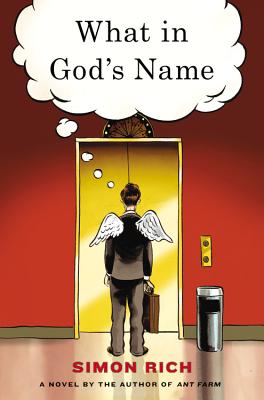
The image above does not fulfill my own expectations, but then, I didn't know that God was a hard-core Lynard Skynard fan, that angels curse like sailors, or that finding a $20 bill in my coat pocket is a bona fide miracle. A miracle that I may owe to Craig, one of the most dedicated angels in the Miracles Department. As the novel opens, this "Angel of the Month" is tasked with training the beautiful Eliza, newly promoted to the department.

If you are a reader of faith, I think you can already see that this is an irreverent and, yes, very funny take on religion. And if the description of the office above wasn't enough of a tip-off, God is a pretty vapid character. "He didn't want to make the humans suffer. He just wanted them to like him." But he is weary of dealing with them. What God really wants to do is open an Asian fusion restaurant. He decides to destroy the earth and all upon it to clear the path for his next business venture. Can Craig and Eliza change his mind? It all comes down to a bet, a single miracle involving love. Can these two angels save the world? And will they ever go on a date?

If you put your mind to it, you can probably guess the answers to those questions. This is a quick, light, cute, and very funny read. It won't challenge anything except, perhaps, your expectations of an afterlife, but it's a darn good way to while away a few hours.

Thursday, September 20, 2012

Goodness, it feels like ages since I visited the Cemetery of Forgotten Books!

The Prisoner of Heaven
by Carlos Ruiz Zafón

And here’s the awesome thing… Within mere pages I was immersed in Ruiz Zafón’s Barcelona. I love authors whose use of language is as idiosyncratic as a fingerprint, and Ruiz Zafón is one. I’d recognize his style immediately, whether his name was on the cover or not. He has stated in the past that the four books that make up this tetralogy can be read in any order, and that was true enough for the first two books, but not, perhaps, for this one. Here’s why:

Bookseller and bibliophile Daniel Sempere was at the heart of The Shadow of the Wind. And while there was plenty of intriguing overlap, The Angel’s Game told the story of writer David Martín in an earlier timeline. The Prisoner of Heaven is the perfect bridge between these two books. It’s told in two different times, and it picks up on the stories of both Daniel and David after the ends of their prior novels. And while there are many, many connections between these two men, the one at the heart of this novel is Daniel’s best friend and bookstore employee, Fermín Romero de Torres.

In the present day of the novel (1958), a visit to Sempere & Sons by a disquieting stranger who leaves a gift for Fermín is the catalyst for the older man to at last come clean about his past. Flashing back to 1939, Fermín tells Daniel about his imprisonment during the war. That was where Fermín met David Martín, and the man had a significant impact on his life. There’s more to the tale, of course, but that’s all I’m telling you.

If this novel has a flaw, it’s that it’s a super-quick read. And it’s just so completely enjoyable that it will leave you aching for book four. As for this book, aside from its shortness, it is notably less complex than the prior offerings. Less complex on its own, that is. The way it fits into the puzzle of the larger story is pretty freakin’ fantastic.

As a writer, Ruiz Zafón’s strengths and weaknesses are fairly consistent. As noted above, at the heart of this novel are characters we already know. They feel well-fleshed to the point that I should be able to recognize them on the street. Time spent at Sempere & Sons feels like visiting old friends. Ruiz Zafón’s prose continues to be somewhat florid, but you know, I like it. Not every author is going to write: “Outside, a cold Monday awaited him, sprinkled with snowflakes that drifted in the air and settled on passers-by like glass spiders hanging from invisible threads.” If you’re reading this review, you’ve already formed an opinion on the man’s prose. Love him or hate him, expect more of the same.

And if you haven’t already formed that opinion, my advice is to read the first two books in either order and then return to this one. As for me, I’m waiting with mixed emotions for the conclusion to this fantastic quartet of novels. I want it! I want it! But I don’t want it to be over.

Monday, September 17, 2012

It had all the ingredients, but this feast failed to satisfy

John Saturnall's Feast
by Lawrence Norfolk

Like other readers, I really wanted to like this novel. It had so much buzz at BEA, and they did a beautiful job with the production of the novel, with lovely illustrations, beautiful endpapers, and red ink accents throughout. Alas, despite my optimism, I found Lawrence Norfolk’s latest a real slog.

John Saturnall’s Feast is the story of John Sandall (who rechristens himself Saturnall for reasons of his own), on his journey from social outcast to kitchen boy to master chef of a 17th century British estate. Moreover, it is a love story between servant and mistress. And finally, it is the story of a struggle to preserve the custom of an ancient feast (but I’d be lying if I pretended I fully understood anything about that sub-plot).

Many have commented on Norfolk’s beautiful prose. Now, I’m a regular reader of literary fiction, but I found the 17th century language difficult and burdensome. Furthermore, the archaic recipes that preceded each chapter brought the action of the novel to a grinding halt—which was unfortunate, as things were already moving at a glacial pace. That seems odd to say about a book that dealt with life and death, love and war, but it took me weeks to get through this novel, simply because it was a chore to pick it up. And again this is strange, as in addition to a love story, this was essentially 17th century food porn, and I love that stuff. But the food was as disinteresting and unappealing as the central characters.

I never connected with either John or Lucy emotionally. I didn’t find them especially likable, which made it hard to care about their romance. Nor did I feel that I ever truly understood who they were as people. I will admit that the second half of the novel was more compelling than the first, but that’s not really saying that much.

Regular readers of my reviews know that it’s rare for me to be so negative, especially for a novel of literary merit. Clearly this book did not work for me, but seems to have resonated far more with other readers. I am sure it’s a fine book, but I am happy to at last move on.

Friday, September 14, 2012

A master of misdirection

The Map of the Sky
by Felix J. Palma

Those who read Felix J. Palma’s The Map of Time are well aware of the author’s hijinks and trickery.  Be forewarned, he is again up to his clever tricks—though not, perhaps, exactly the ones we’ve seen before.  No, this is a writer who will keep readers on their toes!

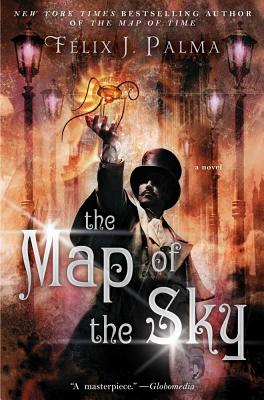
So, about The Map of Time…  You should read it before you even think of picking up this book.  For a long while, I thought it would be unnecessary, but as I got deeper into the novel, it became obvious that you’d be missing much without having read the first volume in the trilogy.  And if The Map of Time is Palma’s homage to H.G. Wells’ The Time Machine, then The Map of the Sky is his homage to The War of the Worlds (as well as other early science fiction classics). 

This second volume is similarly structured.  It’s told by the same omnipotent narrator about whom I desperately hope to learn more in the final volume!  This unnamed voice is a major presence in the story he tells, with remarks like:  “What happens next is hard to describe.  Perhaps a more seasoned narrator would have no difficulty—I am thinking of Wilde or Dumas—but unfortunately it falls to me.”  And, “I hope you will forgive me for having left our hero in such a delicate situation; think of it as my homage to the serialized novels of the time.”  Yes, that kind of intrusiveness can grow precious, but Palma walks a delicate balance and really pulls this device (as well as the literary equivalent of breaking of the fourth wall) off terrifically well.

Also like the prior novel, The Map of the Sky is told in three parts, each of which is a distinct, but linked story.  And again, author H.G. Wells, plays a role in each.  The dire events of this novel are kicked off innocuously enough, as Wells meets an American hack writer for a liquid lunch.  When his counterpart offers to show him a real Martian, how can Wells resist?  The story rapidly moves from the preserved specimen in the British Museum to the events many years earlier that led to the collection of the museum specimen.  This first section is a harrowing tale of Antarctic adventure. 

The second section of the novel brings Wells back to the center of the story, and reintroduces a character from the last book in a new guise.  Identity is a tricky business in this novel.  It’s that magician’s misdirection; never assume you know who anyone really is.  Oh, that Palma is a delight!  The second part of the novel involves a Martian invasion of London much as Wells wrote in his novel a year prior.  This alone makes him suspect and brings a Scotland Yard inspector into the tale.  But what at first appears to be a hoax quickly turns far darker than expected.  Always Palma defies expectations. 

The third part of the novel takes place two years later, and here the story again revisits a secondary character from The Map of Time.  In this section, his tale is the center of the story, but it serves to move the whole narrative towards its terrifically satisfying and pitch-perfect conclusion.

If the novel has a weakness, it is that at 608 pages, it may be a tad overwritten.  I think this is largely due to Palma’s writing in Victorian style.  Why use 100 words when you can use a 1,000?  Despite the occasional excess, the story moves along rapidly and it was torture to put the book down.  The one other criticism I’d noted after reading more than half the novel was a failure to connect with the characters emotionally in more than a superficial sense.  Well, Palma had me eating those words, and in the latter part of the novel he delivered big time. 

This trilogy has proven to be a pure delight.  Mr. Palma has left ample clues about which of Wells’ novels will be featured in the final volume, so I’ve got some reading to do before next summer.  I can’t wait to see what he delivers next. 

And finally, I will leave you with a quotation, completely out of context, just because I like it so much:

“Grieving for the death of beauty is a very human idiosyncrasy.  Do you know, Mr. Wells, when a star dies, the light from it goes on traveling through space for thousands and thousands of years?  The universe remembers for a very long time whatever dies, but it doesn’t grieve.  It is natural for things to die.  Yet I’ll grieve for you when you’re gone, for the beauty you are capable of creating, sometimes unconsciously.  I’m sorry I can’t offer you greater solace, the solace a priest offers his flock.  But all of us are subject to the laws of the cosmos.”

Thursday, September 13, 2012

An Evening at "Brokeland Records" with Michael Chabon


Yes, I've been a bad, bad blogger.  I basically took the summer off.  It was a rough summer, and I needed something really special to jump-start my blog for the fall lit season.  That something special was delivered to me by Michael Chabon and the good folks at HarperCollins.  Michael's contribution was the writing of Telegraph Avenue, which has just become my favorite read of 2012.  I'm very proud to have written the "most helpful" review of the novel on Amazon, and my review of Telegraph Avenue can be read on the blog here.  There is nothing better than being able to sing the praises of a book you truly loved.

So, the publishing industry isn't known for wildly creative marketing events, but kudos to HarperCollins for their promotion of Telegraph Avenue.  For one week, they've turned Diesel Books in Oakland--very close to where the novel is set--into the fictional Brokeland Records at the heart of the novel, complete with signage, shopping bags, and vintage vinyl for sale!  I shot 30 seconds of video as I approached the store.  I was jay-walking in heels and blinded by the sun, so you get what you get.  You can just see the record bins at the front of the store as the video ends.


Completists are invited to view a one-minute tour of the inside of the store. In addition to launching the novel, the evening was a benefit for 826 Valencia, founded by Dave Eggers.  Video of Eggers talking about his organization and hopeful plans for a future Oakland branch, as well as his introduction of Michael Chabon may be viewed here. Finally, Michael took the stage, and began the evening with some old technology and a musical interlude. This may well be the only place you can hear the original composition, the "Theme from Telegraph Avenue."


Afterwards, Michael shared his affection for Diesel Books, his "neighborhood bookstore" and our hosts for the evening. He extolled the numerous cakes that had been baked for the event, which can be better seen in the photograph above. And briefly, he spoke about Telegraph Avenue's genesis, and set up the excerpt he was about to read. The second video is the reading from the novel.


Next, Michael opens the Q & A with questions about some of his earliest musical experiences, how the novel came about, what it's like to write about a world he knows intimately, and the joy of unusual words. (Am I the only person utterly charmed by his use of the phrase "consensus reality"?)


More questions about neighborhood stores he misses, paper versus e-books, book bundling (with a consult from the "publishing industry"), favorite live concerts, and recommendations for children (with a consult from a child).


And that was the end of the Q & A. Afterwards, Michael promoted a raffle to benefit 826 Valencia.  The grand prize is a vintage portable 8-track cassette player, much like the one carried by Julie Jaffe in the novel, and a Telegraph Avenue mix tape recorded by Michael.  He's a nostalgic guy, and this is just funny...


And finally it is cake time:


Uploading this video takes forever! (No wonder I took the summer off.) The good news
for you, but bad news for me, is that I have heaps of video and book reviews stacked up and ready for posting. I will try to get back to my regular posting schedule, because there are so many good books coming out each week this time of year, and great authors coming through San Francisco nightly.

  For now, I'm delighted to have shared a really special launch party for a really special book. Michael will be touring extensively this fall. Check his schedule and see if he'll be coming to you. Oh, and if you'd like a signed first edition of this fantastic book, I can't imagine a better place to order from than our good friends at Diesel Books.


The church of vinyl

Telegraph Avenue
by Michael Chabon

Depending on who you ask, Michael Chabon is either one of the finest writers of the English language working today or he is the finest writer of the English language, full stop. My opinion vacillates between the two. A reputation like that comes with some pretty lofty expectations for each new book. I'm pleased to say that Chabon's latest, Telegraph Avenue, did not disappoint.

At the core of this novel is Brokeland Records, described at points as "the church of vinyl" and "an institution." You know the place, or someplace like it—a down on its heels shop that's a gathering spot for a passionate community of its own making. Brokeland is owned by Archy Stallings (black) and Nat Jaffe (white, Jewish) and these partners echo the diversity and cultures of the Berkeley/Oakland neighborhoods straddled by the eponymous avenue.

This is a long book. It's not epic. I'm not even sure that it's sprawling. But it is full. By the time you reach the end, you will be thoroughly familiar with the businesses, marriages, and families of both Archy and Nat. You'll have met and followed their lives, and the lives of their customers, their adversaries, and one well-educated parrot. You'll know the intimate details of their relationships and their personal histories. Chabon packs a whole heap of detail and digression into the course of his 480 pages, and that doesn't even include a boatload of pop culture references to 70's jazz, Blaxploitation films, and martial arts.

Chabon's affection for his characters is contagious and it's hard not to love


Michael displays a rare copy of the Theme from Telegraph Avenue
them, despite some glaring flaws. However, the Brokeland community is facing any number of threats. Perhaps the most looming is a media megastore helmed by an NFL legend that's being planned for the neighborhood. Their David won't survive this Goliath. Archy and Nat's wives, Gwen and Aviva, are also in business together, and Berkeley Birth Partners is likewise under threat due to a birth gone wrong. Things at home are equally challenging. Will Archy and Gwen's marriage survive his infidelities and the appearance of a previously unacknowledged 14-year-old son just weeks before the birth of their first child? A novelist recently told me that "the clock of your mortality is what moves you." Well, births and deaths are major events driving this narrative, and I'd argue that the clock of an 8-months-pregnant wife moves a story along as well. Meanwhile, the Jaffe household is dealing with their adolescent son's first serious infatuation—with Archy's teenage son. And also the fact that Nat is his own worst enemy. And into this rich stew is a complex subplot involving Archy's estranged father and a crime of the past resurfacing.


Commemorative button & special stamp
It's a lot to take in, really. There's a lot going on. Despite all of this, the action of Telegraph Avenue is character-driven rather than plot-driven. At times, the meandering plot seems almost incidental, as we peer through the windows at these character's complicated lives. Some readers may feel frustration with the digressions, but for me, every word was a delight. It was the path, not the destination. And the path of this novel is strewn with Mr. Chabon's legendary language, the staggering vocabulary, the abundant humor, the soaring similes, the awesome freakin' sentences! I, personally, am ill-equipped to articulate just how extraordinary his gifts are. The man is a virtuoso. "Buoyant," "joyful," "exuberant"—these are words that are frequently used to describe Mr. Chabon's writing. He takes on serious subject matter, and deals with it suitably, but his language is simply irrepressible.

Yes, there are some flashy scenes in this book that you will hear about—the 12-page sentence, the Obama cameo—but for my money Chabon's achievement is in the entirety of this work. He's created a world that's familiar and recognizable, yet somehow just a little better, shinier than reality. As I began reading this novel, I thought it was fantastic, but wouldn't replace Kavalier & Clay in my heart. But now I wonder. The real Telegraph Avenue is a short commute from my home, but it's Chabon's version that will stay with me.

Tuesday, July 3, 2012

Leotta’s strong sophomore novel bodes well for the future of this series

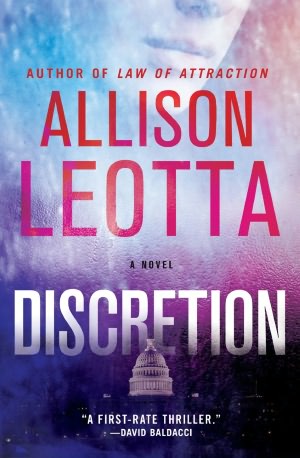
Discretion
by Allison Leotta

Today’s thriller writers come from an astonishing array of backgrounds.  Their books come to life because these cops, doctors, pilots, engineers, spies, bankers, veterinarians, physicists, and the like are intimately familiar with the worlds their characters move in, and in many cases have years of real-life experience to draw upon.  Certainly that is the case with novelist Allison Leotta, who has just published Discretion, her second novel featuring Assistant U.S. Attorney Anna Curtis, who prosecutes sex crimes in Washington, D.C.  Leotta herself held the very same job for years.  As I read the grittier sections of this novel, I found myself thinking, How does this nice writer lady know THIS much about the world of prostitution?  Oh.  Yeah.  It’s the sort of truly in-depth knowledge you can’t get from mere research.  It’s the sort of in-depth knowledge that allows a writer to authentically inhabit her characters.

 While Sex Crimes is Anna’s beat, as the novel opens, she gets called away from a self-defense class (Can you blame her?) to the scene of an assault at the Capitol.  It’s a sex crime, but it’s also a murder.  She meets Homicide Chief Jack Bailey at the scene, and that’s how she gets drafted onto another case with him.  They worked well together in Leotta’s debut, Law of Attraction.  (In fact, the whole team is together again, including the memorable Detective McGee.  Plus, there’s a notable new addition in the form of FBI Special Agent Sam(antha) Randazzo.)  Anna had been looking for a high-profile case to boost her career, but this may be a little more than she bargained for.  A beautiful young woman has been pushed from the balcony adjacent to DC Congressman Emmett Lionel’s hideaway office in the U.S. Capitol building.  This murder is as high stakes and as federal as crime gets.

 While I don’t believe it’s strictly necessary to have read the prior novel, Law of Attraction first, I think there is a lot to recommend doing so.  Anna’s private life is a significant element of this series.  Having the backstory on her current relationship will add to a reader’s pleasure.  I have to admit, that I was thinking that the blush of first romance makes for more compelling reading than a couple in a committed relationship, but as I got deeper into the book, I realized how invested I’d become in that relationship.  It was plenty compelling after all.  Leotta is very good about giving characters room to grow and develop, and the relationship between Anna and the challenging Sam was another narrative thread that had a full and satisfying story arc.

 One of the pleasures of this series for me is the Washington, DC setting.  DC is my hometown, and while it’s great to read about places you know, I think it’s a fascinating location that just about any reader can appreciate.  DC is a town like no other, and Ms. Leotta appears to know it inside and out.  Seriously, it’s my hometown and I keep learning new things about it from her!  Discretion features great wealth, great poverty, and lots of politics—all the things that make DC the unique city it is.

 Strong, believable, and interesting characters are important, as is setting, but ultimately, mysteries and thrillers come down to their plotting.  The plotting here was both smart and tight.  For a long time, readers won’t know who-done-it, but in the course of one page of this novel, without any sort of admission or confession, the author shows a character in a new light, and you just know.  This is very deliberate on Ms. Leotta’s part; she makes revelations in her own time, and you’re unlikely to figure things out before she’s ready for you to.  She is very much in control of the plot.  The pacing was excellent, and I stayed up far too late to finish the last 100 pages, because there was no way I was going to put the book down.  And even as the novel was winding down, there was a character revelation that hit me like a ton of bricks.  I thought something was up, but never came close to guessing the truth.

 Happily for us, there is more Anna on the way, as evidenced by the last sentence of this novel.  It will leave readers clamoring for the next book in the series!

Tuesday, June 26, 2012

Sigma's going to the dogs

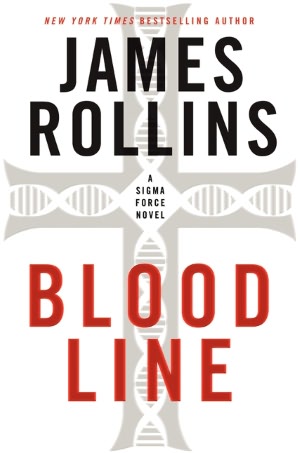
Bloodline
by James Rollins

After a brief prologue, James Rollins’ latest Sigma Force thriller picks up shortly after where last year’s superlative The Devil Colony left off.  Commander Gray Pierce is dealing with the fallout of his mother’s murder, and the team is ready to exact vengeance against the Guild. (Now, those first two sentences should tell readers something.  While I certainly think that there is enjoyment to be had reading Bloodline as a stand-alone, this installment of the series is very much built upon what’s come before, both in terms of plot and character arcs.  In a perfect world, I’d recommend reading this after reading the other books in the series, or at the very least The Devil Colony.)  Early in the book, the enigmatic double-agent Seichan shows up unexpectedly:


“‘There’s been a kidnapping off the Seychelles by Somali pirates.  A high-value American target.  Painter wanted to know if you were up for a mission.’  Gray frowned.  Why was Sigma involved with a simple kidnapping?  There were plenty of policing and maritime agencies that could attend to such a crime.  Sigma Force—made up of Special Forces soldiers who had been retrained in various scientific disciplines—was a covert wing for DARPA, the Defense Advanced Research Projects Agency.  Sigma teams were sent out into the world to protect against global threats, not to address the kidnapping of a single American.”

Well, there’s high-value, and then there’s HIGH-VALUE.  And this kidnapping victim is the latter.  And wouldn’t you know, this crime eventually leads back to the Guild.  This is the book Mr. Rollins has been promising readers.  It is the ultimate showdown between these two organizations.  And, yes, Sigma is called upon to fulfill the mission stated above.  The Guild’s plot goes well beyond kidnapping, but I shall decline to elucidate further.  What I will do, instead, is highlight some of the strengths and weaknesses of the book.

STRENGTHS:

 
·         Seichan tells Gray, “We’ve been ordered to pick up another two teammates, local assets already in the region, with unique skills to help us on this mission.”  Those who read Rollins’ recently published e-short, Tracker, have already guessed that I’m referring to retired Army war dog, Kane, and his handler, Tucker.  These two are the freshest thing to hit Sigma in quite some time!  First, they’re just great characters.  Former-veterinarian Rollins does a bang-up job writing from a dogs-eye view.  These war dogs are unbelievably skilled.  What they can do, and how they work with their human, is flat-out fascinating.  Are you a fan of Dean Koontz’s Watchers?  You are going to LOVE Kane!

·         I think Rollins’ greatest strength is the integration of really smart, completely fascinating, and scarily plausible science into his plots.  I have never failed to learn something within his pages.  This novel deals with genetics, robotics, and the quest for immortality.  At one point, the mad scientist is giving an epic lecture on how men can live indefinitely, and I’m thinking of a huge scientific impediment to that idea.  I’m about to proclaim it all BOGUS.  Well, almost as if he had read my mind, Rollins addressed my objection.  Is it plausible?  I don’t know.  But it sure sounds legit.  I proclaim it NOT BOGUS.

·         Rollins lets some recently underutilized characters shine in this novel, none more so than Kat Bryant, Sigma’s second in command.  She’s out in the field for the first time in a long time, and this lady knows how to kick some ass.  I’ll never look at her the same way again.  Bloodline is very much an ensemble piece, with everyone getting some face time, and it is stronger for it.

·         Which reminds me… Way to write those strong female protagonists, Mr. Rollins!  This has always been a strength, and it continues to impress.

·         Kowalski.  Kowalski is so awesome in his Kowalskiness.  Who else, after watching Kane’s amazing, life-saving performance under fire, would sum everything up with, “I got to get me one of those dogs”?  He’s always good for comic relief, but Mr. Rollins shows great restraint in not making this character too over the top, or of over-utilizing him.

·         As always, Rollins leaves readers with a fascinating author’s note about fact versus fiction.  This time around he even includes links to video.

Now, die-hard fan that I am, it makes sense that I see more strengths than weaknesses, but as always, I do have some quibbles.

WEAKNESSES:

·         For the last few books, Rollins has been trying (successfully) to humanize Seichan, and to reveal more of her background.  That is very much the case here, but for me, personally, things were getting a little too… sentimental.  You may judge for yourself.

·         Also, I don’t need to hear any more about the “inexplicable bond between dog and handler, tying them together by something deeper than just hand signals and spoken commands.”  I LOVED seeing the two in action, and Rollins didn’t belabor the point, but any time their “bond” was referenced, I just wanted to roll my eyes. Clearly, I am a horrible person.

·         Maybe it’s because I’m a Washingtonian, or because I was obsessed with The West Wing, but I found certain elements of the Presidential/White House subplot of the novel strained even my generous suspension of disbelief.

Okay, sorry to prattle on, but there’s always so much to talk about with these books!  Despite my penchant for criticism, when you get right down to it, James Rollins is at the top of my favorite authors list.  As always, he leaves me anxiously awaiting his next installment.

Note: The video below tells far more about the novel's plot than my review does, though obviously the author and publisher aren't giving out significant spoilers.  Also, secret inside scoop, the retriever walking with Jim is his loyal companion, Penny.  I was at his house the day Penny arrived, a sickly, skinny little puppy, many years ago now.  The shepard-looking dog is the same breed as Kane in the novel, and was recently adopted by one of Jim's sisters.  Now you know more than anyone else watching the video, LOL.