Thursday, April 22, 2010

If the series had to end, this was the perfect conclusion

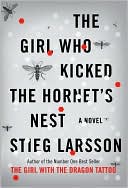
The Girl Who Kicked the Hornet's Nest
by Stieg Larsson

I came to this novel with great trepidation. I'd loved the first two novels in the series and was understandably saddened by the premature end due to the author's untimely death. Aside from that, I was worried that the novel would end with some terrible cliff hanger as the previous one had. For what it's worth, I'm happy to report that if this series had to end now, I'm completely satisfied with how the story of Lisbeth Salander, Mikeal Blomkvist, et al wraps up.

As mentioned above, The Girl Who Played with Fire ends on a cliff hanger. The Girl Who Kicked the Hornet's Nest picks up exactly where it ends off. I'd liked the second novel in the series much more than the first because it dealt far more extensively with the eponymous character. That is also the strength of Hornet's Nest. I just can't get enough of Lisbeth Salander. She is endlessly strange, fascinating, endearing, and resourceful.

This final novel strikes the best balance of the three between Lisbeth's story and Mikeal's story, which essentially converge at this point. But other characters get their fair share of narrative time and a subplot involving Erica Berger particularly captured my interest. Every storyline allowed Larsson to show off new facets of his established characters.

One of the most fascinating things about the plot of this book (which obviously I'm being incredibly vague about) was that in another novel, the good guys and the bad guys could have easily switched places. There are no cookie-cutter heroes and villains in Larsson's world. Sure, there are people to root for, but there's a lot of moral ambiguity involved. All of which makes for complex and smart story-telling. And Larsson's plotting is as strong as it ever was. This novel is his best yet.

At nearly 600-pages, I plowed through the book at breakneck speed, my interest never flagging. It is sadly clear to me that Larsson had further stories to tell about his girl. Not every loose thread is tied up, but the important bases are covered. The novel's end was as satisfying as anything you could ask for.

Rest in peace, Stieg.
Comment Permalink

Was there a kayak in Sense and Sensibility?

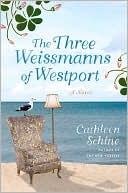
The Three Weissmanns of Westport: A Novel
by Cathleen Schine

Cathleen Schine's ridiculously delightful new novel is a contemporary take on Jane Austen's Sense and Sensibility. Here, the unmarried daughters are middle-aged, New York Jewesses--children of divorce--exiled with their elderly mother to Westport, Connecticut. They've been taken in by wealthy, generous Cousin Lou, who treats absolutely everybody "Like family!" in the revolving door of his hospitality.

I feel no need to summarize the plot further, for a tremendous amount of the pleasure is in seeing how Schine "contemporizes" the tale. Rather than detract from the story, a basic familiarity with Austen's classic adds immeasurably to the read. Yes, you'll have a pretty good idea of where the story is going, but you'll have so much fun with the infinite cleverness of Schine's update. And don't put it past her to throw an occasional curveball.

I suspect The Three Weissmans of Westport is an homage of which any Janeite would heartily approve. It's done with such affection. And even if you're completely disinterested in the original, I don't see how any reader could keep a straight face through this laugh-out-loud satire!
Comment Permalink

The real Jane Austen Book Club!

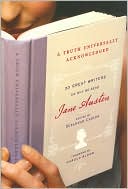
A Truth Universally Acknowledged: 33 Great Writers on Why We Read Jane Austen
by Susannah Carson

I have just indulged in a week of Jane Austen. It's so good for the soul; I really should make it an annual tradition. I read one of the six original novels, a contemporary update of one of the novels, watched cinematic adaptations, and finally delved into this wonderful book of literary criticism. I'd been holding off, wanting to be just a bit more steeped in Janeism before I tackled it. I've been so looking forward to diving in based merely on the wildly distinguished list of contributors.

There are renowned literary critics like Harold Bloom and Lionel Trilling, academicians like John Wiltshire and Janet Todd, classic novelists like Eudora Welty and Somerset Maugham, and contemporary novelists like A.S. Byatt and Jay McInerney. There's even a token filmmaker, Amy Heckerling! There is no hyperbole at all in the assertion that these are 33 (34, really) great writers. One name is more impressive than the next, and I've barely scratched the surface.

Based on the diversity of the contributors, you would be correct in suspecting the diversity of the essays in this collection. Some deal with the author herself, or the time in which she lived, others the entirety of her work, and some focus on a single novel. My first thought was to read the more general essays first and to then focus on the contributions specific to a novel after I had just read or re-read it, so that the particulars were very fresh in my mind. Now that I've been reading the essays, Austen's work, and the work of others inspired by Austen at roughly the same time, I don't believe my approach need be that rigid. Reading some of the essays on Emma while still reading the novel gave me great insights that I might not have come to or appreciated on my own.

I'm refraining, in this review, from pulling out quotes from the essays, but only because I wouldn't know where to start. There hasn't been one yet that wasn't infinitely quotable. Where's a highlighter when you need one? Some of the essays are more academic in tone than others (many have endnotes), but they are all smartly-written, challenging, and elucidating on this eminently worthy subject. This collection of essays will surely become a cherished reference I delve into over and over as I continue to enjoy Ms. Austen's timeless works the rest of my life.

Comment
Permalink

"I recommend a little gruel before you go."

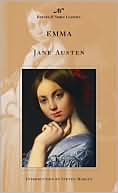
Emma
by Jane Austen

Many literary critics have proclaimed Emma to be the most accomplished of Jane Austen's novels. That may well be, but I don't personally number it among my favorites. That said, it easily deserves its five-star rating; I haven't read an Austen novel yet that doesn't.

Emma is, of course, the story of beautiful, young, wealthy and accomplished Emma Woodhouse. Of her, too many kindnesses can not be said. At least, that is the attitude displayed by everyone around Emma. She's heard nothing but praise and exaltations her entire life, and has come to quite believe her own billing. And while she generally means well, Emma has grown into an unforgivable busybody and snob.

Emma lavishes most of her attentions on her dear friend Harriet Smith. While Harriet is of a lower status and desirability than Emma herself, Emma feels confident she can improve upon Harriet, introduce her to all the right society, in short, make her a most advantageous match. Never mind the perfectly nice farmer who is already in love with her.

And so, Emma insinuates herself into the affairs of Harriet and several others around her. She is certainly not the most sympathetic of Austen's heroines and my feelings about her tended to fluctuate from chapter to chapter. Nevertheless, no conflicted feelings got in the way of the joy brought about by a patented Austen ending. Additionally, Austen proves yet again that humor based on an intimate knowledge of human nature is timeless. I defy you not to laugh over the antics of Emma's possessive and gruel-loving father. Austen's social satire is as sharp as it ever was.
Comment Permalink

What is it about these circus stories?

Water for Elephants: A Novel
by Sara Gruen

Since acquiring my Kindle, I've started playing a new game. I download "samples" of all kinds of books. If I can get hooked in the first few chapters, well clearly the author deserves the book sale.

That is exactly what happened with Water for Elephants. Almost immediately I was completely drawn into the story. Ms. Gruen uses an effective framing device for her tale. Nonagenarian Jacob Jankowski is telling his story in flashbacks from his present in a nursing home. And it is the story of his first job out of veterinary school. The year is 1931 and the country is embroiled in the Depression. Tragedy sends Jacob fleeing his orderly life. Without trying to, the young man winds up running away to the circus.

Water for Elephants is a coming of age novel, a buddy tale, a period drama, and a love story. It's one of those rare novels that seems to captivate almost all readers. I came late to it, but I was as entranced as all those who have raved before me. Gruen's prose is strong, but it's her characters and setting that capture the imagination. I haven't been to a circus in decades, and have no particular interest in that life. But Sara Gruen is a fantastically gifted storyteller, in the most elemental sense of the word. I will be grabbing future novels upon publication. Highly recommended to all who crave a great story!
Comment Permalink

Monday, March 15, 2010

Holocaust in a suitcase

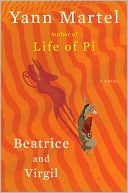
Beatrice and Virgil: A Novel
by Yann Martel

Coming in to this slight novel--barely more than a novella--all I knew was that it was Yann Martel's "Holocaust allegory," and that it had animal characters. Those animals are the eponymous Beatrice (a donkey) and Virgil (a howler monkey) but they're actually characters in a play within the novel. Let me back up...

The central character of Beatrice and Virgil is a novelist named Henry. Henry has written a very successful book that featured animals as characters. Henry's career, in short, is remarkably similar to that of Yann Martel. The beginning of the novel describes his travails while attempting to publish a follow up to his very successful book. Henry, who is not Jewish, wants to write about the Holocaust. He has noticed that almost all Holocaust fiction is in the style of historical realism. Henry believes there are other ways to have this dialogue, to tell this story. "Other events in history, including horrifying ones, had been treated by artists. To take just three well-known instances of artful witness: Orwell with Animal Farm, Camus with The Plague, Picasso with Guernica. In each case, the artist had taken a vast, sprawling tragedy, had found its heart and had represented it in a non-literal and compact way. The unwieldy encumbrance of history was packed into a suitcase. Art as suitcase, light, portable and essential--was such a treatment not possible, indeed, was it not necessary, with the greatest tragedy of Europe's Jews?"

It is this that Henry attempts, but fails, to write. Despite his exalted stature, he is told repeatedly that his book is unpublishable. At this point, sick of publishing and completely blocked, Henry decides to pursue other interests. He and his wife move to an unnamed major city in another county. He takes music lessons, acts in plays, and even waits on customers in a chocolateria. He's happy. And it's a pleasure to read about Henry. Sure, he's rich, talented, and free, but at heart he's an everyman and so darn likable.

Eventually, a series of events leads Henry to an acquaintance with a taxidermist, also coincidentally (?) named Henry. In most ways Henry the taxidermist is completely unlike Henry the novelist. He's older, dour, and very, very serious. But he, too, is a frustrated writer. He has been struggling for years on a play about Beatrice and Virgil. The characters are real in his mind, as they are literally two stuffed animals in his shop. Gradually Henry the novelist begins collaborating on the play, and sections of the the play's text make up large portions of the novel. And the text is... well, I swear it sounds like Beckett wrote it. Beatrice and Virgil may as well have been renamed Vladimir and Estragon. Truly, if you have any appreciation of that sort of thing, it's an absolute joy to read.

And that's the thing: This light, short novel is a compelling and deceptively simple read. Other than novelist Henry's unpublished work, there's no further talk of the Holocaust until more than halfway through the novel. There's something going on a bit under the surface, but you can't really put your finger on it. And then novelist Henry says to his wife, "It's all quite fanciful, yet there are elements that remind me, well, that remind me of the Holocaust." She accuses him of seeing the Holocaust everywhere, and that's that. Mr. Martel's fanciful story of the novelist and the taxidermist and the donkey and the monkey continues. And slowly, gently, the real story being told becomes more and move self-evident. By the time I reached the end, I was well and truly chilled, with goosebumps breaking out all over.

Where the fictional Henry failed, Yann Martel has succeeded. It's a stealth allegory, and as I stated earlier, it's deceptively simple. Deceptive, because there's actually so much going on in this little novel. There are cultural, literary, historic, and religious references. I was actually busy googling things as I read and there was much food for thought. It seems almost ridiculous to say this about another Yann Martel novel, but you want to read this with a friend or a book group. By the time you're done, there is so much you'll want to talk through and discuss. Highly, highly, highly recommended!
Friday, March 12, 2010

Is it possible to write a likeable book about an unlikeable character?

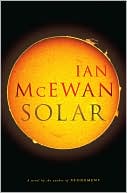
Solar
by Ian McEwan

I think the answer to the question above is, "Yes." Others will disagree. For this reason, I expect Ian McEwan's latest, Solar, to be a polarizing novel. On the one hand, you've got Mr. McEwan's considerable literary talent. On the other hand, you've got an unlikable protagonist, a whole lot of physics, and a comic novel. And if there's anything more subjective than humor, I don't know what it is.

Solar is a satirical look at the life of Nobel Laureate in Physics, Michael Beard. As the novel opens, 50-something Michael is married to 30-something Patrice. This, his fifth marriage, is on the rocks and his brightest, most promising days are long behind him. While the reader will want to find redeeming qualities in Michael, his character follows a trajectory from ridiculous to reprehensible to repugnant. "He was sufficient, self-absorbed, his mind a cluster of appetites and dreamy thoughts. Like many clever men who prize objectivity, he was a solipsist at heart, and in his heart was a nugget of ice..."

McEwan is smart in the way he relays the story. It's told episodically, opening in 2000, then jumping ahead to 2005, and finally to 2009. This draws the reader in. What has happened since we've seen Michael last? What are the repercussions of his behavior? Has he learned any lessons? Is he a better person? I would begin each section full of these questions and eager for answers.

So, can you write a likeable book about an unlikeable character? I found myself reflecting on John Kenney Toole's Pulitzer Prize-winning novel A Confederacy of Dunces and its unlikely hero, Ignatius J. Reilly. Michael Beard, while less of a complete buffoon, is not cut from entirely different cloth. Readers who can laugh at his foibles and maintain at least some empathy will enjoy this novel the most.

The other thing I mentioned above is physics. It's Michael's career, and McEwan doesn't shy away from what will be challenging territory for some readers. Think of it as a foreign language. When I read The Yiddish Policeman's Union, I found myself wondering how readers with no grasp of Yiddish would handle the book. As it turns out, they handled it just fine. I am fortunate to have a reasonable working vocabulary in both Yiddish and physics; consequently my enjoyment of these novels was merely enhanced. Like Chabon, McEwan isn't talking down to his readers. There is no unnecessary exposition. McEwan has given his unlikeable character some very admirable skills and placed him in a position to do good on a grand scale. Can that redeem him?

Solar is social commentary. And it is a novel of ideas. It's the type of comedy that feels slightly mean and not always that funny. Throughout the novel, Michael Beard has set a lot in motion. The ending of the novel was what it had to be. Some readers won't appreciate this work. Others will hate how it ends. Ultimately, for me, the joy of reading McEwan's prose, of following his flawed character, and of seeing where the story would take me made this odyssey a pleasure.

Wednesday, March 10, 2010

Sympathy for the Devil


Horns
by Joe Hill

"Ignatius Martin Perrish spent the night drunk and doing terrible things." So begins Joe Hill's excellent sophmore novel, Horns. As the straightforward title suggests, the novel has a simple, high-concept premise. After the aforementioned night of doing terrible things, Ig Perrish wakes up the next morning with a pair of horns growing out of his head. His reaction is typical enough. After the immediate shock of it, he concludes he's hallucinating--and either way, he'd better see a doctor.

It is with these initial interactions, with his girlfriend, the folks in the doctor's office, and most disturbingly with his family, that Ig makes several unpleasant discoveries. No one reacts to the horns. Rather, they're compelled to share their deepest, darkest, sickest secrets. Trust me; you don't want to hear the most vile thoughts of a stranger on the street--much less those of your grandma!

Just when this grotesque show-and-tell is beginning to feel a bit old, Hill moves on and dives into the meat of his story, Ig's story. One year prior, Ig's childhood sweetheart, the love of his life, was violently murdered. The crime was never solved, and Ig is widely believed to be the murderer. Very widely believed, he is to learn. Hill's novel ultimately spans several literary genres. It's a supernatural thriller, a murder mystery, a coming of age story, and a dark comedy all rolled into one. And the novel succeeds quite well on all counts.

As the story drew to its conclusion, the thing that was very noticeable to me was how elegantly constructed the novel was. It was like a perfect puzzle, with different clues and unanswered questions salted throughout. By the end, everything came together in a way that wasn't so much neat as inevitable. It was elegant. And it was emotionally satisfying. And it was darn entertaining, which is just about the highest praise I can offer.

P.S.: For those of you who realize there is a coded message on the end papers of the novel, but are too, uh, busy to decipher the message, I'm putting the solution in the comments section of my review.

Tuesday, March 9, 2010

A library could be a dangerous place...

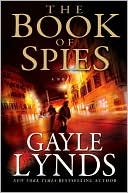
The Book of Spies
by Gayle Lynds

For years now, I've heard nothing but good things about the work of Gayle Lynds. So much so that I've purchased several novels, but never got around to reading any until now. I'm sorry to report that as introductions go, The Book of Spies was a real disappointment.

Where to start? How about with the excellent first sentence: A library could be a dangerous place. This is proven quickly enough by the murder of a librarian on the third page. This, incidentally, is our introduction to the novel's antagonist, amusingly named Doug Preston. Unlike his namesake, he's not a pleasant man.

Rapidly after the opening murder, we're introduced to manuscript conservator Eva Blake. Eva, we learn, is about to be jailed for her role in the drunk driving death of her husband Charles. Next, two years later we're in the head of CIA operative Tucker Anderson. Just before an old friend can spill the beans about a possible terrorist plot, he's assassinated right there in downtown DC. And so begins what truly felt like a very worn plot. An international cat and mouse game, a hunt for a fabled treasure--in this case the Library of Gold--and a side plot concerning Middle Eastern politics.

Here are a few things I did learn in The Book of Spies:
  • It is totally believable for a scholar of illuminated manuscripts to also be an expert pickpocket and a black belt in karate.
  • If you are an academician, it is totally natural for you to pepper your dialog with pithy Latin quotations, no matter how tense or volatile the situation you may be in.
  • Even though I can never seem to find a colleague in the same office, while being hunted by bad guys through the major cities of Europe, you'll run into each other by accident time and time again.
  • An anklet is an excellent way to track a missing CIA asset when necessary, and it will never cause a delay at airport security.
  • No matter how good the disguise, any individual can be identified by any stalker by their gait.
  • These days you don't just have to be rich and white to be part of a secret, villainous cabal, you also have to be at least six feet tall. It's mentioned more than once.

Snarkiness aside, that's just the tip of the iceberg of what bugged me in this book. I wanted to get caught up in the action, and I tried, I really tried, to just ignore the sloppy writing and ridiculous plot contrivances, but I couldn't. I spoke to a respected friend who also read this book, and he enjoyed it and wasn't bothered by anything. So, perhaps I was just in a vile mood, but I couldn't see past what were to me glaring faults. That said, Ms. Lynds knows a thing or two about writing an action sequence. Also, even I enjoyed the character known as "the Carnivore." He was just pure fun, and I'd love to see a novel built around him.

My friend, who has read several of Ms. Lynds' novels told me that The Book of Spies isn't typical of her work. He acknowledged that it's the most poorly written, but the most commercial. And so it goes. I predict a best-seller.

How Jane discovered she's a selkie and got her groove back

Tempest Rising
by Nicole Peeler

I'm a fairly prolific reader and reviewer, but my reading year got off to a terrible start. I couldn't seem to find the time to read, and what I was reading wasn't holding my interest. In short, I couldn't seem to finish a book. It was at this point that a friend recommended Tempest Rising. She said it was light, funny, and had a protagonist who worked in a bookstore. All points in its favor.

On the other hand, it's one of those paranormal romance-type books that I generally hate. Vampires, werewolves, as a rule I avoid them like the plague. Nicole Peeler's debut has them, but the novel also has selkies, gnomes, kelpies, succubae, goblins, elves, and a whole bunch of creatures I've never heard of. Peeler embraces a broad cross-section of world mythology, but she makes it her own. She keeps the traditions she likes, and changes what she has no use for. The world she's created is interesting in its departure from the conventional mythology--for instance the vampire who's a lover not a fighter. More on him in a moment.

I summarized the novel's plot in the title of this review: How Jane discovered she's a selkie and got her groove back. Okay, I was having a little fun, much as author Nicole Peeler seems to be. Tempest Rising is the story of Jane True of Rockabill, Maine. As the novel opens, 20-something Jane is living with her dad and despite being a total hottie is something of a pariah around town. It's partially due to her oddball mom who ran off years ago, but it's mostly to do with the role she played in the drowning death of her popular boyfriend. Jane's resigned to the life she leads and tries to take pleasure in her father and few friends. And then she finds another body in the water.

It is this event that opens the door to a life and a world that Jane would never have dreamed of. A world where people she's known her entire life are not what they seem--including her long-absent mother. So begins an adventure and a romance with, yes, a hunky vampire. Be forewarned, this is not an innocent little cozy mystery. Peeler seems to delight in frequent, somewhat explicit sex scenes. Look, no one likes a bit of erotica more than me, but eventually it just became page-filler.

Ultimately, the book managed to live up to expectations. It was light, funny, and a very, very fast read. Jane had an amusing voice. There really wasn't much to the novel, clearly the beginning of a series, but it was something of a palate cleanser for me. If I were looking for a bit of mindless entertainment, yeah, I would consider reading the next in the series. For readers who are really into this sort of thing, it would probably be a slam dunk.