Wednesday, July 24, 2013

“Kittens one day, old cats the next.”

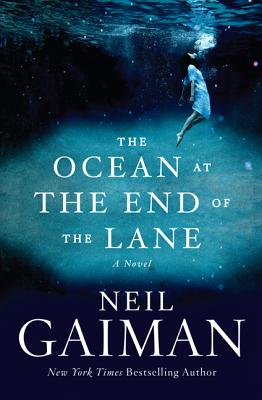
The Ocean at the End of the Lane
by Neil Gaiman

I’m not going to tell you much about the plot of Neil Gaiman’s latest, The Ocean at the End of the Lane. It’s a slender book, under 200 pages, and his first novel for adults in eight years. Here, however, is a short exchange that happens early in the tale:
She shrugged. “Once you’ve been around for a bit, you get to know stuff.”
I kicked a stone. “By ‘a bit’ do you mean ‘a really long time’?”
She nodded.
“How old are you really?” I asked.
“Eleven.”
I thought for a bit. Then I asked, “How long have you been eleven for?”
She smiled at me.
That exchange occurs between the unnamed seven-year-old narrator and his new friend, Lettie Hempstock. However, we first meet this narrator about 40 years later in the novel’s prologue. He’s returned to the rural English village of his youth to attend a funeral. After the service, he takes a drive and finds himself strolling down not only the lane of his childhood home, but down memory lane as well. And what this visit unearths are some long-suppressed memories of extraordinary events.

Mr. Gaiman has been candid in admitting that the bookish protagonist of the tale is a stand-in for his younger self, and that the novel has autobiographical elements—though I think it will be clear that they are merely a jumping off point for the fantastic. And fantastic it is! In all senses of the word.

I read The Ocean at the End of the Lane on Father’s Day, which somehow felt appropriate. And I
read it travel-woozy and jet-lagged. Also good, I think. I was halfway into another world already. What I can tell you is this: I read the book in one sitting. I did not eat, drink, or take a bathroom break. I did not move. It’s possible I did not breathe. But I did get chills. The book opens with what I gather was a true incident from the author’s childhood, a tragedy that is the catalyst for all that is the come. And as the tale grew darker and darker, I began to truly fear for these characters Gaiman had brought to life and made me care about.

The story is a heady combination of fantasy, horror, nostalgia, and coming-of-age tale. Like all of Mr. Gaiman’s work, there is much subtext to be mined. One could discuss the fascinating Hempstock women at length—their mythic origins, the various legends and cultures from which they may have derived, and their relationship to other Hempstocks in the author’s catalog. Or, you could concentrate on how the author examines adulthood from a child’s perspective and childhood from an adult’s perspective. Or, you could identify the influences of numerous other writers on this work, and explore the importance of literature in our lives and the power of story within the tale. The narrator asks, “Why didn’t adults want to read about Narnia, about secret islands and smugglers and dangerous fairies?” (Some of us do, Neil, some of us do.) What I’m saying is, that while The Ocean at the End of the Lane may be short on page count, it’s quite long on substance.

The writing is evocative, eerie, and very, very good. Dialogue and dialect bring characters’ voices to life. (“Right, my proud beauties,” said Ginnie Hempstock, loudly.) The tale moves quickly. At that length, there is nothing superfluous. More than anything, Mr. Gaiman is a masterful story-teller. When he tells you, in the guise of a pre-adolescent old soul, that a duck pond is an ocean, well, you will believe it.


Monday, July 22, 2013

“The next step in human evolution”

Chimera
by David Wellington

David Wellington’s latest novel, Chimera, opens with a prison break. Except, Camp Putnam isn’t a typical prison:
“Sergeant Brian Lourdes had a pretty good security clearance. Not enough to know why those seven men had been locked away so tight. Not enough to know why they were so dangerous they could never be set free. But enough to know what would happen if they ever did get out. Enough to know it could mean the end of America.”
That’s page two of what may be horror writer Wellington’s break-out thriller. So, right from the get-go, readers are told the stakes are high. We learn a few other disquieting facts about these escaped “detainees” in that first chapter. They dodge bullets moving at inhuman speed and gaze at the world through solid black eyes. Cue the eerie music!

Next the action moves to Fort Belvoir, Virginia, and the office of Captain Jim Chapel. Chapel, a veteran of Afghanistan, works at INSCOM, the army’s Intelligence and Security Command handling oversight on weapons system acquisitions. As the novel opens, he’s not exactly field-ready, having lost his left arm in combat. But receiving new orders he notes:
“DIA was the Defense Intelligence Agency, the top level of the military intelligence pyramid. DX was the Directorate for Defense Counterintelligence and HUMINT—HUMINT being Human Intelligence, or good old-fashioned spycraft. DX was the group that used to give him his orders back when he was a theater operative in Afghanistan, but he hadn’t worked for them in a long time—these days his work was handled directly by INSCOM and he hadn’t so much as spoken to anyone in the DIA in five years.”
Therefore, Chapel is an odd choice to track down and, well, neutralize these escaped detainees. What little he learns about them is deeply disturbing. He’s working mostly in the dark however, repeatedly told by superiors that information is on a “need to know” basis. Chapel’s given two things to help track the fugitives down. The first is a list of targets the detainees may be going after. And the second is a “guardian angel” whispering in his ear:
“Captain, I’ll always be with you. But this is as physical as I get. The sweet little voice in your ear, making helpful comments and keeping you company. I’ve already been briefed on your operation, and I’m looking for ways to help right now.”
So, that’s the set-up, and it’s a good one. The tale melds a bit of speculative science with a whole lot of action. The entire premise is about pace, pace, pace, and things move along at a fair clip. Mr. Wellington isn’t Michael Crichton, and while there’s a veneer of science to the tale, for better or worse, it never gets bogged down in facts or exposition.

Given the title of the novel, I don’t think it’s too much of a spoiler to reveal that in the course of his
investigation, Chapel learns that, “In genetics a chimera is an organism that has more than one kind of DNA in the same body.” I had to chuckle a bit over that (much like one of the novel’s central characters) because this tale is a bit of a chimera itself. I can think of any number of other novels it owes some of its DNA to. For instance, in his Sigma Force series James Rollins has written about a protagonist with a high-tech prosthetic arm for years, and Mark Alpert mined that territory as well in his recent science thriller Extinction. As for chimeras, Jeremy Robinson went to town with them in Island 731. Wellington’s creations are far less over-the-top, and I’m not implying that he actually borrowed from any of these writers. There are only so many new ideas under the sun. Some parts of Chimera (such as assistant “Angel” who really kept me guessing for the duration of the novel) feel fresher than others. The romantic sub-plot was neither the best nor worst I’d seen, though the whole “good guy hero just looking for love” motivation felt fairly superficial.

As I mentioned above, the novel moves swiftly. Chimera is more streamlined than a typical Rollins or Preston/Child thriller in that it’s a single narrative thread, making it a quick read—very much the sort of thing to make a long plane ride fly by. There were moments when I felt the plot was getting contrived, but author Wellington often boldly addressed these objections heads on, somewhat overcoming the issue. His protagonists are appealing enough—good news as the novel’s subtitle, “A Jim Chapel Mission” seems to indicate we’ll be seeing Captain Chapel again. Additionally, Mr. Wellington deserves brownie points for creating some strong and interesting female characters.

A science thriller-writing pal of mine once commented that “Writing techno-thrillers is really hard.” (Pithy, he is.) But, yes, it really is. I’ve seen a lot of dismal examples over the years. Chimera certainly isn’t perfect, but it’s promising. I’m quite looking forward to the next Jim Chapel mission.

Saturday, July 20, 2013

“The date for the end of the world… it’s in four days.”

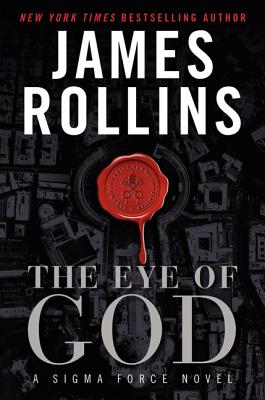
The Eye of God
by James Rollins

The quote above is the final sentence of the first chapter of James Rollins’ latest Sigma thriller, The Eye of God. In other words, it’s just another low-stakes drama from this master of disaster. This time around, the prologue opens in AD 453 with the death of Attila the Hun. From there, we quickly move to present-day Rome, with our old friends Vigor and Rachel. (Already, things are off to a good start.) Vigor is consulting with his niece about a mysterious package he’s just received from an old friend—a priest declared dead more than a decade prior. The package contains an artifact, a human skull etched with Jewish Aramaic. “I believe this relic is an example of early Talmudic magic practiced by Babylonian Jews.” It also contains a book bound in human skin. And these artifacts are pointing towards a coming apocalypse with a very imminent date.

Meanwhile… At an air force base in California, “something’s gone wrong.” So says Sigma’s Painter Crowe, who happens to be in attendance. A special camera has been tracking a comet’s progress through space, trying to collect “proof that the comet was shedding or disturbing dark energy in its wake.” After a few pages of fairly sexy physics talk, remote data is retrieved: “It displayed a satellite view of the eastern seaboard of the United States, the photo taken as the satellite blazed a trail across the sky. It was detailed enough to make out the major coastal metropolises. Boston, New York City, Washington, D.C. Every city lay in a smoldering ruin.” So, you’ve got your ancient prophecies lining up disturbingly with your weird space-time science anomaly prophesies. Ladies and gentlemen, we are off to the races!

Now, I’ve reviewed a lot of Rollins’ novels in the past decade plus, and the reviews are beginning to feel a bit redundant only because Mr. Rollins is so consistent with the strengths of his novels. So please bear with me as I go over the major bullet points:
  • I read a lot of this type of science/adventure thriller and I don’t think there’s another writer out there that can touch Rollins for the complexity of the tales he weaves—and I mean that in an entirely positive way. Above I alluded to Attila the Hun, the Roman Catholic Church, advanced physics, and Jewish mysticism. That is merely the tip of the iceberg. Throw into the mix Genghis Khan, the world’s only freshwater seal, exotic locales spanning the globe, magnetic fingertips (So freakin’ cool!), St. Thomas, multiverses, and the question, “Could the ancient Chinese have had knowledge of events described in the book of Genesis?” In every book, Rollins weaves an astonishing number of incredibly diverse, incredibly cool elements into one cohesive tale. And usually it hangs together so well, I wonder if he hasn’t stumbled onto some secrets of the universe.
  • Again, I must commend the author on his strong female characters. I don’t think readers are ever disappointed when Rachel and Seichan are both a part of the mix. The Eye of God introduces several noteworthy new female characters as well. (And for those of you waiting for something to happen with Gray… Your wait is over.)
  • How many different times and ways can I express my love of Kowalski? This time around he
    enters with the line, “Why does that duck keep looking at me?” Which is just so Kowalski. I thought he was funnier than ever in this book. I want to quote all his best lines, but I’ll refrain.
  • Easter eggs! There are Easter eggs in this novel that refer to a non-Sigma book in the Rollins-verse. It’s not a character this time around. Really, really fun!
  • Not just one super-cool author’s note at the end describing what’s fact and what’s fiction, this time there are several of them.
Now, this is the point where I usually kvetch about a bunch of nit-picky stuff, but I don’t really have any significant complaints this time around. Once I was going to ding him on a plot element being too outlandish, but as he often does, he followed it up with enough science that I was willing to continue suspending my disbelief. No, this is a strong novel in the long-running Sigma series. The plot is fascinating, and I hope it goes without saying that it moves at a lightning pace. Furthermore, there are significant developments among the major players. And that’s all I’ll say about that.

I honestly don’t know how long James Rollins can possibly come up with these convoluted tales he spins. Surely he’s written about every single interesting thing in the universe by now? But apparently not. As long as he keeps writing them, I’m going to keep reading them!

Friday, July 19, 2013

“The Impossible happens once to each of us.”

The Impossible Lives of Greta Wells
by Andrew Sean Greer

I warn you now, I’m going to gush.

The speaker of the above sentiment is the eponymous Greta Wells, the first-person narrator of Andrew Sean Greer’s fourth novel. We are introduced to her as the story opens. It’s New York City, circa 1985, the height of the AIDS crisis. She has just lost her twin brother, Felix—to whom we are introduced in a flashback that occurs not long before his death—at the age of thirty-two. Greta’s grief is almost more than she can bear. When, a few months later, her long-term relationship dissolves, it is more than she can bear. A pervading sadness leads her eventually to the door of Dr. Cerletti, who will administer a course of 25 electroconvulsive therapy (ECT) treatments over a span of 12 weeks. The doctor warns she “might experience some disorientation afterward.”

What Greta experiences is more migration than disorientation. She awakens in a different time, a different life. A different Greta. After her first treatment, Greta finds herself in 1918. World War I is nearly over. Just as she finds herself inhabiting an altered version of herself there, so too she discovers alternate versions of the most important people in her life: Nathan, the lover who left her; her beloved, bohemian aunt, Ruth; and her brother, Felix. Alive.

After her second ECT treatment, Greta awakens in yet another version of her life. It is 1941, and America is about to go to war. Here again are versions of those she loves and a new version of herself and the life she might have lived. So the months pass, spending a day or a week rotating through these different lives in 1985, 1918, and 1941, each with its own joys and sorrows. Because, as Greta learns, no life is perfect.

That is the set-up of this moving masterpiece of a novel. Mr. Greer is rather brilliant in his choice of time periods. The beginning of a war is juxtaposed with the end of a war. The plague of AIDS is juxtaposed with the Spanish influenza of 1918. Changing social mores are examined, and our protagonist gets to explore the lives she might have known if some of her fondest wishes and greatest fears came true. Ultimately, it is up to her to decide the life she will lead, in an eerie echo of her lover’s words, “I leave it to you.” Greer writes:
“A shrew, a wife, a whore. Those seemed to be my choices. I ask any man reading this, how could you decide whether to be a villain, a worker, or a plaything? A man would refuse to choose; a man would have that right. But I had only three worlds to choose from, and which of them was happiness? All I wanted was love. A simple thing, a timeless thing. When men want love they sing for it, or they smile for it, or pay for it. And what do women do? They choose. And their lives are struck like bronze medallions. So tell me, gentlemen, tell me the time and place where it was easy to be a woman?”
At times, I found it difficult to believe this novel was written by a man, so convincing was the voice of his female protagonist. I’m not sure how much I related to Greta, but I believed in her—despite a premise that required significant suspension of disbelief. And I didn’t have to love her, because I fell in love with those she loved, none more so than warm and colorful Aunt Ruth, a veritable Mrs. Madrigal of a woman, complete with kimonos. And I was deeply moved by the relationship of these fraternal twins, so eloquently conveyed by the author, a twin himself.

There are many echoes in this brief book. Echoes of other novels—though Greer’s tale is unique. I
found myself reflecting upon stories as diverse as Ken Grimwood’s Replay, Jack Finney’s Time and Again, and even Baum’s Oz! Greta’s life had echoes of other lives, with lines of dialogue recurring like motifs in entirely different circumstances:

“When you were a little girl, was this the woman you dreamed of becoming?”

“I understood nothing! But it was a great show!”

“If only we just loved who we’re supposed to love.”

These are brief quotes, but I want to pull long passages from this novel. Greer’s prose is so beautiful it hurts. Indulge me once more:
“They say there are many worlds. All around our own, packed tight as the cells of your heart. Each with its own logic, its own physics, moons, and stars. We cannot go there—we would not survive in most. But there are some, as I have seen, almost exactly like our own—like the fairy worlds my aunt used to tease us with. You make a wish, and another world is formed in which that wish comes true, though you may never see it. And in those other worlds, the places you love are there. Perhaps in one of them, all rights are wronged and life is as you wish it. So what if you found the door? And what if you had the key? Because everyone knows this:  
That the impossible happens once to each of us.”
I was very fortunate to receive a review copy of this extraordinary novel from the publisher in late 2012. I held on to it and made it my very first read of 2013. Will it make my top 10 list for the year? Absolutely. Will it be the single best novel I read in 2013? Very likely. But more than that, this is the book I will be foisting on friends 20 years from now. My love of Greta Wells will last a lifetime.

Thursday, July 18, 2013

The story of the T-fest t-shirt

This is me. 

It's a self-portrait I shot in a hotel room mirror a few days ago.  No, no I was not wearing any pants, but that's neither here nor there.  It was Sunday morning, after Thrillerfest, and I'd been up past 4:00am the night before.  'Nuff said.

Please note the t-shirt I'm modeling.  It has a few signatures on it.  It is my memento from Thillerfest VIII in New York.  And I have one t-shirt like this for each of the eight years that the conference has been in existence.  This is the story of how the tradition started.

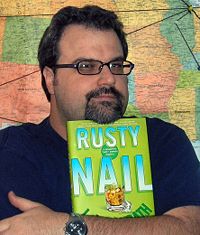
It was the first day of the very first Thrillerfest in Phoenix, way back in 2006.  I already had a few friends in the thriller community.  (I'd actually been at the party at the Algonquin Hotel a year earlier where ITW, and hence Thrillerfest, was born.)  Nothing was really scheduled to begin until late afternoon, and so I agreed to join my friend J.A. "Joe" Konrath to sign stock at a couple of bookstores.  That's a whole story in and of itself.  I actually accompanied Joe on the first two stops of his insane 600-store book tour for Rusty Nail.  Was he grateful for my company as he embarked on this epic journey?  I don't think so.  I recall him snarling, "Flap faster, Susan, faster!"  That was at the renowned Poisoned Pen Bookshop.  After that, we were joining some other ITW authors at a Walmart somewhere in Phoenix.  They were promoting the first Thriller story collection.
Joe Konrath plots his book tour.


There were quite a few big-name authors all sitting at a table, filled with books just waiting to be signed.  When Joe and I walked up, they were all alone.  I know that James Rollins, Steve Berry, and David Liss were there.  Gayle Lynds was supposed to be there, but she was feeling unwell, and I actually wound up in her seat.  And I could swear that there was one other author present, but for the life of me I can't remember who it was.  Isn't that awful? 

This is what I do remember: no one would come near the signing table.  Here were all these best-selling authors, and in the words of a boss I once had--they couldn't sell sex to a sailor.  In the course of about two hours they sold and signed maybe two or three books.  And that was with the added inducement of a free t-shirt!  It was truly pathetic.  At some point, one of them handed me a t-shirt and said, "Here, we'll sign this for you."  They were desperate to sign anything by that time.  And that is the moment this tradition started.

After the signing, I bailed on Konrath and hopped into the back of a limo with Rollins, Berry, and Liss to head back to the Biltmore and the official start of Thrillerfest.  It was where I had the first of many arguments with David Liss, who I'd just met.  Good times!  Eight years later, we're still at it.  It's how we express affection for each other.

Once the conference got going, there were so many awesome writers in attendance, it seemed
David Liss
like a good idea to have them all sign the t-shirt.  As I've said countless times in the years since, "It weighs a hell of a lot less than schlepping everyone's books back and forth from California."  I had a spare Thriller t-shirt I used for the same purpose the following year in New York, and I've bought a cheap t-shirt on the street every year since. 

I'm one of a dwindling number of individuals who have never missed a T-Fest in the conference's history.  The t-shirt is my memento of each year's conference.  It gives me an excuse to interact, at least briefly, with most of the authors in attendance.  The regular attendees know exactly what's up when they see me coming.  F. Paul Wilson addressed me as "T-shirt lady" the other day.  That's a moniker I could live without, but I'm sure he's not the only one who thinks it.  The newbies look at me (with my shirt stretched helpfully over a stitching frame) and say, "That's a great idea!"  Every year someone says, "I ought to do that."  They never do.

Close friends James Rollins & Steve Berry
And there's one more question I get over and over, "What do you do with these shirts?"  The answer, truthfully, is nothing.  I throw them in a drawer.  (Well, technically, most of them are in storage in a box at the moment.)  I'm not really the t-shirt-wearing type.  They're not framed.  They're not sold on E-bay.  They're kept.  I think of each t-shirt as a yearbook for that year's conference.  Who was in attendance that year?  They're a memento of dozens of friendships I've made through Thrillerfest in the past eight years.  So while I don't technically "do" anything with them, they're quite special to me. 

Lately, I've been wondering how much longer I can continuing trekking to New York for Thrillerfest each summer.  I'm eight for eight, but 3,000 miles is a long way to fly.  It's an expensive conference, and I'm neither a writer nor a wanna-be.  The truth is, I go to spend time with my friends.  Many of my closest friends for the past decade have been made at Thrillerfest.  It's hard to believe.  Exhibit A is Boyd Morrison, who I also met on the first day of that first conference in Phoenix and who has become a dear friend.  Eight years later and he hasn't missed a T-fest yet either.  I'm so grateful to spend this time with Boyd and Randi Morrison each year.

I was talking to ITW Director Liz Berry the other day.  We were talking about how many long-time attendees were missing this year's conference for the first time.  Apparently there were about 250 attendees total that first year.  So there can't be that many of us who have made it to all eight?  It was Liz who reminded me of the tenth anniversary of ITW's formation next year, and of Thrillerfest the year after.  That's my goal.  Make it to ten years, ten t-shirts.  After that, well, we'll see.  It's a great party and a great tradition.  I really hate to let it go.
Wednesday, July 17, 2013

A blogger in motion stays in motion...


...and a blogger at rest stays at rest.
 
Except, it would be rather disingenuous to claim that I've been "at rest."  On the contrary, I've been
traveling frantically for much of the past six weeks.  I've been to BookExpo America in New York, down to DC to visit my family, back to San Francisco to get sick, over to Sacramento for WesterCon, and then back to New York for Thrillerfest.  God, I'm exhausted just typing it. Plus, I must confess that all kinds of bad crap has been happening in my life lately.  Exactly the sort of stuff that isn't the scope of this blog, so there's no need to get into it here.  No worries, readers, I'm fine.
 
Anyway, I've just returned from Thrillerfest, where I was introduced repeatedly as a blogger.  Clearly, it is time to get back to blogging before I make a liar of my friends.  Inertia--it's a brutal force.  The good news is that I've read a boatload of awesome books in the past couple of months, and have even written a few reviews.  So, there is much to update you on.  Also, much of my travel has been book-related.  Even the non-book-related travel becomes book-related.  For instance, I did a amazing literary quest while back home visiting my parents and documented it.  So, I'm going to try very hard to get back with the program and posting regularly again.  There are too many good books that need the publicizing! 
But first, I'm going to tell you a story...


Monday, May 27, 2013

Abandon all hope, ye who enter here...

Inferno
by Dan Brown

Dan Brown opens his fourth Robert Langdon thriller running—or rather lying down. The Harvard professor awakens in a hospital. In rapid sequence he discovers that he’s lost two days from his memory; that—astonishingly—he’s in Florence, Italy; and most shocking of all, that he’s in the hospital because persons unknown have tried to murder him. Most of these facts are given to him by a (naturally) pretty young doctor. Mere pages into the novel, an assassin is shooting up the hospital and Langdon and this doctor are on the run. (“She knew it was probably just the adrenaline, but she found herself strangely attracted to the American professor. In addition to his being handsome, he seemed to possess a sincerely good heart. In some distant, alternate life, Robert Langdon might even be someone she could be with.”)

Soon enough, there are more revelations—about this impressive woman, about mysterious objects secreted on Langdon’s person, and about a larger conspiracy. Of course, the conspiracy involves a bio-terror plot, and it can only be foiled by… a professor of symbology! Brown sums the opening up well in the following quote—and forgive me if the punctuation is not letter perfect, I’m transcribing from the audiobook without a printed copy for reference:
“Dante’s Inferno, Langdon thought. Inspiring foreboding pieces of art since 1330. Langdon’s course on Dante always included an entire section on the illustrious artwork inspired by The Inferno. In addition to Botticelli’s celebrated map of Hell, there was Rodin’s timeless sculpture of the three shades from The Gates of Hell, Stradanus’s illustration of pledges paddling through submerged bodies on the river Styx, William Blake’s lustful sinners swirling through an eternal tempest, Bouguereau’s strangely erotic vision of Dante and Virgil watching two nude men locked in battle, Bayros’s tortured souls huddling beneath a hail-like torrent of scalding pellets and droplets of fire, Salvador Dali’s eccentric series of watercolors and woodcuts, and DorĂ©’s huge collection of black and white paintings depicting everything from the tunneled entrance to Hades to winged Satan himself.

Now it seemed that Dante’s poetic vision of Hell had not only influenced the most revered artists throughout history, it had also, apparently, inspired another individual, a twisted soul who had digitally altered Botticelli’s famous painting, adding ten letters, a plague doctor, and then signing it with an ominous phrase about seeing the truth through the eyes of death. This artist had then stored the image on a high-tech projector sheathed in a freakishly carved bone. Langdon couldn’t imagine who would have created such an artifact. And yet, at the moment, this issue seemed secondary to a far more unnerving question: Why the Hell am I carrying it?”
As for the twisted soul above, well, it’s not a priest. Inferno’s plot doesn’t revolve around the Church this time. The catalyst of the novel’s events is a mad scientist. Oh, he’s got a plan, and it’s positively Bond-villain-esque! The fact that his actions make absolutely no sense in the world as we know it must simply be overlooked. This sort of convoluted plotting comes with the madness, you see.

On to the substance of the book… If Brown’s writing has irritated you in the past, you can most
definitely expect more of the same. I think you can see how easily the language flows in the lengthy quote above. The action commences from the outset, as if the characters were sprinting from a starter’s gun, and the pace keeps up, but a lot of it begins to feel like action for action’s sake. Momentum without meaning. Plot is Brown’s bread and butter, and while there is definitely some fun stuff in this book, a big part of me feels like it’s nothing we haven’t seen from this and other authors before. And I, personally, didn’t feel like there was significant emotional payoff to compensate for other flaws.

So, am I trashing this book? No. Not really. Listen, I’ve read every book the man has written. At this point, it’s almost entirely because I need to read what everyone else on the planet is reading. (And apparently I’m immature enough to stay up all night and read it first.) But I love thrillers. Dan Brown does have the basic skills down. The story moves relentlessly forward on short, hooky chapters. It’s the type of quick read that makes long airplane rides fly by, and I’m entirely in favor of that. Furthermore, you might learn a few factoids and a thing or two about art that inspires you to visit a museum sometime. And apparently, Robert Langdon has a great many fans. They’ll be happy to see their old friend (much like his creator) up to his old tricks.

Tuesday, April 30, 2013

Lauren Graham: As funny on the page as she is on the stage!

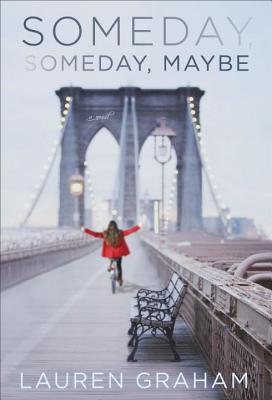
Someday, Someday Maybe
by Lauren Graham

Life is often heavy. Literature is often heavy. Sometimes I just want a little light entertainment, and Lauren Graham’s debut novel, Someday, Someday Maybe sounded like just what the doctor ordered. Now there’s no reason to believe that a gifted comic actress would be a particularly gifted comic novelist. Actually, my expectations might lean slightly in the opposite direction. So let me be the first to proclaim what a fun, funny, clever, and refreshing debut this is. It was absolutely everything I wanted and more than I expected.

Someday, Someday Maybe is the story of aspiring actress Franny Banks. She’d given herself three years to make it in New York, and as the novel opens in 1995, her deadline is fast approaching. Currently, she’s waiting tables, not for Godot. The novel details Franny’s travails personally and professionally as her deadline looms. There’s no real need to describe the plot further.

It seems reasonable to assume that there’s at least a smidge of autobiography in the mix. It can’t be a coincidence that Lauren Graham’s first professional listings on IMDB showed up right around 1995. She’s writing about a time, a place, and a world that she knows. The details ring true. And she does an excellent job of articulating the work of an actor. It’s quite interesting being inside Franny’s head, hearing her thought process, as she taps into the emotions she needs to convey. It’s easy to empathize with the likeable Franny and to root for her to succeed.

One of the greatest pleasures of the novel is the humor. Both actors and the industry are satirized. Additionally, there is rich observational humor. In discussing a neighbor, Graham writes:
“We worry about Frank in the way New Yorkers worry about strangers whose apartments they can see into. Which is to say, we made up a name for him and have theories about his life, and we’d call 911 if we saw something frightening happen while spying on him, but if I ran into him on the subway, I’d look the other way.”
Aside from her career, Franny is a twenty-something woman navigating the rocky shoals of romance. There’s a light chick-lit feel to the novel, and the romantic subplot was truly delightful. Graham has meta-fictional fun with romance tropes:
“I mean, the whole ‘love triangle’ THING bothers me. Who even thought of that? I’ve never been in a love triangle. Especially one where the girl is torn between the obviously right guy played by the more famous actor and the obviously hideously wrong guy played by the slightly less famous actor. And also, why does the heroine always have a sassy best friend? And why is she always a brunette?”
This is not literary fiction. Graham is writing in the voice of her first-person narrator. Yes, there are a
fair number of run on sentences and sentence fragments, but she brings Franny’s voice to life. I could hear her, and she didn’t actually sound very much like Lorelei Gilmore at all. Franny is a new creation. The novel’s prose is very readable, and occasionally it’s more than that. Also, Franny’s tale moves swiftly. It’s a story you’ll read in no time, and the odds are good you’ll be left wishing for a few chapters more.

Graham’s characters are appealing. You want these young people to find their happy ending—whatever that happens to be. The novel comes to a very satisfying conclusion, and I enjoyed my time in Franny’s company enough that I wouldn’t mind at all visiting with her in the future. Given her creator’s success, I’m going to gamble that things turn out alright for her. As for Lauren Graham, I can only hope those long hours on set translate to further forays into fiction. This was an auspicious and entertaining debut. I’m waiting for a sequel.

Monday, April 29, 2013

"This house may not give you what you want, but it will give you what you need."

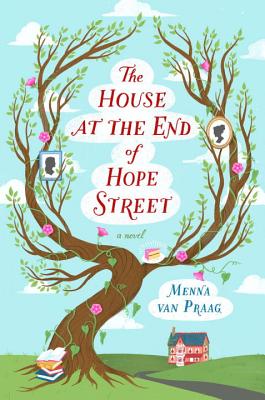
The House at the End of Hope Street
by Menna van Praagh

“The house has stood at the end of Hope Street for nearly two hundred years.” So begins Menna van Praag’s debut novel. In those opening pages, nineteen-year-old Cambridge doctoral student Alba Ashby, reeling from an unnamed “worst event in [her] life,” is inexplicably drawn to the house. Alba is more than an academic over-achiever. She sees things that others can’t: ghosts and auras, but also vibrant and colorful scents and sounds. She immediately senses that this house is different.

Welcomed in by Peggy, the house’s elderly caretaker, she’s told, “You can stay here for ninety-nine nights, until the seventh of August, just before midnight. And then you must go… No rent, no bills. Your room will be your own, to do with as you like. But take care of the house and it’ll take care of you.” This last is an understatement. The house at the end of Hope Street is a veritable Hogwartsian Room of Requirement. When you’re sad and lean against the wall, it softens to comfort you. When you want to draw, a notebook materializes. You get the idea.

The tale opens with Alba, but eventually it proves to be an ensemble fantasy, as readers meet the other inhabitants of the house. There’s Peggy, of course, as well as an aspiring singer, Carmen, and actress, Greer. Each woman gets her ninety-nine days for healing, for reinvention, for whatever it is she needs. And this has been going on for two centuries. All over the house are framed photos of illustrious and accomplished ladies: Florence Nightingale, Daphne du Maurier, Vita Sackville West, Beatrix Potter, and dozens of others. (Don’t worry that you won’t recognize all the names—such as Elizabeth Garrett Anderson, the first female doctor in England—there’s a handy guide to all the ladies at the novel’s end.) These women are more than the house’s history; they’re a part of its present. Their photographs speak and frequently advise the house’s current tenants. It’s just that kind of place. Okay, so that’s the set up. I’ll leave the actual plot for you to uncover.

The reason I actually decided to take a chance on this book is that Ms. Van Praag was compared to so many authors whose work I loved: Jasper Fforde, Sarah Addison Allen, Alice Hoffman. I’d say that Addison Allen is the most apt comparison, and that fans of her light, magical realism-filled novels are likely to enjoy this. I don’t believe that van Praag’s prose is up to par with Ms. Hoffman’s lush writing. And Jasper Fforde was, for me, the strangest and most disappointing comparison. While it’s true that many classic literary figures make an appearance in the novel’s pages, this book contains none of the wit and great humor that is such a feature of his work. Overall, I’d describe this as gentle women’s fiction with a fantastic edge.

As the paragraph above indicates, I had a mixed response to the novel. I’m not going to lie… I had issues with Alba. “Every day she went to the library at the same time. Every day she bought her lunch at the same cafĂ© and ordered the same thing.” This character is not just boring and repressed; she’s painfully shy and incredibly passive. When confronting a person who has wronged her terribly, she’s “barely audible.” Again and again I found myself wanting to slap this little mouse. And this is something I see in fiction all the time. An author who wants to show growth creates a character that is so damaged and diminished that it’s hard to care about her. (Kinder, gentler readers may well disagree with me on this.)

In general, I found the characters of the novel to be fairly one-dimensional. Alba has siblings, for instance, that are so cold and uncaring that they in no way resemble real human beings. And another thing—if you use historic figures like Dorothy Parker and Sylvia Plath as characters, write them dialogue that sounds like it might come out of their mouths. Give Parker a witty line, for God’s sake! Give Plath some poetry!

On the other hand, one of the great pleasures of the novel is the bibliophily on display throughout.
Alba is a serious book lover, her one redeeming quality. I thoroughly enjoyed her ruminations on literature. And even if they weren’t well-characterized, the extensive literary cast and references were great fun. I’ve always said that you can’t go wrong preaching to the choir. The story, in general, is entertaining and it all moves quickly. Also, Ms. van Praag did manage to surprise me with a few fun plot twists I didn’t see coming. And I actually quite enjoyed the theme of female empowerment, as exemplified by the house’s past tenants. The other thing that van Praag handled well was the novel’s resolution. While I felt frustration with certain elements of the tale, I have no complaints about the ending. It was the feel-good fix I was looking for.

So, all in all, a mixed bag. I’m happy enough to have read the book. It was quick and not overly challenging. In other words, not a bad way to pass a day. And the great thing about debut novels? The authors are still learning and growing. Who knows what Menna van Praag may dream up next?

Friday, April 26, 2013

Helene Wecker says: "I'm a giant nerd."


Okay, I'm just going to make this Helene Wecker Week on the blog, because I can't seem to stop talking about her wonderful debut novel, The Golem and the Jinni.  I have already bullied stiff-armed coerced encouraged several friends to read this novel, and they've loved it as much as I have.  Really stunning debut novels are rare.  When you uncover one, the news must be shared.  Am I right?

Helene and I have been chatting casually via Twitter for months now.  It's just a coincidence that she,
This photo was too cute not to steal from Linus's Blanket!
too, lives in the Bay Area.  (Good God, we have some serious literary talent in this part of the country!)  We'd never met until last night.  I was so delighted to be able to attend her official book launch party held--where else?--at the Booksmith on Haight Street.  (For those who are keeping score, it was my third visit to the shop in a week.)

And I am equally pleased to be able to share footage of this event with folks who aren't able to catch Helene on tour.  This was her first bookstore event ever, and she performed like a seasoned pro.  In the very first clip above, she makes a few introductory remarks and also sets up the first selection that she will read.  That takes up the first seven and a half minutes.  After that, she reads the passage that introduces her golem.  In this second clip, she introduces her jinni:


These next two video clips below are the Q & A session.  Helene discusses both pop-culture and literary influnces, the research process, language barriers, and (in response to me) why golems are cool and vampires are not.  In part two, she discusses the industry of turn of the century New York, audiobiographic influences, what she'll be working on next, and overseas publication.  Look for a really amusing response to a reader's interpretation of an element of the book.

Enjoy the book, enjoy the video, and spread the word!