Showing posts with label non-fiction. Show all posts

Wednesday, January 15, 2014

“Art stands on the shoulders of craft…”


This is the Story of a Happy Marriage
by Ann Patchett

Ann Patchett is a writer I’ve come late to. Everyone raved about Bel Canto, but opera-lover that I am, have I read it yet? Nope. Still, her most recent novel, State of Wonder, made my annual top 10 list, and seeing her speak inspired a blog post entitled, “No one ever told me Ann Patchett was so charismatic.” So, even though I read relatively little non-fiction, I was well-primed for this collection of essays, penned over the course of many years. Allow me to cut to the chase and tell you that I loved this book from start to finish.

After a brief introduction meditating on the differences in writing fiction and non-fiction, Patchett launches into writings on craft. And I thought to myself, I could read her thoughts on this subject all day! At one point, she writes, “If you’ve read this far, you must be pretty interested in writing yourself.” On the contrary, I’m the furthest thing from a writer and I was utterly captivated. And while I don’t write, there were plenty of underlined quotes to share with writing friends.

Ms. Patchett truly charmed me in these pages. I found her reflections on her most influential teachers
both generous and winning. Likewise, I was utterly enchanted by her essay on attending the Met’s simulcast at the local multiplex. Ms. Patchett writes on subjects that resonate with me—her love of her dog; ups and downs with her husband; on becoming an independent bookseller, and the importance of bookstores in our communities; on her relationship with her elderly grandmother. An unexpected, but terrific, story recounts her efforts to get into the LAPD Police Academy. There’s great diversity in the collection.

Ms. Patchett, as always, writes beautifully. And as so much of the writing is frankly autobiographical, her voice and personality come shining through in each entry. They paint the portrait of an artist whose work—whether fiction or non-fiction—I intend to get to know better. And they portray an interesting and accomplished woman with whom it was a true pleasure to spend time.

Thursday, March 14, 2013

“For the moment, then, let’s allow our imaginations free reign.”

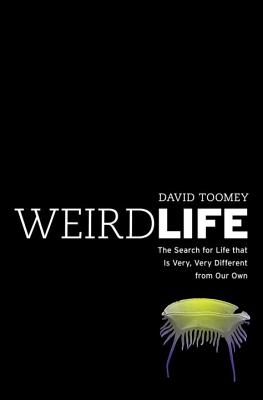
Weird Life: The Search for Life That Is Very, Very Different From Our Own
by David Toomey

Look, I’m as geeky as the next girl. How can you hear the subject matter of this book and not be fascinated? David Toomey opens Weird Life exactly where I would expect—with extremophiles. Extremophiles are some of the most unusual and extraordinary creatures in all of biology. Which makes sense, because life = biology. Right?

That’s what I thought, but clearly that’s due to a massive failure of imagination on my part. One the most impressive things about Toomey’s book are the sheer breadth, depth, and scope of what is covered. Toomey starts with biology—microbiology, exobiology, marine biology, synthetic biology, molecular biology, astrobiology, evolutionary biology. That, friends, is the mere tip of the iceberg. Toomey touches on disciplines and theories including: organic chemistry, inorganic chemistry, interstellar chemistry, molecular chemistry, biochemistry, nuclear chemistry, geology, genetics, robotics, computer science, mathematics, theoretical physics, particle physics, quantum physics, astrophysics, string theory, nanotechnology, multiverses, astrology, botany, taxonomy, engineering, ecology, epistemology, psychology, and philosophy. If that’s not enough, there’s even a chapter on weird life in science fiction! This book is thorough, that’s all I’m saying. There’s a reason for this:
“The attentive reader may have noticed that ideas for the weirdest sorts of weird life did not originate with biologists or even, for that matter, with astrobiologists. They came from scholars and practitioners in other fields. The hypotheses of life in other universes were formulated by theoretical physicists (Harnik, Kribs, and Perez; and Jaffe, Jenkins, and Kimchi). Ideas of life in the vicinity of black holes and the atmospheres of white dwarf stars were conceived by astrophysicists (Adams and Laughlin). Hypotheses of life surviving through eternity were developed by a mathematician and theoretical physicist (Dyson), who also supplied us with what may be the broadest definition of life so far. Of the many ideas of weird organisms from science fiction, two that are notably well grounded in science are from a physicist turned aerospace engineer (Forward) and from a professional astronomer (Hoyle). Even the relatively conservative hypothesis of hydrogen-breathing dirigibles was proposed by a physicist (Saltpeter) and a planetary scientist turned astrobiologist (Sagan).”
So… there’s some smart stuff in this book. Do not be intimidated! I’m incredibly uneducated, and I had no difficulty reading Weird Life from cover to cover. My mind was occasionally blown—but always in a good way. And if you need a little reminder on the difference between a mesophile and a methanogen, please be aware that there’s a glossary at the back of the book between the text and the endnotes, but before the very thorough bibliography.

This book covers science that is being done right up to the minute. At least three times a variation on the phrase “as we go to press” was used. This science is emergent and so very, very fascinating. Here’s a good example, arising from our lack of understanding of what comets are made of:
“Being mostly solid bodies, comets resist interferometry. In 2003, it occurred to Allamandola and his colleague Doug Hudgins that there was another way. If they could make a comet from scratch, they could study it. They took a sample chamber called a “cosmic ice simulation chamber,” removed most of its atmosphere, and froze what was left to a temperature near absolute zero, thus making the inside of the chamber a fair representation of deep space. They introduced into the chamber a few simple molecules that might be found in a star’s outflow, and turned on a lamp (representing nearby stars) that bathed the molecules in ultraviolet radiation. Then they waited. They were not expecting much, and they were certainly not expecting what happened. The molecules combined, split, and recombined, and before long the chamber contained some very complex molecules, many of which were prebiotic.”
Is your mind blown? Maybe it’s just me. But I couldn’t put this book down. My only minor disappointment is that there weren’t more photos and illustrations, but I guess it’s hard to fault an author for not including images of hypothetical things that may or may not exist. Toomey did pretty well, all things considered.

Life, in all its colors and flavors, is amazing. Mr. Toomey has reminded me of that fact. This was the most enjoyable science book I have read in quite a few years. My mind and ideas have been expanded, quite painlessly. So let’s, as Mr. Toomey suggests, allow our imaginations free reign.

Friday, November 18, 2011

33 years later, it’s still inconceivable

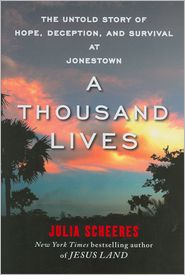
A Thousand Lives: The Untold Story of Hope, Deception, and Survival at Jonestown
by Julia Scheeres

On November 18, 1978, the day of the Jonestown massacre, I was nine years old.  I vaguely remember the news stories, but I’ve always wanted a more adult understanding of these inconceivable and tragic events.  I don’t read a whole lot of non-fiction, but Julia Scheeres’ A Thousand Lives: The Untold Story of Faith, Deception, and Survival at Jonestown seemed like exactly what I had been looking for.

The book takes its title from an eerie 1975 Jones quote, “I love socialism, and I’m willing to die to bring it about, but if I did, I’d take a thousand with me.”  And it delivers on what it promises in the title, starting with “hope.”  Scheeres describes Jones’s early life in Indiana, and the way he was drawn to the church from childhood.  By the time he was a teenager, he was preaching on street corners.  And he was preaching a fairly radical (for the times) message of inclusion, integration, and racial tolerance.  This was the philosophy on which he founded his first church in Indiana in 1954.  Reverend Jones’s attitudes about race were ahead of his time, and he quickly built up a devoted, multicultural flock.

Alas, it didn’t take long for “deception” to enter the picture.  Jones was a practitioner of faith healings.  While some may claim to have been genuinely helped by the man, his trickery in bringing about his so-called miracles is well established.  In addition to simple cons, Jones was a master manipulator.  He utilized all kind of tactics—from inducing paranoia to actually drugging people without their knowledge—all the while increasing his sway over his church-goers.  A few years after the Indiana church was established, he convinced a healthy percentage of them to pick up and relocate to rural Northern California to avoid a predicted nuclear explosion in Chicago.  The relocated People’s Temple thrived in Redwood Valley, California, before it eventually relocated yet again to San Francisco.

Scheeres reduces the epic tragedy to a human scale by introducing the reader to several individual church followers.  Dating all the way back to the Indiana church were sisters Hyacinth Thrash and Zipporah Edwards.  In Redwood Valley, grief led the entire Bogue family to the church.  In San Francisco, juvenile delinquent Stanley Clayton stayed on the straight and narrow because of the church community.  And Edith Roller, a well-educated, 61-year-old “opinionated loner” came to the church as an agent of social change.

Scheeres writes, “The world seemed to be imploding in the late 1960s and early 1970s, and his message struck a nerve.  The headlines were saturated with death: Vietnam, nuclear war, murdered civil rights leaders, and student protestors.  Americans of every stripe were angry, insecure, afraid.  Gone was the Leave It to Beaver complacency.  The establishment fissured along with its enabler—mainstream religion—and people turned for solace to alternative sources of supposed wisdom, including gurus, spiritualism, astrology, and self-help.  The time was ripe for a self-appointed prophet like Jim Jones.”

Scheeres details the events that led inexorably to the Temple’s final move to Guyana and the shocking tragedy that occurred there.  She is assisted in this effort by new information in the form of thousands of pages of FBI documents that have recently been declassified.  The full perversity of what went on with Jones for years, and the crimes he perpetrated against his followers, is staggeringly difficult to believe: the sex, the drugs, the madness, and the abuse of power.  It’s a terrible, terrible story, and yet the book is a quick read—in part because the last 40-some pages of the book are made up of end-notes than can be easily skipped.

I think that Scheeres has done a reasonable job of relating the history in as impartial a manner as anyone could.  Following specific Temple members closely and watching their eventual fates unfold was an effective way to tell the story.  Where I felt let down was in trying to understand with any real depth the psychology of those involved.  I especially hungered for more information on what was going on inside Jones’s head, but that may be something we will never know. 

You couldn’t sell this story as fiction; it’s simply too unbelievable.  Looking back seems worthwhile, but in the end, I’m not sure what we’re supposed to have learned.

Tuesday, May 10, 2011

A story so amazing, I wish it weren’t true

Long Way Home: A Young Man Lost in the System and the Two Women Who Found Him

I’m a fiction girl. Ninety percent of what I read is fiction, and I like it that way. So, that when I read something especially upsetting, I have the comfort of knowing, “It’s just a story.” And it is for the reason above that it has taken me six months to review Laura Caldwell’s extraordinarily compelling non-fiction book, Long Way Home: A Young Man Lost in the System and the Two Women Who Found Him. This book affected me so powerfully that I needed time to simply process my feelings.

“The Sixth Amendment guarantees all Americans the right to a fair and speedy trial.” That is what I kept repeating to myself as I read the absolutely staggering true story of Jovan Mosely. Jovan’s story begins in one of Chicago’s toughest neighborhoods. Despite every bad influence in the book, this teenager had managed to keep out of trouble and away from the gangs. He was smart. He did well in school and was thinking about college. All of that changed on August 6, 1999 when he was 19 years old. He was out walking with some friends and acquaintances when they came across a group beating a man in the street. Jovan took no part in it, and when he saw the direction that things were heading, he walked away. But witnesses placed him at the scene. When the victim died, Jovan was picked up for questioning. He was not out of custody again for the next six years of his life.

The phrase that comes to mind to describe Jovan’s ordeal is “miscarriage of justice.” I’m aware of what a cliché it is, but how else can you describe an innocent man’s life stolen? Jovan’s story reads like a John Grisham plot at its over-the-top best, but it’s a lot less entertaining when there’s a real life on the line.

Enter author Laura Caldwell. In addition to being a writer of light mysteries, she is a former civil attorney and a professor of law at Chicago’s Loyola University. She has researched this story backwards and forwards and has laid it out in a straightforward and engaging manner. Additionally, she addresses what went wrong by looking at the issues from all sides, rather than simply casting blame. Caldwell is more than qualified to be the chronicler of this tale, but perhaps what is most amazing is her personal involvement in the story. After years of unjust imprisonment, Jovan finally acquires competent counsel in the form of defense attorney Catharine O’Daniel. At last he will get his day in court. But his attorney needs help trying this pro bono murder case. One thing leads to another, and she convinces a writer with no background in criminal law to second chair.

It’s such an amazing story! Surely someone is developing the film? But it is when she becomes a major player in the drama that author Caldwell shows the most restraint. There’s no self-aggrandizing here. In fact, she downplays her role as much as possible. I’ll say it again, John Grisham couldn’t have invented a more compelling tale. Truthfully, by the time I finished reading the book, I felt angry and helpless, as there is little the average citizen can do to change the system. But my eyes are open now, and to the degree that I can effect change, I will.

Read. This. Book.


Monday, February 21, 2011

My name is Susan and I’m a dummy…

Blogging for Dummies
by Susannah Gardner & Shane Birley

No, really, a BIG dummy because I’ve been blogging for two years now! I got tired of looking at other people’s awesome blogs and thinking, “Why can’t I do that?” I finally admitted that I was a big, hopeless dummy and bought this book. God, I wish I’d done it sooner!

With two years of experience under my belt, I figured that I’d just skip around the book, picking out little nuggets of info here and there. On the contrary, I find myself reading the vast majority of the chapters in their entirety. The book is written in a pleasant and engaging style. I figure it can’t hurt to do a little remedial work on the stuff I think I already know. Meanwhile, I’m just thrilled with what I’ve learned already. Don’t laugh at the blonde girl, but links have always been a mystery to me. Now, I’m a pro! I’ve “claimed” my blog through Technorati. I’m committed to adding occasional guest blogger posts. I’m working on a simpler redesign of my blog, and I’m considering ways to add multimedia posts. I’m going to spruce up my sidebar and try to engage my community more. The great thing is that now I have a reference that will help me accomplish all of this and more.

My only complaint is that while this most recent edition (the third) is barely a year old, already some of the information is becoming outdated. I don’t know if I’ll spring for the fourth edition once it’s published, but I’ll definitely take a look at it to see what’s new.

I have a list of friends waiting to borrow this reference book. It may not be the right tool for all bloggers, but it you’re as clueless as I clearly am, Blogging for Dummies is highly recommended!


NOTE:  I wouldn't normally post a review of a book like this to my blog, but changes are afoot, and I wanted to give you guys a heads-up.  This would be a great time to chime in in the comments on anything you'd like to see added or changed with the blog.  I'm open to suggestions, and after all, it's all about you, dear reader.  ;-)

Monday, January 10, 2011

Absolutely deserving of all the praise it has received!

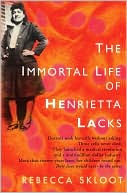
The Immortal Life of Henrietta Lacks
by Rebecca Skloot

What is there to say about a book so widely acclaimed? What can I possibly add to the discourse? Truthfully, there isn't much I can say that hasn't been said before, so I will keep this brief.

The Immortal Life of Henrietta Lacks is journalist Rebecca Skloot's first book, and it was ten years in the writing. In that time, she didn't merely research her subject matter thoroughly, she became a participant in the story she was writing. As a biology student, Rebecca's interest was piqued when she learned of the contribution to medicine and science of a cell line called HeLa--the first ever "immortal" human cell line. Immortal because the cells would continue to reproduce in culture indefinitely, as long as they were fed and cared for. It had been going on for decades. What Rebecca wondered was: Where did these cells come from? Therein lies the tale...

Nowadays, it is relatively common knowledge that these cells were cultured from a woman named Henrietta Lacks who died of cervical cancer back in 1951. That wasn't always the case. Ms. Lacks' identity, and the contribution she unwittingly made to the world, was obscured for years. Unwittingly, because the culture of her tumor was taken without her knowledge or consent. This was common practice at the time.

The book covers a lot of territory. There is detailed biographical information about the life and death of Henrietta Lacks. There is a lot of information about the contribution of the HeLa cells to science, from helping develop the polio vaccine, to going up into space. There is a thorough discussion of the bio-medical ethics in general, of the sad history of this issue and race, and in light of current issues and technology. And, finally, it is very much the story of the family that Henrietta Lacks left behind, her husband, five children, and innumerable cousins, and their interactions and relationship with the author.

Material that could have been overly complex or dry is absolutely engrossing. And all subject matter is handled with sensitivity and intelligence. It was all so interesting, but I think my favorite parts were the ethical discussions, past, present, and future. Reading the shameful history is painful. Unfortunately, in many ways the present isn't much of an improvement. Ms. Skloot ends her book in a primer of the issues we face moving forward. Hopefully, the more educated we are, the better we can protect ourselves and others. For now, it's a small step forward to see this subject matter gain such wide readership. And happily, there seems to be little danger of Henrietta's name or contribution being lost to history again.

Friday, October 29, 2010

You *are* what you read

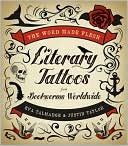
The Word Made Flesh: Literary Tattoos from Bookworms Worldwide
by Eva Talmadge & Justin Taylor

I've never considered getting a tattoo. They're fine, but never held any personal appeal... until I saw The Word Made Flesh. It's a photo essay of literary tattoos, and in addition to the fine editors who put the book together, it owes its success to the creativity and literacy of the individuals pictured within. Don't expect to see a lot of smiling faces. Most photographs are disembodied arms, legs, and other assorted body parts.

The tats pictured take all forms. Many are literary quotations, and it's quite fascinating to see the words that moved a reader so profoundly that he or she literally wanted them to become part of their selves. Other tattoos were recreations of cover art, illustrations, bookish logos, punctuation marks, and even portraits of authors.

One of the sequences that interested me most was a press release and a series of photographs from "The Skin Project." Writer Shelley Jackson has penned a 2,095-word short story entitled "Skin." It will never be published anywhere. The only place it is being printed is word by word on the bodies of volunteers. The only individuals who will ever be privileged to read the entire text are the tattooed "words." Five of them are pictured. And once the "words" die, the story will be gone. Very cool.

While the photographs are the central focus of the book (and they're nicely shot and pleasingly laid out), the text is likewise pleasing and diverse. Much of the text is made up of brief discussions of the tattoos in the bearers' own words, which are almost always interesting. The editors do a good job, as well, keeping things mixed up. I mentioned the press release earlier. At one point, a two-page short story that inspired a tattoo is printed in its entirety. Elsewhere, a man talks about his tattoo, and the writer quoted responds to being immortalized in this manner.

The pictures in this book are awesome! But after I'd done the quick flip, I went back and read every word of text. Literature is my greatest love, and I dig people who have been permanently marked by their reading. And I really dig this little book!

Wednesday, October 27, 2010

Culture vultures, prepare to feast!

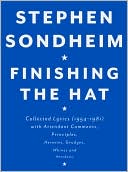
Finishing the Hat: Collected Lyrics (1954-1981) with Attendant Comments, Principles, Heresies, Grudges, Whines and Anecdotes
by Stephen Sondheim

If you are lucky, you will discover artists whose work speaks to you in a very profound way. For me, it's the paintings of Henri Matisse, the novels of John Irving, the musicals of Stephen Sondheim. I'm an unabashed fan.

Mr. Sondheim's new coffee table book, Finishing the Hat: Collected Lyrics (1954-1981) with Attendant Comments, Principles, Heresies, Grudges, Whines, and Anecdotes, is a gift to us all. Before you even start reading the text, flip through it and you'll see that this is a gorgeous book. It is chock full of photographs--more than 200--many of them full page blowups. There are pictures and artwork from the productions, candid photos from Mr. Sondheim's personal collection, and images of his hand-written notes, lyrics, and sheet music. This book is richly and beautifully illustrated. The only small disappointment is that all images are black and white, but it is truly a minor complaint.

Once you've feasted your eyes, dive into the text. Almost immediately, you'll see that Mr. Sondheim has written his book with the care and precision with which he writes his songs. There's a slight formality to the tone (with the laying down of copious rules along the way), but at the same time, it's a very candid look at his work, his collaborators, his predecessors, and his life. For musicians or composers, there is much substantive information on his process. And for theater buffs like me, this book is a treasure! Mr. Sondheim's contributions are the apotheosis of musical theater. The shows recounted are theatrical history. Sadly, I'm too young to have seen the original productions of any of these 13 shows, but now I've heard about the drama behind the scenes of Merrily We Roll Along straight from the horse's mouth. I know his two regrets from West Side Story, what he really thinks of theater critics, how he wanted to plot A Little Night Music, and the influence of Hammerstein's Allegro on his career. The truth is, there is just so much packed into this book, it is simply impossible to even begin to summarize the contents.

This book is specifically dedicated to Mr. Sondheim's lyrics, and what a joy it was to sing, er... I mean, read my way through them. To give you an idea of how comprehensive Finishing the Hat is, every lyric of every song from the original production of Follies is included. Nine songs cut from the show are included, along with the reasons behind the changes. A revised lyric for a later London production is included. And altered versions of "I'm Still Here" (for Barbara Streisand and for the film Postcards from the Edge) are included. And always Mr. Sondheim's thoughts, observations, and occasional criticisms are shared, often through the use of extensive footnotes.

The book ends at Merrily, 423 pages in, with a provocative statement and the word INTERMISSION. This is indeed the intermission between the volumes of Mr. Sondheim's collected lyrics/memoir, the second of which will encompass the remainder of his storied career. I can only hope the second book is well into its production. As excited as I was to get my hands on this book, it is truly more than I could have hoped for. In the end, it's a fitting testament to an immense talent.