Showing posts with label 2-star review. Show all posts

Sunday, October 14, 2012

Wonder twin powers ACTIVATE!


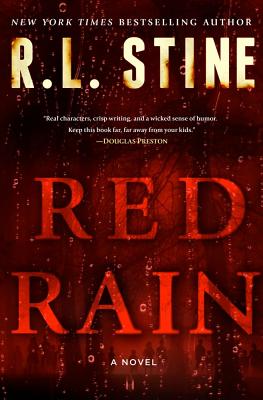
Red Rain
by R. L. Stine

The pop culture reference above has probably already alerted you to the fact that I'm a good decade older than the kids who grew up reading R.L. Stine--which is not to say that I haven't read his kid lit. I'm that kind of adult. And let me put out there that I have nothing but respect for this talented author, so youthful Stine fans, please don't beat me up for the following review. Yes, it's critical, but I'll support my criticism.

Stine's latest foray into writing for adults is of limited success. First, a brief synopsis: After a prologue, we follow the exploits of "adventure travel blogger" Lea Harmon Sutton as she visits the mysterious Cape Le Chat Noir off the coast of South Carolina. It's a beautiful part of the country, but apparently no one visits due to the island's spooky reputation. Says Lea in a blog post:
"I've saved the best (or worst) for last. Here's the most interesting historical detail--and it's definitely creepy. Especially with frightening forecasts of a big hurricane heading this way. I don't want to talk about the hurricane now. I'm pretending it's not going to happen. You see, Le Chat Noir was devastated by one of the most powerful storms in hurricane history. It was the Labor Day Hurricane of 1935. And I have every finger crossed that history is not going to repeat itself now."
Okay, we're going to return and look at the quote above more closely in a minute, but for now we'll move on. In short, you'll be shocked to learn that the hurricane hits. At this point, we are introduced to Lea's husband Mark, a child psychologist who is just wrapping up the book tour for his best-selling (if controversial) book about child rearing. He gets a panicked call from Lea in the hurricane while he's on stage at a book signing. He can't wait to wrap things up and head home to Sag Harbor and their two kids and his single mother sister to await further news from Lea.

Back to Le Chat Noir... The devastation is complete and Lea is traumatized. In the midst of the "horror," Lea encounters two angelic blonde 12-year-old twins, Daniel and Samuel. They tell her that they've lost their parents and home in the hurricane. Lea is instantly smitten with these two kids and decides on the spot that she's going to "adopt" them (in the completely illegal sense of the word) and take them back to New York:
"Later Martha warned her that she was being too hasty. `You don't know anything about these boys. You are acting on pure emotion. You need to wait till you can think about it clearly. Do some research. Try to find out something about them.'"
Ah, if only. Lea proceeds over the strenuous objections of her husband. We're now at 20% of the book, and at this point the story actually starts. What follows is a evil twin/bad seed mash-up with an utterly ridiculous supernatural twist. And I guess what I have to say about the novel is: There isn't enough willing suspension of disbelief in the world.

Let's return to that first quote I pulled. A few observations... Visiting a spooky island is considered adventure travel? And the fact that there was once a terrible hurricane is "the most interesting historical detail" a travel writer can come up with about the place? Meanwhile, with the island's history, another major storm is forecast and there isn't a single mention of evacuating in advance of it? And then, if you're an adventure writer who went into this scenario with your eyes wide open, to completely lose your mind in the aftermath? Finally, a past hurricane is considered "definitely creepy"? That will give you an idea of the level of horror in the novel.

Throughout the novel, I had big, big problems with believability of events and characters' actions, and that was before the supernatural even came into it. But there were many other problems. As noted above, this is supposedly a horror novel, and I am admittedly the biggest wimp alive. While there were occasionally gross-out scenes, there wasn't a single scary moment in the book. Part of me wondered if this was supposed to be some sort of horror satire, because I know that R.L. Stine is a truly funny man. If so, I missed the humor entirely. This book is notably un-funny.

And, I'm sorry to say, it is badly written. The more traumatized the characters became, the more cringe-worthy their dialogue. I could quote, but I'll spare you. And on the subject of dialogue, let's talk about redundancy. Three separate times, Mark confronts the eavesdropping twins asking "How long have you two been standing there?" within less than 100 pages. Who was editing this book? Because there were also flat out errors. At one point Mark states that he hadn't seen his wife in "a week" when it had been, like, a day and a half. At another point Martha claims that a priest who held a ceremony in 1935 "told" her something. Well, I suppose it's possible, but it seems highly unlikely.

Individually, none of these issues are deal-breakers, but when you have flaw on top of flaw, it gets awfully hard to immerse yourself in a story, and virtually impossible to believe it. Despite these many criticisms, I will say this: It wasn't a terrible reading experience. The book moved quickly. It was both well-paced and also relatively short, with brief chapters and lots of white space on the pages. I read the book in just a few hours, and while I can't recommend it or really say I liked Red Rain, I truly didn't hate it. I was curious to see what Mr. Stine had written, and now I know. I think I'll stick to his children's fiction.

Monday, September 17, 2012

It had all the ingredients, but this feast failed to satisfy

John Saturnall's Feast
by Lawrence Norfolk

Like other readers, I really wanted to like this novel. It had so much buzz at BEA, and they did a beautiful job with the production of the novel, with lovely illustrations, beautiful endpapers, and red ink accents throughout. Alas, despite my optimism, I found Lawrence Norfolk’s latest a real slog.

John Saturnall’s Feast is the story of John Sandall (who rechristens himself Saturnall for reasons of his own), on his journey from social outcast to kitchen boy to master chef of a 17th century British estate. Moreover, it is a love story between servant and mistress. And finally, it is the story of a struggle to preserve the custom of an ancient feast (but I’d be lying if I pretended I fully understood anything about that sub-plot).

Many have commented on Norfolk’s beautiful prose. Now, I’m a regular reader of literary fiction, but I found the 17th century language difficult and burdensome. Furthermore, the archaic recipes that preceded each chapter brought the action of the novel to a grinding halt—which was unfortunate, as things were already moving at a glacial pace. That seems odd to say about a book that dealt with life and death, love and war, but it took me weeks to get through this novel, simply because it was a chore to pick it up. And again this is strange, as in addition to a love story, this was essentially 17th century food porn, and I love that stuff. But the food was as disinteresting and unappealing as the central characters.

I never connected with either John or Lucy emotionally. I didn’t find them especially likable, which made it hard to care about their romance. Nor did I feel that I ever truly understood who they were as people. I will admit that the second half of the novel was more compelling than the first, but that’s not really saying that much.

Regular readers of my reviews know that it’s rare for me to be so negative, especially for a novel of literary merit. Clearly this book did not work for me, but seems to have resonated far more with other readers. I am sure it’s a fine book, but I am happy to at last move on.

Wednesday, December 21, 2011

Imagine the most boring John Hughes film never made…

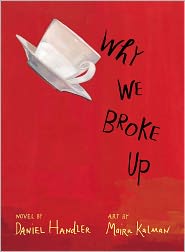
Why We Broke Up
by Daniel Handler
Art by Maira Kalman
Release date: 12/27/2011

“Dear Ed,

In a sec you’ll hear a thunk.”

So begins Daniel Handler’s (AKA Lemony Snicket) latest YA offering, Why We Broke Up. The aforementioned “thunk” is the sound of a heavy box flung by Min Green hitting the porch of her ex-boyfriend, Ed Slaterton. The 350-page novel is comprised of the long, long, long letter that she includes as she returns to him the minutia of their relationship. This relationship is recounted from start to finish in the letter/novel through Min’s apparently photographic recall. Scattered throughout the text are Maira Kalman’s charming illustrations of the contents of the box, which range from bottle tops to ticket stubs to clothing.

With all the drawings and white space throughout the book, it isn’t really a full 350 pages, and yet it felt longer. It was written as an angsty, teen, stream of conscious rant, and it was chock-full of pointless filler, such as detailed descriptions of dozens of fictional films, made by fictional people, starring fictional stars. You see, Min’s the substantive one in the relationship. She’s “different.” Ed’s a popular jock, co-captain of the basketball team. They’re from different worlds, with different friends! And yet they struggle to make it work.

I’ve never been an adult that had the slightest problem reading and appreciating YA or children’s fiction, but this was just an overly drawn-out, boring, and humorless waste of time. Ultimately, I found it unsatisfying on every level. And that, Daniel, is why WE broke up.

Note to parents: This novel includes frequent obscenities, underage drinking, references to drug use, lack of respect for parents and authority figures, and teen sex.

Thursday, December 15, 2011

Too much... something

Too Much Stuff
by Don Bruns

I had been looking forward to reading Too Much Stuff, my introduction to Don Bruns' work. I love both comic novels and treasure hunts, so I thought this would be a sure-fire winner. Ever the optimist, in this case I was mistaken.

Too Much Stuff is, I believe, the fifth sixth novel in Bruns' Stuff series. While it's true that I have not entered this series with the characters' full back stories and histories, I have a very difficult time imagining it would have made a difference in my enjoyment of the novel. The protagonists at the center of the series are 20-somethings Skip Moore and James Lessor. They're high school grads that have been bumbling their way through a series of menial jobs. Now they've decided they're going to be private detectives. They got the licenses and placed the yellow pages ad. This leads to their improbable first job, helping track down a fortune in lost gold in the Florida Keys.

The blurb from Mystery Scene Magazine promised me "witty dialogue and likeable, wacky characters." Well, I suppose that first person narrator Skip was ok, but violent, cop-hating, married woman-chasing James left me rather cold. As for the dialogue, it was about as far from witty as I can imagine. Sophomoric is more like it. In fact, that's really the best description for these two characters. They are so unbelievably unsophisticated (emphasis on the unbelievable) that the prospect of valet parking throws them completely for a loop. I get it that these are working class characters, but, what? They've never seen a movie? I simply don't find stupidity, ignorance, and a lack of sophistication to be a recipe for hilarity. What it is is tiresome.

And perhaps I could have gotten past the cast of not very interesting or likable characters, and the decidedly unfunny comedy, if only there had been a great mystery plot. But the simple truth is, I was bored. The pages plodded, the dénouement was telegraphed, and surprises were rare. It was a short novel, but it was work to get through it.

The publisher recently offered the first novel in this series as a Kindle freebie and I downloaded it, but somehow I doubt I'll be revisiting this series. I'm glad others have enjoyed the novels, and goodness knows that humor is subjective. This stuff, it seems, is not for me.

Thursday, November 3, 2011

Masada did not need the Alice Hoffman treatment

The Dovekeepers
by Alice Hoffman

Let me start by saying that Alice Hoffman is a tremendously gifted writer. I love the magic and magical realism of her stories, and I think she has a good sense of people and emotions. At what she does, there are none better.

Still, when I grabbed a galley of The Dovekeepers at BEA, it definitely seemed like a departure from her typical work. In fact, the jacket copy made it seem as though The Dovekeepers was a passion project, “over five years in the writing.” I have no doubt that Ms. Hoffman’s heart was in the right place, but this reader is left with the thought that Masada didn’t need the Alice Hoffman treatment.

Set in 70 C.E., this is the story of the Roman siege of the Jewish settlement at Masada, a mountain stronghold. Ms. Hoffman has humanized the historic events by telling the story in four parts through the first-person narration of four very different women. I went into this novel with the highest of expectations, but my ultimate response was quite negative.

I had several issues with the book, but probably the biggest was this—the tragedy at Masada is one of the most dramatic tales in all of history. There was no need to add witchcraft and fantastic elements. It's clear that Ms. Hoffman did a ton of research, and I don't expect that ancient Jews were just like contemporary ones, but I didn't even recognize the people she was writing about as Jews. They were like some kind of weird, superstitious pagans. And this is coming from a woman with absolutely no religious faith—but apparently I have strong feelings of connection to my Jewish history. And I felt she took tremendous liberties with a story that shouldn't have been altered out of respect. I was kind of offended.

For instance, the Jewish faith doesn't tend to dwell on any kind of afterlife. It's a vague concept at best. We focus on this life. However, Hoffman uses the phrase "world-to-come" 44 times in this novel! These people are obsessed with the afterlife. And there are plentiful references to ghosts, demons, magic, spells, witches, etc. I realize there is mysticism in Judaism—real Kabbalah, not the nonsense practiced by Christian celebrities—but it's a tiny part of the religion. And yet it seems to be all Alice Hoffman is able to write about.

Obviously, a lot of the issues above have more to do with me and my Jewish identity than the quality of the novel, strictly speaking. Beyond all that, the novel still has some problems. As noted above, the story is told through the voices and experiences of four different female narrators. I found the first narrator to be unlikable and unsympathetic in the extreme. I understand that redemption was a major theme of the novel, but it made getting into the story challenging. In general, I had a lot of trouble connecting to these women.

Finally, OMG, I can't believe how badly the endless exposition was handled! Truly dreadful. I could give you any number of examples, but here are a few:

"The settlement had been destroyed by the Romans. It was intended to be a paradise built by the Yahad, a group of believers from the Essene sect, Jews who practiced strict codes with fixed hours of prayer. It was said that our people had been cut into four quarters, each with their own philosophy, and then cut up four more times for good measure. Truly righteous, the Essenes has indeed cut themselves off from all others."

"My father came up to me and asked if it was my desire to be a zonah. I felt that he had slapped me. He compared me to the prostitutes who lived at the edge of Jerusalem and were willing to pull off their cloaks for anyone who would pay them, even Roman soldiers."

"Shirah was a practitioner of keshaphim, initiated into the secrets of magic. Our people believed that any item with a sun and a moon upon it must be taken to the Salt Sea and thrown into the water, but several women claimed to have seen such figures worn at the witch's throat."
I don’t know that any other reader would respond to this novel the way that I have. (In fact, I welcome comments from other readers about the points I raised.) I see that, in general, The Dovekeepers has gotten extremely positive reviews. I’d much rather praise than criticize, but I just can’t join the majority on this one. I will look forward to Ms. Hoffman’s next effort. I am confident that it will be more to my liking.


Tuesday, October 25, 2011

“Pseudoscientific snake oil” in Lalawood

L.A. Mental
by Neil McMahon

Having just finished an emotionally devastating novel, I was looking for something lighter and a lot less challenging. Literary sorbet. Well, you get what you ask for.

LA Mental opens with several news reports of bizarre incidents of Angelino’s hurting themselves or others. From there, we’re plunged into the first-person world of clinical psychologist and college professor Tom Crandall as he gets a 3:00am wake-up call from his addict brother. Wanting to keep the police out of it, Tom ascertains his brother’s whereabouts in Malibu and races to the site. He find’s Nick’s cocaine-dusted car first, and stops to confiscate the drugs. He then follows the howls to his brother. Nick is perched on the edge of a cliff and even less coherent than usual, ranting, “There. Are. Worms. Eating my brain.” Tom’s attempt to lure him away from the ledge is interrupted by a cell phone call. Nick listens a moment and then immediately attacks Tom. The brief scuffle comes to a halt, and just as suddenly, Nick throws himself over the ledge. Tom leaps after.

And so it begins. I guess it’s not a terrible start, but this is one of those novels that just kept losing stars as it went. So much of the plot felt contrived, from Tom’s youthful background as a lifeguard, to a later convenient association with a renowned physicist. He comes from a family dripping with money, be unlike the rest of them, he chooses to live a modest, unassuming life. After that opening, the bulk of the plot revolves around a film production that his other brother, Paul, got the family involved with. It’s shooting on location at one of their properties. “The head of Parallax Productions—a native Swede named Gunnar Kelso—had been a world class physicist earlier in his life.” ‘Cause that’s normal. And the film they’re shooting isn’t just a little light entertainment; it actually explicates Kelso’s insane, cult-like theories. Kelso dresses his madness up in science, but Tom thinks to himself, “pseudoscientific snake oil.” That’s an understatement. God, it just gets more and more convoluted from there, and I don’t have the heart to go on. It’s all so dumb. I think I lost several IQ points just reading it.

I’m not very forgiving of bad science (and this is beyond bad), but it might be overlooked if the writing, characters, pacing, anything were exemplary, but it was all so… meh. Tom was such a non-entity to rest a novel on. I read this book at lightning speed, but I still kept forgetting his name. None of the other characters were very likable or especially noteworthy. Dialogue was occasionally cringe-worthy. (“If something goes wrong—they’re up against the power structure that owns the bones of this city.” Ugh.) Plot points are left hanging. It’s just a hot mess.

On the plus side, LA Mental is a short, quick read. It moved at a reasonable pace. It was, as requested, not too challenging. The author managed to capture the superficiality of Los Angeles. Most of the prose was serviceable. And best of all, I see no reason for a sequel.

Saturday, May 14, 2011

I wish I had better news to report...

Sweet Jiminy
by Kristin Gore

As a big fan of all things Gore, it gives me no pleasure to pronounce Sweet Jiminy, well, a train wreck. I don’t know what happened. I read Ms. Gore’s debut, Sammy’s Hill, several years ago. It was flawed, but at least entertaining. This one is flawed, and notably unentertaining.

Here’s the story: Out of the blue, one day 25-year-old Jiminy Davis up and decides that the life of a Chicago law student is not for her. Not knowing what else to do with herself, or where to turn, she shows up at the door of her maternal grandmother, Willa Hunt, in Fayeville, Mississippi. While there, she embarks upon an interracial romance, and generally gets the town good and stirred up. One of her discoveries during this period is that she was named after an earlier Jiminy. That Jiminy was the daughter of her grandmother’s friend/maid, Lyn. Teenage Jiminy and her father Edward were murdered in a brutal and unsolved hate crime back in 1966. When contemporary Jiminy starts digging into the past, most citizens of Fayeville clam up tight. So, she brings in outside help in the form of Hispanic truth-finder Carlos Casteverde. Because, of course, once the truth is finally brought to light, the hate that has poisoned this town for decades will finally be exorcised.

Does that sound like some sort of unholy John Grisham/Harper Lee mash-up? I only wish. On the plus side, the novel is mercifully short. However, that may be its biggest flaw. The story jumps around from POV to POV, constantly, and with jarring abruptness. One moment a character is fighting for their life in the hospital. The next, they’re back at home and on their feet again, with absolutely no transition or explanation between the two. If one were being extremely charitable, one might describe the novel as episodic, but the episodes aren’t particularly interesting, and Gore does nothing to hook her audience into continued reading.

Additionally, in the space of 240 pages, a huge cast of characters is introduced, but most are insufficiently fleshed out to differentiate them. Despite the heavy (some might say clichéd) subject matter, there are out of place comedy elements present, making me wonder in passing if it was all some kind of satire I really, really wasn’t getting? Even the romantic subplot at the heart of the novel was a dismal, ridiculous failure.

Oh well, I would have read this in no time flat—if I didn’t keep falling asleep. On a sunny Sunday afternoon. I’m not kidding. (I still love you, Al Gore!)

Thursday, April 14, 2011

An exotic tale marred by novice writing

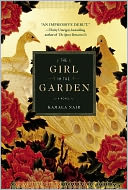
The Girl in the Garden
by Kamala Nair

There are a million stories in the naked city, and a million writers trying to get them published. At times like this, I really have to wonder: Why this one? How was it that author Kamala Nair won the golden ticket? Because I just don’t see it.

The novel opens in the present day in the form of a letter from first person narrator Rakhee to her fiancée. “By the time you read this, I will be flying over the Atlantic on my way to India. You will have woken up alone and found the diamond ring I left on the bedside table and beneath it, this stack of papers you now hold.” Okay, already I find her unsympathetic because that “stack of papers” is in fact the 300-page manuscript that makes up the novel. Premeditate much, Rakhee? Well, never mind adult Rakhee because this is a coming of age tale about the summer that Rakhee turned 11. It was a pivotal season in her life and as she explains (in absentia) to her fiancée, until she comes to terms with her past, she can’t move forward with their marriage.

Rahkee is of Indian descent, born in America. She was raised among the blondes of Minnesota, so it’s no wonder she felt like an outcast. She’s a lonely, artistic girl, more close to her scientist father than her indifferent and depressive mother. During a time of heightened family tensions, Rahkee’s mother decides it will be good for them to spend the summer in rural India with her family. There Rakhee meets aunts, uncles, cousins, and the grandmother she hasn’t seen in years. At first, it’s a happy time of finally belonging. But there are dark undercurrents at the family home. Why have the children been warned away from entering the jungle behind their home?

Rakhee is not so suspicious or easily manipulated as her cousins, and before long she has discovered a mysterious cottage surrounded by a beautiful garden, all behind a tall, locked fence. And, she eventually discovers the deformed girl who is the cottage’s sole resident… Are you fully appreciating the references to The Secret Garden yet? That is just one of the many motifs in this dreary melodrama.

Why dreary? I really didn’t find this book well-written. I'm not specifically speaking of Nair's use of language, but what she did with her words.  I found the pace frequently plodding, the dialogue occasionally cringe-worthy (“I’ve been dreading this, but it has to be done. People will talk if I don’t go and see them and act as if everything is normal. Stupid gossips.”), the imagery heavy-handed (“The entire garden had transformed into a crumbling shell of its former self.”), the "secrets" and twists to be obvious and telegraphed, the melodrama to be over the top, and the devices for plot exposition to be excruciatingly obvious and poorly done (e.i. lonely elderly relative regurgitates family history, and multiple drunken confessions). Actually, the over-the-topness did help pick up the pace of things as the novel approached its climax. I was grateful for that, at least.

I think this could have been a rich, exotic tale in a more experienced writer’s hands, but alas, this is a debut I could have skipped.